Redhat Developers  Logo
  • AI

    Get started with AI

    • Red Hat AI
      Accelerate the development and deployment of enterprise AI solutions.
    • AI learning hub
      Explore learning materials and tools, organized by task.
    • AI interactive demos
      Click through scenarios with Red Hat AI, including training LLMs and more.
    • AI/ML learning paths
      Expand your OpenShift AI knowledge using these learning resources.
    • AI quickstarts
      Focused AI use cases designed for fast deployment on Red Hat AI platforms.
    • No-cost AI training
      Foundational Red Hat AI training.

    Featured resources

    • OpenShift AI learning
    • Open source AI for developers
    • AI product application development
    • Open source-powered AI/ML for hybrid cloud
    • AI and Node.js cheat sheet

    Red Hat AI Factory with NVIDIA

    • Red Hat AI Factory with NVIDIA is a co-engineered, enterprise-grade AI solution for building, deploying, and managing AI at scale across hybrid cloud environments.
    • Explore the solution
  • Learn

    Self-guided

    • Documentation
      Find answers, get step-by-step guidance, and learn how to use Red Hat products.
    • Learning paths
      Explore curated walkthroughs for common development tasks.
    • Guided learning
      Receive custom learning paths powered by our AI assistant.
    • See all learning

    Hands-on

    • Developer Sandbox
      Spin up Red Hat's products and technologies without setup or configuration.
    • Interactive labs
      Learn by doing in these hands-on, browser-based experiences.
    • Interactive demos
      Click through product features in these guided tours.

    Browse by topic

    • AI/ML
    • Automation
    • Java
    • Kubernetes
    • Linux
    • See all topics

    Training & certifications

    • Courses and exams
    • Certifications
    • Skills assessments
    • Red Hat Academy
    • Learning subscription
    • Explore training
  • Build

    Get started

    • Red Hat build of Podman Desktop
      A downloadable, local development hub to experiment with our products and builds.
    • Developer Sandbox
      Spin up Red Hat's products and technologies without setup or configuration.

    Download products

    • Access product downloads to start building and testing right away.
    • Red Hat Enterprise Linux
    • Red Hat AI
    • Red Hat OpenShift
    • Red Hat Ansible Automation Platform
    • See all products

    Featured

    • Red Hat build of OpenJDK
    • Red Hat JBoss Enterprise Application Platform
    • Red Hat OpenShift Dev Spaces
    • Red Hat Developer Toolset

    References

    • E-books
    • Documentation
    • Cheat sheets
    • Architecture center
  • Community

    Get involved

    • Events
    • Live AI events
    • Red Hat Summit
    • Red Hat Accelerators
    • Community discussions

    Follow along

    • Articles & blogs
    • Developer newsletter
    • Videos
    • Github

    Get help

    • Customer service
    • Customer support
    • Regional contacts
    • Find a partner

    Join the Red Hat Developer program

    • Download Red Hat products and project builds, access support documentation, learning content, and more.
    • Explore the benefits

IoT edge development and deployment with containers through OpenShift: Part 1

<p>&nbsp;</p> <quillbot-extension-portal></quillbot-extension-portal>

January 31, 2019
Alessandro Arrichiello
Related topics:
CI/CDContainersLinuxKubernetes
Related products:
Red Hat OpenShiftRed Hat OpenShift Container PlatformRed Hat Enterprise Linux

    Usually, we think about IoT applications as something very special made for low power devices that have limited capabilities. For this reason, we tend to use completely different technologies for IoT application development than the technology we use for creating a datacenter's services.

    This article is part 1 of a two-part series. In it, we'll explore some techniques that may give you a chance to use containers as a medium for application builds—techniques that enable the portability of containers across different environments. Through these techniques, you may be able to use the same language, framework, or tool used in your datacenter straight to the "edge," even with different CPU architectures!

    We usually use "edge" to refer to the geographic distribution of computing nodes in a network of IoT devices that are at the "edge" of an enterprise. The "edge" could be a remote datacenter or maybe multiple geo-distributed factories, ships, oil plants, and so on.

    In this article, we'll address a very common theme—the creation and distribution of containers—but our target environment will be an x86_64 edge gateway.

    As you know, OpenShift is a great platform for application development. It's shipped with a Kubernetes orchestrator enriched with a fully integrated and containerized Jenkins, native “build” resources, and a very powerful web interface.

    Consider the following real use case scenario, in which a customer asked for a way to create and test containers in a Platform as a Service (PaaS) environment for deployment at the edge.
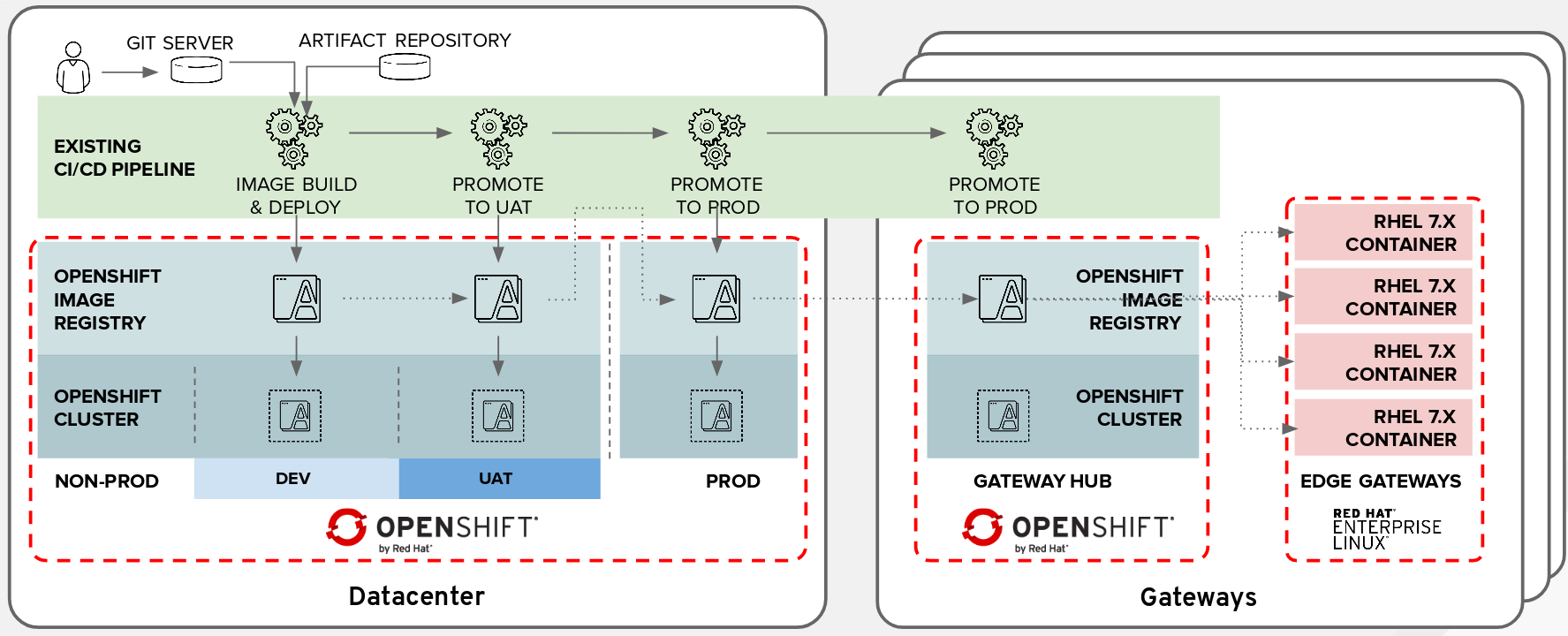
    Diagram of a real use case

    We used an existing standalone IoT demo application, splitting it into different projects to create truly independent containers.
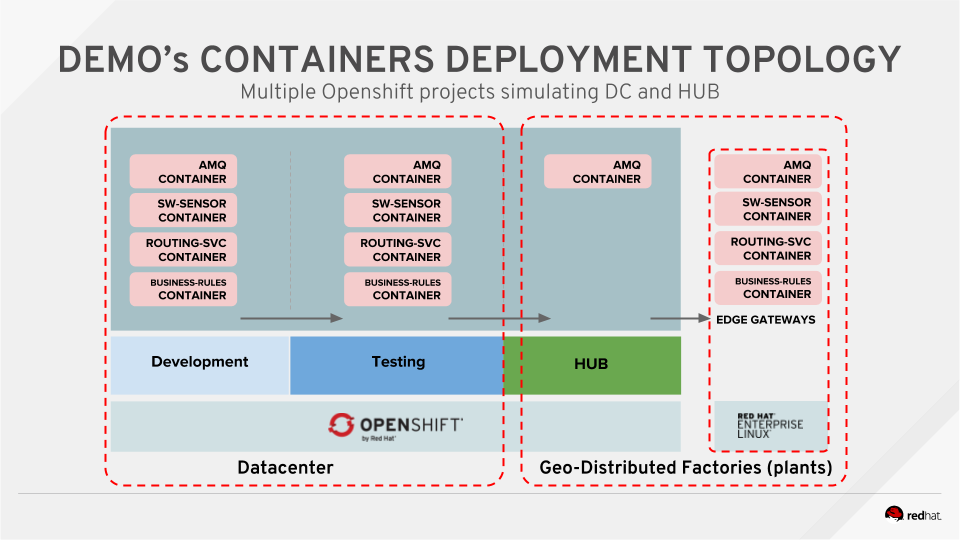
    Splitting a standalone IoT application into different projects

    You'll find the initial demo project here and the main placeholder container project here.

    The main project page also contains instructions for re-creating the demo environment on your platform.

    As you'll see from the project's pages, the containerization process was not difficult, thanks to the usage of Red Hat AMQ queues for messaging.

    We created three containers, one for each software brick of our standalone application demo, and then we created respective Jenkins pipelines in OpenShift, as shown in the following screenshot. Thanks to this containerization, every software piece may inherit a full, independent development environment and have independent testing activities.
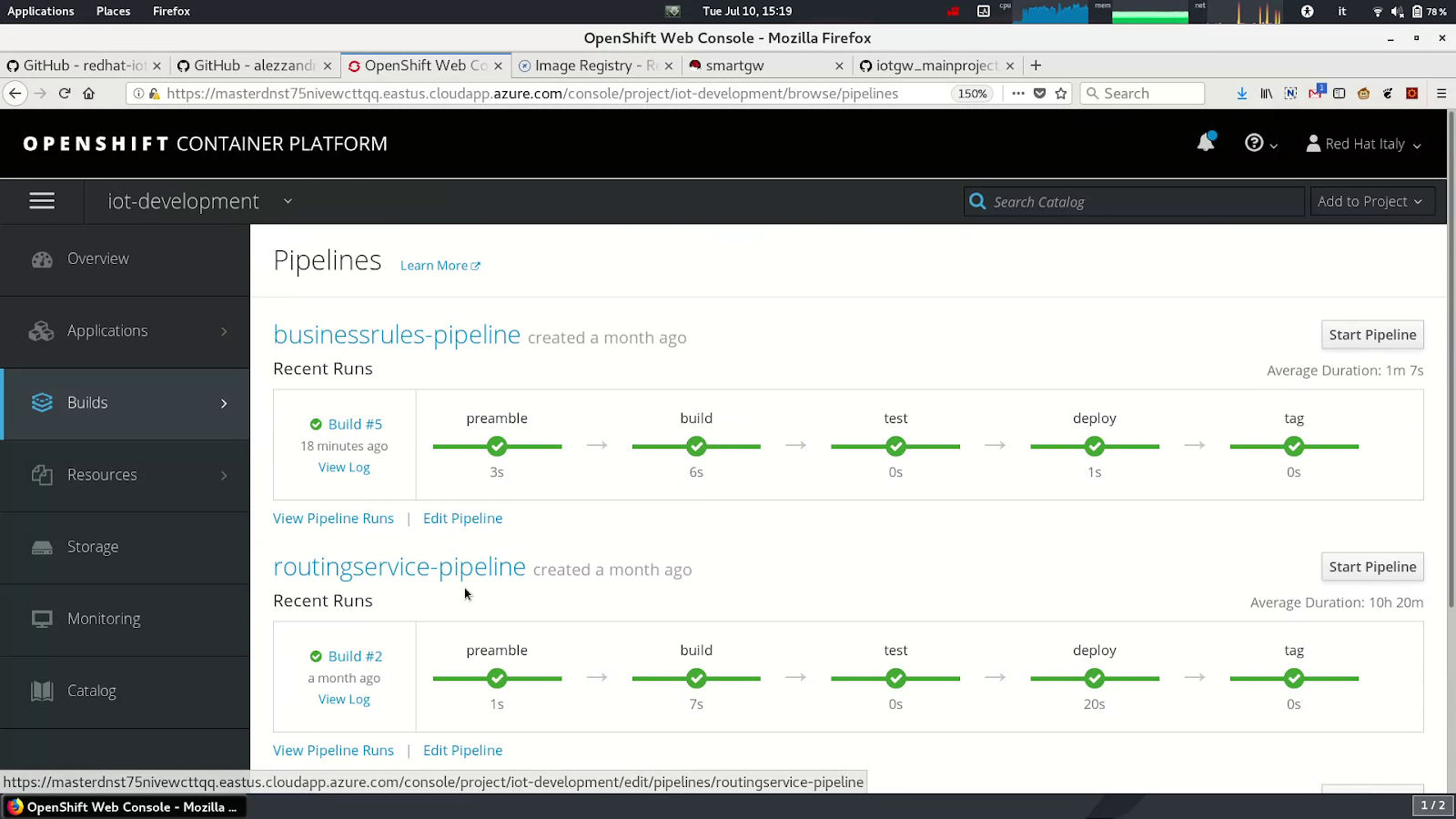
    Jenkins pipelines in OpenShift

    A benefit of the created pipelines and the independent project is that we can also leverage the OpenShift/Kubernetes features of project isolation and replication for testing our brand new containers in different environments.

    Thanks to the containers' portability, the last step would be to push the containers onto a gateway hub, which is a secondary Red Hat OpenShift Container Platform setup in a remote factory, for deploying the developed applications onto the edge gateway.

    I bet you’re guessing about the final deployment at the edge, right?
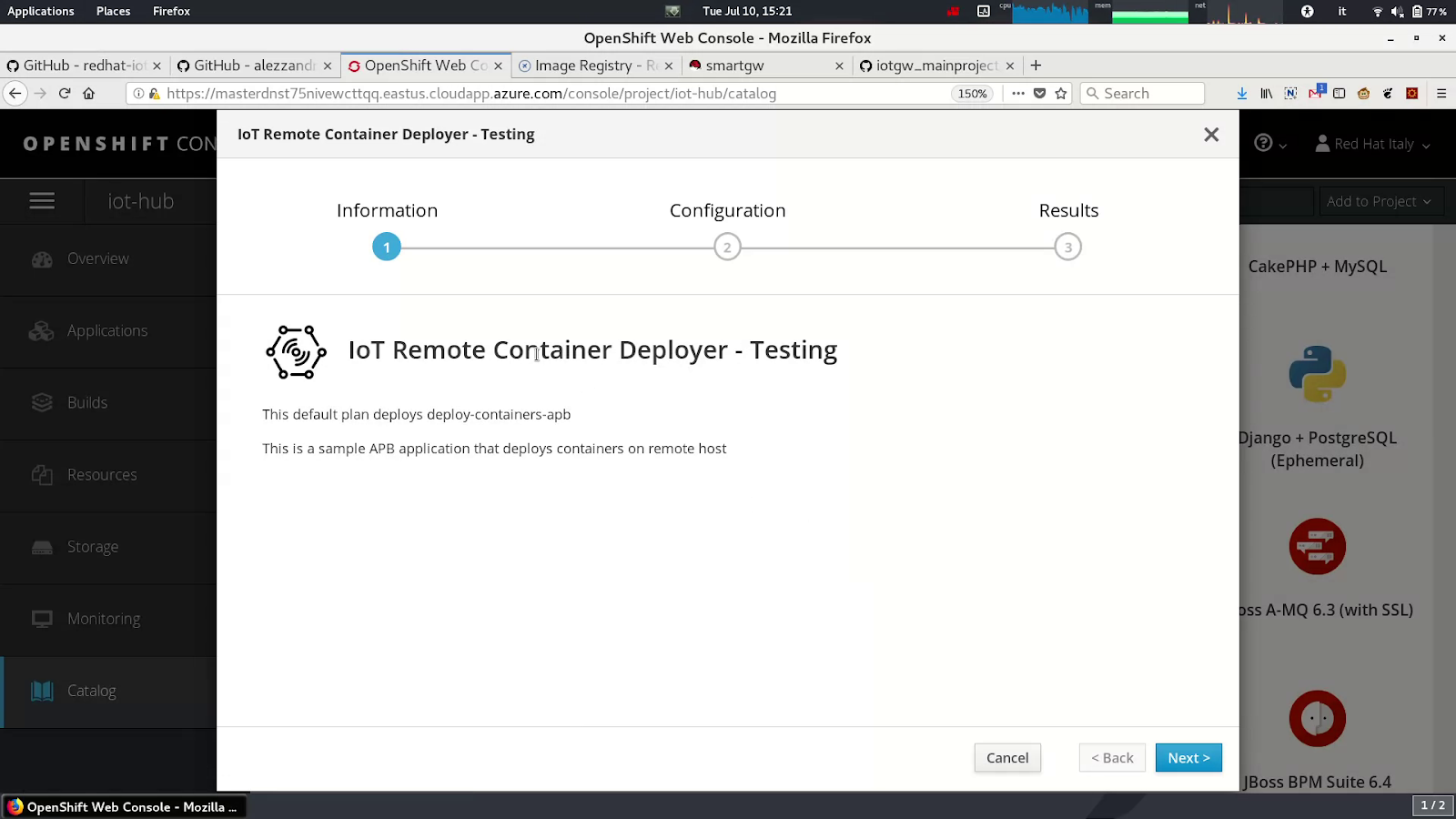
    Final deployment at the edge

    The final deployment will be handled by the central OpenShift platform or through the remote one (on an IoT hub, the "remote factory"), thanks to the Red Hat Ansible Automation suite.

    OpenShift has a special feature included called OpenShift Ansible Service Broker. It follows the Open Service Broker API and let you use a common Ansible Playbook for invoking an internal service (a Kubernetes/OpenShift one) or an external service, for example, a virtual machine or just a remote gateway.

    For this reason, we can leverage this feature to invoke a custom Ansible Playbook created for deploying the standalone containers on a remote system to test them.

    Once we tested one or multiple deployments, we can then scale out the container distribution through Red Hat Ansible Tower using the same Ansible Playbook we developed and tested through OpenShift Ansible Service Broker.

    The first version of our Ansible Playbook for remote container deployment leveraged the Docker daemon for their execution. We then enhanced it by replacing the daemon (a single point of failure) with standalone container execution, thanks to Podman and its systemd integration. (Read more about Podman in Red Hat Enterprise Linux and managing containerized system services.)

    The main objective of this example is to show the powerful capabilities of a complete PaaS environment created on top of Kubernetes—the best and de facto container orchestrator—that is used for creating and testing containers for your IoT edge applications.

    Are you curious to see a live demo? Take a look at this OpenShift Common Briefings recording, in which I presented live the solution:

    https://www.youtube.com/watch?v=bNipu5OA1o4

    Of course, this is just an example and every use case could be different, for example, introducing the need for a container architecture other than x86_64.

    In the second and last part of this series, we’ll go over the creation, execution, and testing of multi-architecture containers on Red Hat OpenShift Container Platform. Stay tuned!

    Additional resources

    • Podman: Managing pods and containers in a local container runtime
    • Managing containerized system services with Podman
    • Containers without daemons: Podman and Buildah available in RHEL 7.6 and RHEL 8 Beta
    • Podman – The next generation of Linux container tools
    • Intro to Podman (New in Red Hat Enterprise Linux 7.6)
    • Customizing an OpenShift Ansible Playbook Bundle

    About Alessandro

    Alessandro Arrichiello

    Alessandro Arrichiello is a Solution Architect for Red Hat Inc. He has a passion for GNU/Linux systems, which began at age 14 and continues today. He has worked with tools for automating enterprise IT: configuration management and continuous integration through virtual platforms. He’s now working on distributed cloud environments involving PaaS (OpenShift), IaaS (OpenStack) and Processes Management (CloudForms), Containers building, instances creation, HA services management, and workflow builds.

    Last updated: March 27, 2023

    Recent Posts

    • Trusted software factory: Building trust in the agentic AI era

    • Build a zero trust AI pipeline with OpenShift and RHEL CVMs

    • Red Hat Hardened Images: Top 5 benefits for software developers

    • How EvalHub manages two-layer Kubernetes control planes

    • Tekton joins the CNCF as an incubating project

    What’s up next?


    Red Hat Developers logo LinkedIn YouTube Twitter Facebook

    Platforms

    • Red Hat AI
    • Red Hat Enterprise Linux
    • Red Hat OpenShift
    • Red Hat Ansible Automation Platform
    • See all products

    Build

    • Developer Sandbox
    • Developer tools
    • Interactive tutorials
    • API catalog

    Quicklinks

    • Learning resources
    • E-books
    • Cheat sheets
    • Blog
    • Events
    • Newsletter

    Communicate

    • About us
    • Contact sales
    • Find a partner
    • Report a website issue
    • Site status dashboard
    • Report a security problem

    RED HAT DEVELOPER

    Build here. Go anywhere.

    We serve the builders. The problem solvers who create careers with code.

    Join us if you’re a developer, software engineer, web designer, front-end designer, UX designer, computer scientist, architect, tester, product manager, project manager or team lead.

    Sign me up

    Red Hat legal and privacy links

    • About Red Hat
    • Jobs
    • Events
    • Locations
    • Contact Red Hat
    • Red Hat Blog
    • Inclusion at Red Hat
    • Cool Stuff Store
    • Red Hat Summit
    © 2026 Red Hat

    Red Hat legal and privacy links

    • Privacy statement
    • Terms of use
    • All policies and guidelines
    • Digital accessibility

    Chat Support

    Please log in with your Red Hat account to access chat support.
