Redhat Developers  Logo
  • AI

    Get started with AI

    • Red Hat AI
      Accelerate the development and deployment of enterprise AI solutions.
    • AI learning hub
      Explore learning materials and tools, organized by task.
    • AI interactive demos
      Click through scenarios with Red Hat AI, including training LLMs and more.
    • AI/ML learning paths
      Expand your OpenShift AI knowledge using these learning resources.
    • AI quickstarts
      Focused AI use cases designed for fast deployment on Red Hat AI platforms.
    • No-cost AI training
      Foundational Red Hat AI training.

    Featured resources

    • OpenShift AI learning
    • Open source AI for developers
    • AI product application development
    • Open source-powered AI/ML for hybrid cloud
    • AI and Node.js cheat sheet

    Red Hat AI Factory with NVIDIA

    • Red Hat AI Factory with NVIDIA is a co-engineered, enterprise-grade AI solution for building, deploying, and managing AI at scale across hybrid cloud environments.
    • Explore the solution
  • Learn

    Self-guided

    • Documentation
      Find answers, get step-by-step guidance, and learn how to use Red Hat products.
    • Learning paths
      Explore curated walkthroughs for common development tasks.
    • See all learning

    Hands-on

    • Developer Sandbox
      Spin up Red Hat's products and technologies without setup or configuration.
    • Interactive labs
      Learn by doing in these hands-on, browser-based experiences.
    • Interactive demos
      Click through product features in these guided tours.

    Browse by topic

    • AI/ML
    • Automation
    • Java
    • Kubernetes
    • Linux
    • See all topics

    Training & certifications

    • Courses and exams
    • Certifications
    • Skills assessments
    • Red Hat Academy
    • Learning subscription
    • Explore training
  • Build

    Get started

    • Red Hat build of Podman Desktop
      A downloadable, local development hub to experiment with our products and builds.
    • Developer Sandbox
      Spin up Red Hat's products and technologies without setup or configuration.

    Download products

    • Access product downloads to start building and testing right away.
    • Red Hat Enterprise Linux
    • Red Hat AI
    • Red Hat OpenShift
    • Red Hat Ansible Automation Platform
    • See all products

    Featured

    • Red Hat build of OpenJDK
    • Red Hat JBoss Enterprise Application Platform
    • Red Hat OpenShift Dev Spaces
    • Red Hat Developer Toolset

    References

    • E-books
    • Documentation
    • Cheat sheets
    • Architecture center
  • Community

    Get involved

    • Events
    • Live AI events
    • Red Hat Summit
    • Red Hat Accelerators
    • Community discussions

    Follow along

    • Articles & blogs
    • Developer newsletter
    • Videos
    • Github

    Get help

    • Customer service
    • Customer support
    • Regional contacts
    • Find a partner

    Join the Red Hat Developer program

    • Download Red Hat products and project builds, access support documentation, learning content, and more.
    • Explore the benefits

Supercharge Helm workflows with OpenShift Toolkit in VS Code

January 8, 2024
Mohit Suman
Related topics:
HelmKubernetes
Related products:
Red Hat OpenShift

    In the fast-paced world of cloud-native application development, having the right tools at your fingertips can make all the difference. Enter the OpenShift Toolkit IDE extension for Visual Studio Code (VS Code), a game-changer for developers diving into the Red Hat OpenShift ecosystem. One standout feature that elevates your development experience is the robust Helm support integrated into this extension. In this article, we'll explore the advantages Helm brings to cloud-native application development on OpenShift and how its seamless integration into the IDE can supercharge your workflow.

    Harnessing the power of Helm charts: Browse and install from OpenShift Toolkit

    Helm, the Kubernetes package manager, simplifies and accelerates the deployment of applications on OpenShift. With the OpenShift Toolkit's Helm support, you gain easy access to Helm charts, enabling the streamlined packaging, versioning, and deployment of complex applications—all within the comfort of your IDE. This means less time spent on manual configurations and more focus on writing code (Figure 1).
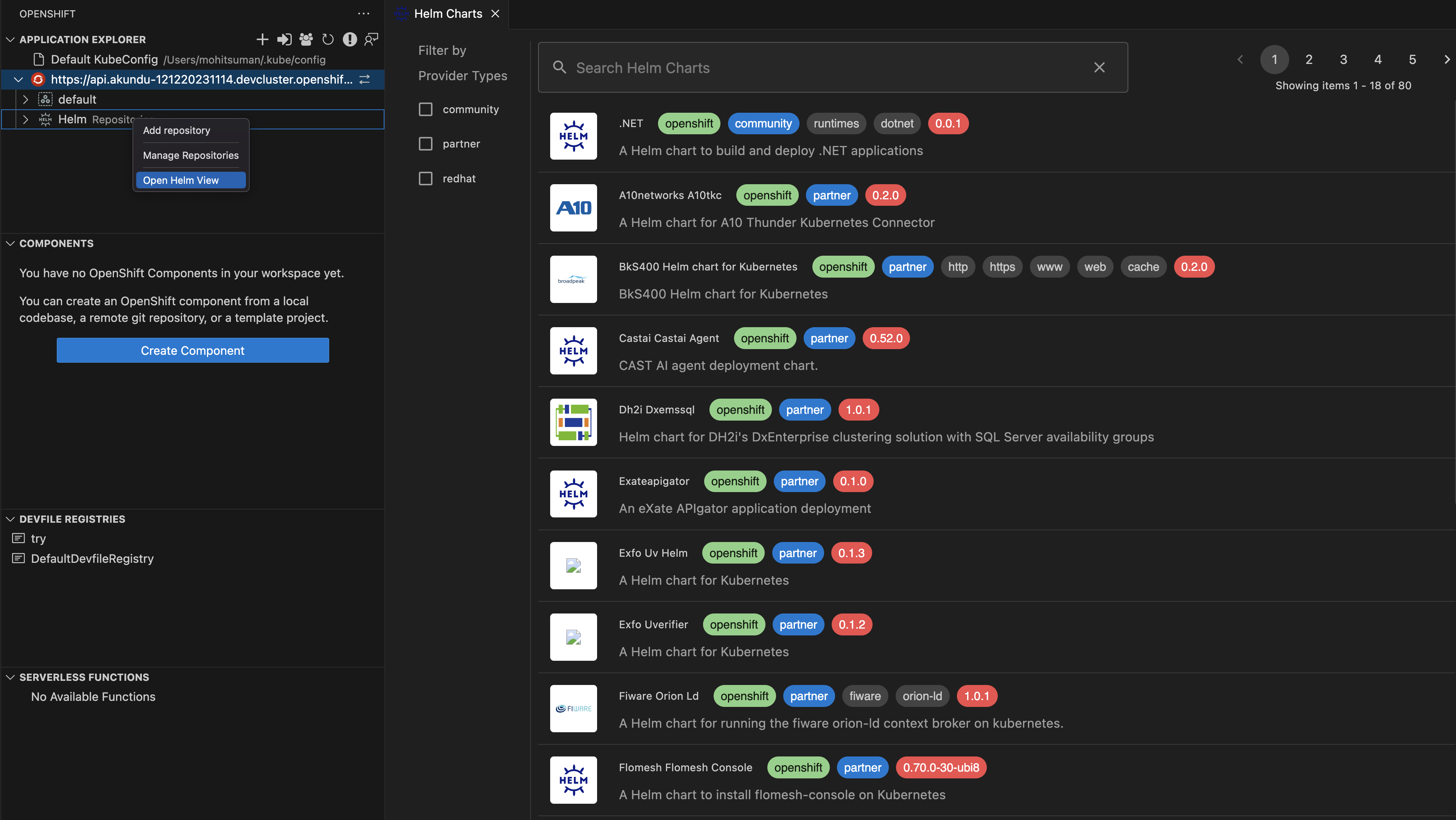
    OpenShift Toolkit Helm View
    Figure 1: Browse & Install Helm Charts from OpenShift Toolkit
    Figure 1: Browse and install Helm charts from OpenShift Toolkit.

    Deploy projects using Helm charts

    You can utilize the Helm chart Registry view, search for a specific Helm chart based on multiple filters, and install the specific Helm chart. Users can also harness the power of Helm workflows to streamline Helm chart creation, modification, and deployment, ensuring efficient management of your Kubernetes applications. It works seamlessly with any Helm chart version and can be customized based on the Helm repo you want to use (Figure 2).
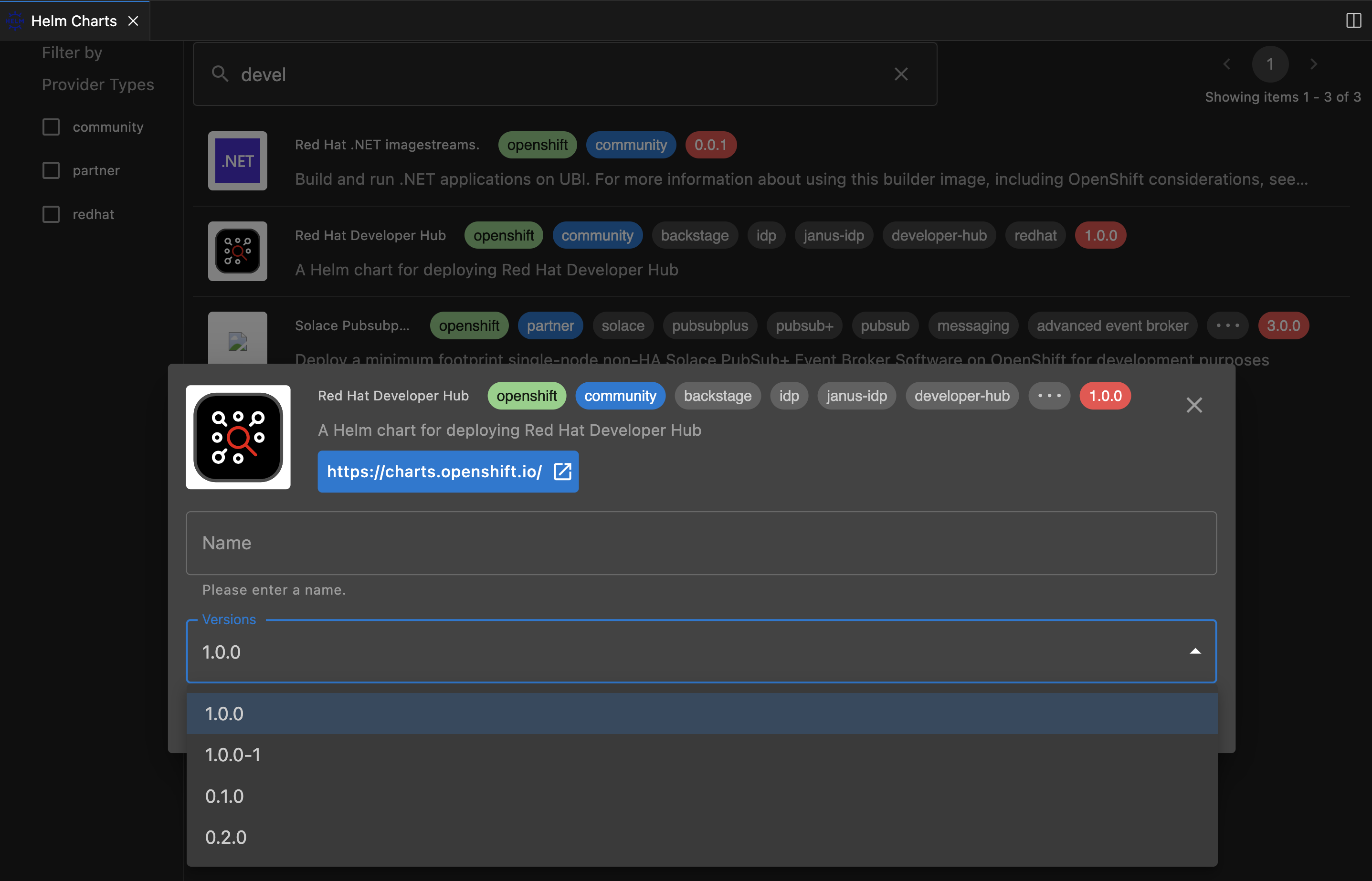
    select helm chart for red hat developer hub
    Figure 2: Install Red Hat Developer Helm Chart
    Figure 2: Install Red Hat Developer Helm chart.

    Efficient collaboration and code sharing

    Helm charts promote collaboration by providing a standardized way to package applications and their dependencies. With the OpenShift Toolkit IDE extension, you can seamlessly share and reuse Helm charts, fostering a collaborative ecosystem. This not only accelerates development but also ensures consistency across the team, making it easier to manage and scale applications.

    Visualize and edit Helm charts directly in the IDE

    The OpenShift Toolkit IDE extension takes Helm support to the next level by offering a visual editor for installing and deploying Helm charts. You can now visualize and edit Helm charts directly within VS Code, eliminating the need to switch between different tools. This editing enhances code comprehension and simplifies the customization of Helm charts, making it accessible to both seasoned developers and newcomers.

    Continuous integration and continuous deployment (CI/CD) integration

    The OpenShift Toolkit IDE extension seamlessly integrates with popular CI/CD pipelines, ensuring a smooth transition from development to production. Helm charts play a crucial role in this process by providing a consistent deployment artifact. With Helm support in the IDE, you can automate the entire CI/CD pipeline, from building container images to deploying Helm charts on OpenShift.

    Community-driven innovation

    The OpenShift Toolkit IDE extension is built on open source principles, and Helm support is no exception. By contributing to and leveraging the open source community, developers can actively participate in shaping the future of Helm integration within the IDE. This collaborative approach ensures that the extension stays up-to-date with the latest Helm features and best practices.

    Demo

    To see OpenShift Toolkit's Helm support in action, check out the following demo.

    Learn more

    The marriage of Helm support with the OpenShift Toolkit IDE extension in Visual Studio Code marks a significant milestone in cloud-native application development. From simplifying deployment processes to providing a visual editor for Helm charts, this integration empowers developers to build, debug, and deploy applications with unprecedented ease. As the open source community continues to drive innovation, the future looks bright for developers seeking a seamless and efficient development experience on OpenShift. Embrace the power of Helm and the OpenShift Toolkit and let your cloud-native applications soar to new heights.

    The support for Helm workflow in IntelliJ plugin OpenShift Toolkit is also out and will be discussed in detail in a future article. Stay tuned and happy coding!

    • Visit the Marketplace to learn more about our offerings and download the extension.
    • Open an issue on our GitHub Issues page.
    • Send an email to devtools-pm@redhat.com.

    Related Posts

    • Getting started with the OpenShift Toolkit for VS Code and IntelliJ

    • 3 ways to install a database with Helm charts

    • Developer workflows using the VS Code for Java extension 1.0

    • Debugging components in OpenShift using VS Code

    • Manage namespaces in multitenant clusters with Argo CD, Kustomize, and Helm

    • 3 patterns for deploying Helm charts with Argo CD

    Recent Posts

    • Red Hat UBI 8 builders have been promoted to the Paketo Buildpacks organization

    • Using eBPF in Red Hat products

    • How we made one data layer serve the UI, the mocks, and the E2E tests

    • Build trusted Python containers with Project Hummingbird and Calunga

    • Simplify distributed tracing: ObservabilityInstaller installation

    What’s up next?

    Operating OpenShift Share image

    Read Operating OpenShift, a practical guide to running and operating OpenShift clusters more efficiently using a site reliability engineering (SRE) approach. Learn best practices and tools that can help reduce the effort of deploying a Kubernetes platform.

    Get the e-book
    Red Hat Developers logo LinkedIn YouTube Twitter Facebook

    Platforms

    • Red Hat AI
    • Red Hat Enterprise Linux
    • Red Hat OpenShift
    • Red Hat Ansible Automation Platform
    • See all products

    Build

    • Developer Sandbox
    • Developer tools
    • Interactive tutorials
    • API catalog

    Quicklinks

    • Learning resources
    • E-books
    • Cheat sheets
    • Blog
    • Events
    • Newsletter

    Communicate

    • About us
    • Contact sales
    • Find a partner
    • Report a website issue
    • Site status dashboard
    • Report a security problem

    RED HAT DEVELOPER

    Build here. Go anywhere.

    We serve the builders. The problem solvers who create careers with code.

    Join us if you’re a developer, software engineer, web designer, front-end designer, UX designer, computer scientist, architect, tester, product manager, project manager or team lead.

    Sign me up

    Red Hat legal and privacy links

    • About Red Hat
    • Jobs
    • Events
    • Locations
    • Contact Red Hat
    • Red Hat Blog
    • Inclusion at Red Hat
    • Cool Stuff Store
    • Red Hat Summit
    © 2026 Red Hat

    Red Hat legal and privacy links

    • Privacy statement
    • Terms of use
    • All policies and guidelines
    • Digital accessibility