Redhat Developers  Logo
  • AI

    Get started with AI

    • Red Hat AI
      Accelerate the development and deployment of enterprise AI solutions.
    • AI learning hub
      Explore learning materials and tools, organized by task.
    • AI interactive demos
      Click through scenarios with Red Hat AI, including training LLMs and more.
    • AI/ML learning paths
      Expand your OpenShift AI knowledge using these learning resources.
    • AI quickstarts
      Focused AI use cases designed for fast deployment on Red Hat AI platforms.
    • No-cost AI training
      Foundational Red Hat AI training.

    Featured resources

    • OpenShift AI learning
    • Open source AI for developers
    • AI product application development
    • Open source-powered AI/ML for hybrid cloud
    • AI and Node.js cheat sheet

    Red Hat AI Factory with NVIDIA

    • Red Hat AI Factory with NVIDIA is a co-engineered, enterprise-grade AI solution for building, deploying, and managing AI at scale across hybrid cloud environments.
    • Explore the solution
  • Learn

    Self-guided

    • Documentation
      Find answers, get step-by-step guidance, and learn how to use Red Hat products.
    • Learning paths
      Explore curated walkthroughs for common development tasks.
    • Guided learning
      Receive custom learning paths powered by our AI assistant.
    • See all learning

    Hands-on

    • Developer Sandbox
      Spin up Red Hat's products and technologies without setup or configuration.
    • Interactive labs
      Learn by doing in these hands-on, browser-based experiences.
    • Interactive demos
      Click through product features in these guided tours.

    Browse by topic

    • AI/ML
    • Automation
    • Java
    • Kubernetes
    • Linux
    • See all topics

    Training & certifications

    • Courses and exams
    • Certifications
    • Skills assessments
    • Red Hat Academy
    • Learning subscription
    • Explore training
  • Build

    Get started

    • Red Hat build of Podman Desktop
      A downloadable, local development hub to experiment with our products and builds.
    • Developer Sandbox
      Spin up Red Hat's products and technologies without setup or configuration.

    Download products

    • Access product downloads to start building and testing right away.
    • Red Hat Enterprise Linux
    • Red Hat AI
    • Red Hat OpenShift
    • Red Hat Ansible Automation Platform
    • See all products

    Featured

    • Red Hat build of OpenJDK
    • Red Hat JBoss Enterprise Application Platform
    • Red Hat OpenShift Dev Spaces
    • Red Hat Developer Toolset

    References

    • E-books
    • Documentation
    • Cheat sheets
    • Architecture center
  • Community

    Get involved

    • Events
    • Live AI events
    • Red Hat Summit
    • Red Hat Accelerators
    • Community discussions

    Follow along

    • Articles & blogs
    • Developer newsletter
    • Videos
    • Github

    Get help

    • Customer service
    • Customer support
    • Regional contacts
    • Find a partner

    Join the Red Hat Developer program

    • Download Red Hat products and project builds, access support documentation, learning content, and more.
    • Explore the benefits

Istio Circuit Breaker: How to Handle (Pool) Ejection

March 20, 2018
Don Schenck
Related topics:
KubernetesJavaContainersMicroservicesNode.jsService mesh
Related products:
Red Hat OpenShift Container Platform

    Everybody out of the pool!

    Well ... not everybody. Just those bad actors. You know, those microservices that aren't playing nice, that are not doing their job, that are too slow, etc. We're talking about Istio, Circuit Breakers and Pool Ejection.

    [This is part three of my ten-week  Introduction to Istio Service Mesh series.  My previous article was Part 2: Istio Route Rules: Telling Service Requests Where to Go. Rather see this in a video? Check out the video edition here.]

    How Things Should Be

    When you are managing your microservices with Kubernetes -- such as is done with OpenShift -- your capacity is auto-scaled up or down based on demand. Because microservices run in pods, you may have several microservice instances running in containers at a single endpoint, with Kubernetes handling the routing and load balancing. This is great; this is how it is supposed to be. All good.

    As we know, microservices are small and ephemeral. Ephemeral may be an understatement; services will pop up and disappear like kisses from a new puppy. The birth and death of a particular instance of a microservice in a pod is expected, and OpenShift and Kubernetes handle it quite well. Again, this is how it is supposed to be. All good.

    How Things Really Are

    But what happens when one particular microservice instance -- container -- goes bad, either by crashing (503 errors) or, more insidiously, taking too long to respond? That is, it wasn't auto-scaled out of existence; it failed or became slow all on its own. Do you try again? Reroute? Who defines "taking too long", and should we wait and try again later? How much later?

    When did this tiny microservice stuff all of a sudden get so complicated?

    Istio Pool Ejection: Reality Meets Its Match

    Again, Istio comes to the rescue (don't act surprised, these blog posts are about Istio, after all). Let's take a look at how the Circuit Breaker pattern with Pool Ejection works in Istio.

    Istio detects faulty instances, or outliers. In the Istio lexicon this is known as outlier detection. The strategy is to first detect an outlier container and then make it unavailable for a pre-configured duration, or what's called a sleep window. While the container is in the sleep window, it is excluded from any routing or load balancing. An analogy would be front porch lights on Halloween night: If the light is off, the house isn't participating, for whatever reason. You can skip it and save time, visiting only the active houses. If the homeowner arrives home 30 minutes later and turns on the porch light, go get some candy.

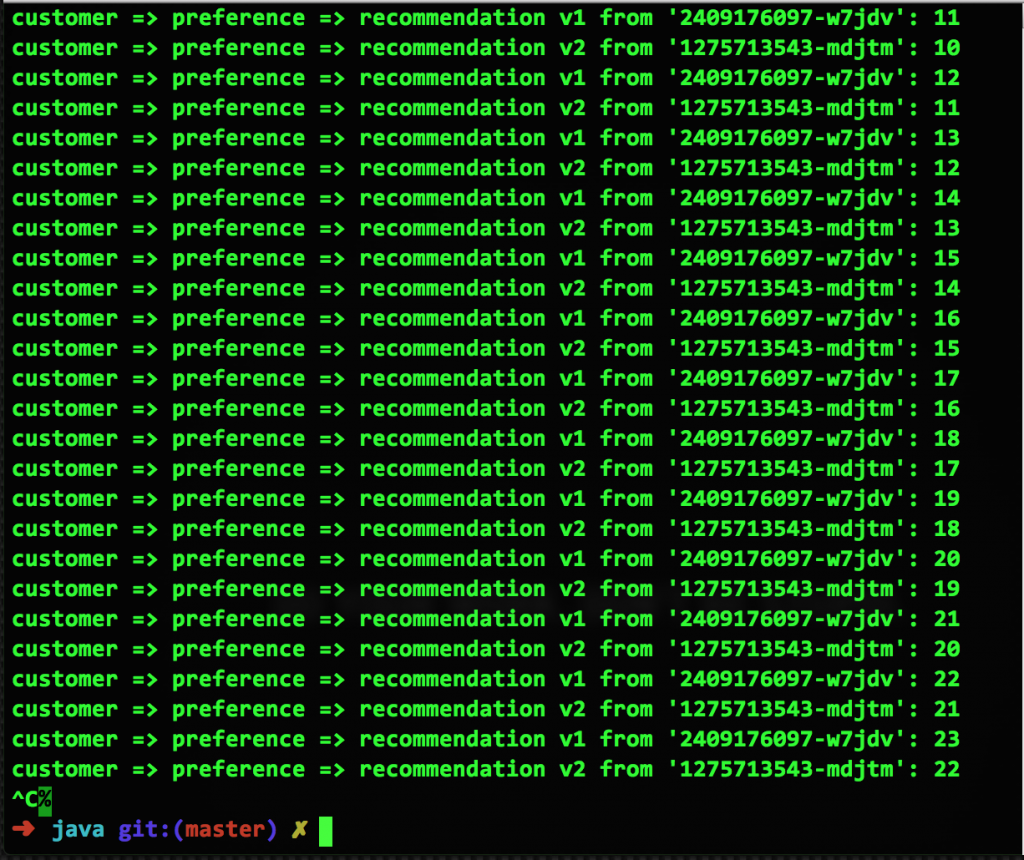
    To see how this plays out in Kubernetes and OpenShift, here's a screen capture of a normally-operating microservices sample, taken from the Red Hat Developer Demos repo. In this example, there are two pods (v1 and v2), each running one container. With no Route Rules applied, Kubernetes defaults to an evenly-balanced, round-robin routing:
    Preparing For Chaos

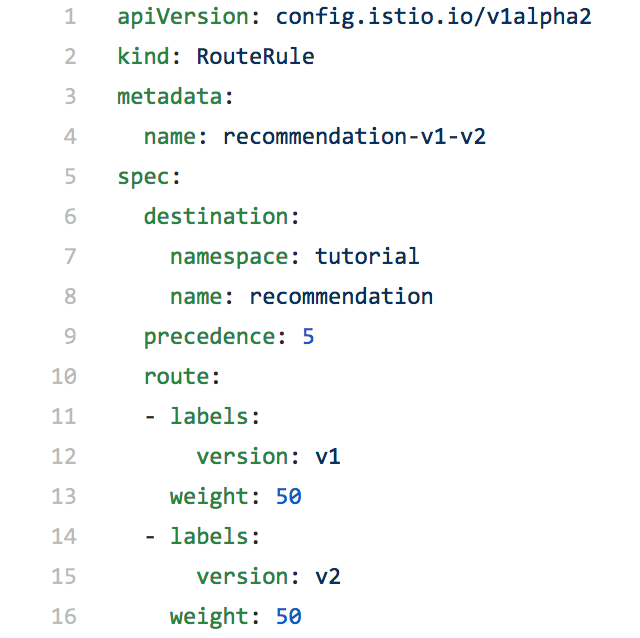
    To enforce pool ejection, you first need to insure you have a routerule in place. Let's use a 50/50 split of traffic. In addition, we'll use a command to increase the number of v2 containers to two. Here's the command to scale up the v2 pods:

    oc scale deployment recommendation-v2 --replicas=2 -n tutorial

    Taking a look at the contents of the route rule, we can see that traffic is split 50/50 between the pods.

    Here's a screen capture of that rule in action:
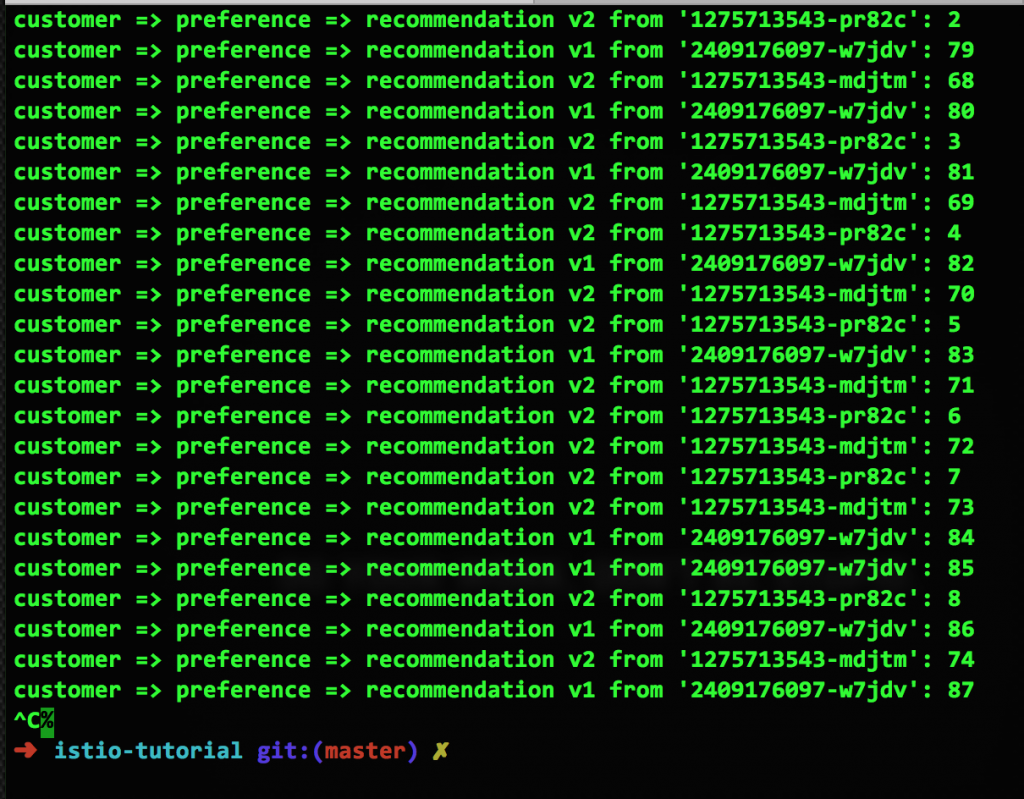
    The astute observer will note that this is not an even, 50/50 mix (it's 14:9). However, over time, it will even out.

    Let's Break Stuff!

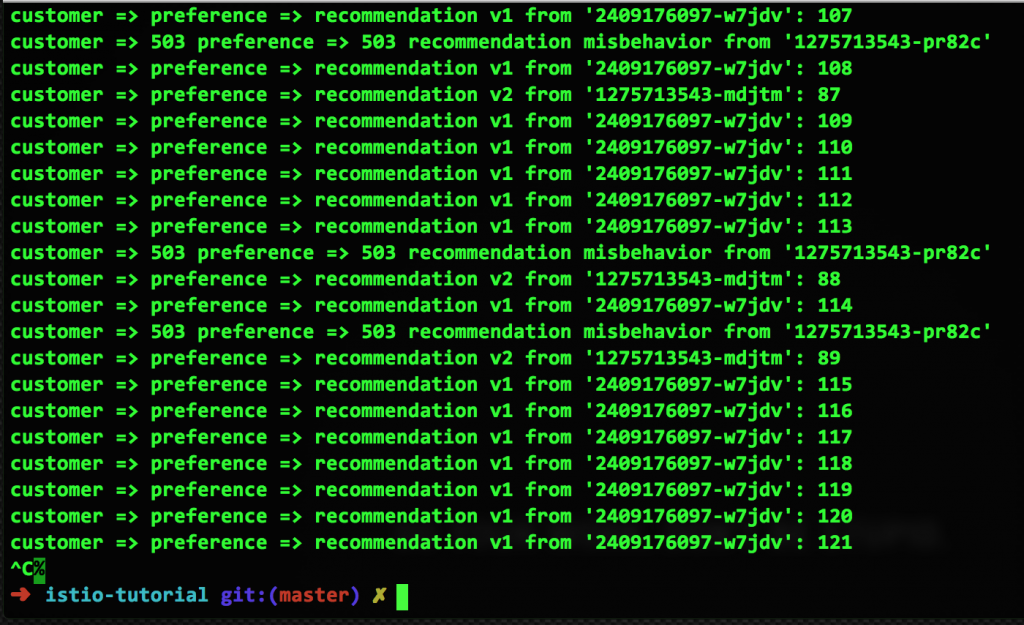
    Now let's introduce a failure in one of the v2 containers, leaving: one healthy v1 container, one healthy v2 container, and one failing v2 container. Here is the result:
    Finally, Let's Fix Stuff

    So now we have a container that's failing, and this is where Istio pool ejection shines. By activating a simple configuration, we are able to eject the failing container from any routing. In this example, we'll eject it for 15 seconds, with the idea that it will correct itself (e.g. by restarting or returning to higher performance). Here's the configuration file and a screen capture of the results:
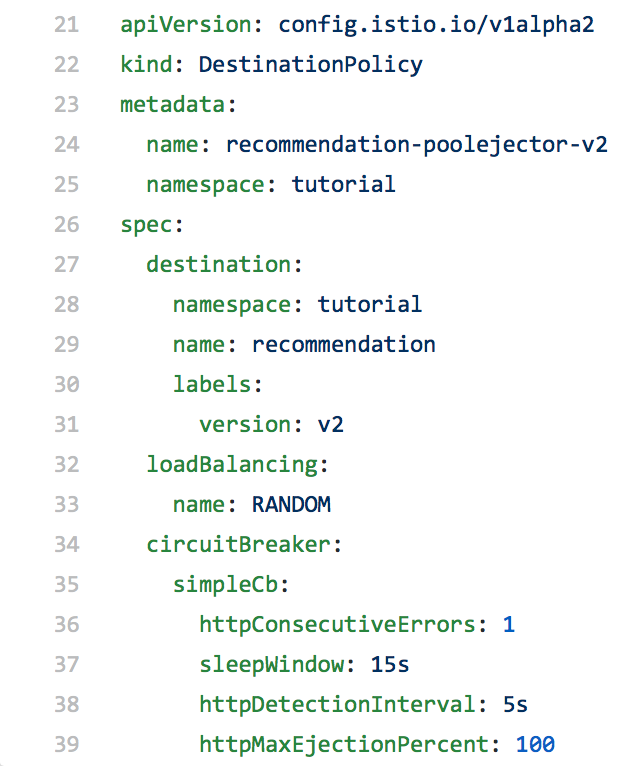
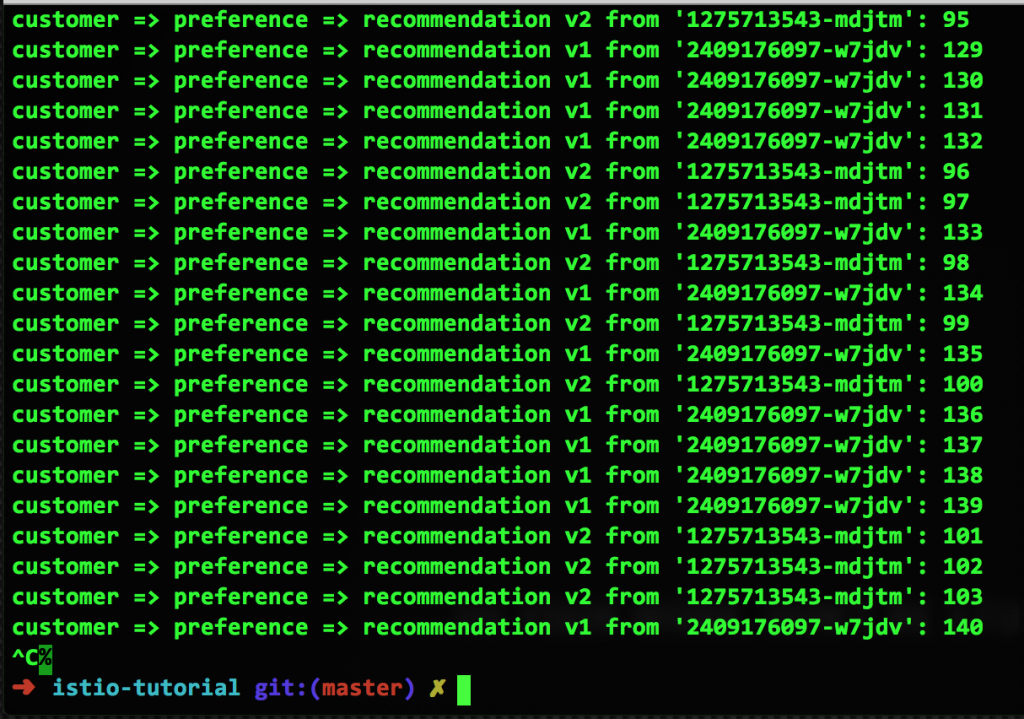
    The failing v2 container is not being used. After the 15 seconds has elapsed, the container is automatically added back into the pool. This is Istio pool ejection.

    Starting To Build An Architecture

    Combining Istio pool ejection with monitoring, you can start to build a framework where faulty containers are removed and replaced automatically, reducing or eliminating downtime and the dreaded pager call.

    Next week's blog post will take a look at the monitoring and tracing provided by Istio.


    All articles in the "Introduction to Istio" series:

    • Part 1: Introduction to Istio; It Makes a Mesh of Things
    • Part 2: Istio Route Rules: Telling Service Requests Where to Go
    • Part 3: Istio Circuit Breaker: How to Handle (Pool) Ejection
    • Part 4: Istio Circuit Breaker: When Failure Is an Option
    • Part 5: Istio Tracing & Monitoring: Where Are You and How Fast Are You Going?
    • Part 6: Istio Chaos Engineering: I Meant to Do That
    • Part 7: Istio Dark Launch: Secret Services
    • Part 8: Istio Smart Canary Launch: Easing into Production
    • Part 9: Istio Egress: Exit Through the Gift Shop
    • Part 10: Istio Service Mesh Blog Series Recap

    Last updated: September 3, 2019

    Recent Posts

    • Every layer counts: Defense in depth for AI agents with Red Hat AI

    • Fun in the RUN instruction: Why container builds with distroless images can surprise you

    • Trusted software factory: Building trust in the agentic AI era

    • Build a zero trust AI pipeline with OpenShift and RHEL CVMs

    • Red Hat Hardened Images: Top 5 benefits for software developers

    Red Hat Developers logo LinkedIn YouTube Twitter Facebook

    Platforms

    • Red Hat AI
    • Red Hat Enterprise Linux
    • Red Hat OpenShift
    • Red Hat Ansible Automation Platform
    • See all products

    Build

    • Developer Sandbox
    • Developer tools
    • Interactive tutorials
    • API catalog

    Quicklinks

    • Learning resources
    • E-books
    • Cheat sheets
    • Blog
    • Events
    • Newsletter

    Communicate

    • About us
    • Contact sales
    • Find a partner
    • Report a website issue
    • Site status dashboard
    • Report a security problem

    RED HAT DEVELOPER

    Build here. Go anywhere.

    We serve the builders. The problem solvers who create careers with code.

    Join us if you’re a developer, software engineer, web designer, front-end designer, UX designer, computer scientist, architect, tester, product manager, project manager or team lead.

    Sign me up

    Red Hat legal and privacy links

    • About Red Hat
    • Jobs
    • Events
    • Locations
    • Contact Red Hat
    • Red Hat Blog
    • Inclusion at Red Hat
    • Cool Stuff Store
    • Red Hat Summit
    © 2026 Red Hat

    Red Hat legal and privacy links

    • Privacy statement
    • Terms of use
    • All policies and guidelines
    • Digital accessibility

    Chat Support

    Please log in with your Red Hat account to access chat support.