Start using the Red Hat build of OpenJDK
Build, test, and host Java systems using the official Red Hat distribution of the OpenJDK upstream open source project.

Build and deploy Java applications
More than a decade of walkthroughs, explanations, summaries, and notes are here to help you start building and running Java applications. No matter which project version you standardize on or what common task you need to do, we probably have an article on it—or any number of other learning content types and resources.


Learn how to troubleshoot, monitor, and profile your container-based Java...

Learn about the Shenandoah garbage collector, including basic features, use...

Try a hands-on workshop in the Developer Sandbox to learn about Quarkus (a...
In this preview of a 2022 Red Hat Summit talk, Jim Tyrrell breaks down the...
Discover the advantages of using Java for AI development in regulated...

Learn about my recommendation for updating OpenJDK images since Docker Hub's...
This article provides insights into the process of migrating Java applications.

Discover Eclipse JKube and learn how the Kubernetes Maven Plugin simplifies...

Using Dekorate to generate Kubernetes manifests not only simplifies Java...

This article is part of a series on Java Operator SDK, and covers how to...
Explore new concurrency patterns enabled by virtual threads in Java 21, along...

Learn how to build applications with Paketo buildpacks and Red Hat Universal...
Explore 3 issues that can compromise your Java application's data...

Red Hat Universal Base Images now offers OpenJDK runtime container images as...

Use the Cryostat JDK Mission Control (JMC) agent and its API handlers for...

Announcing the release of the first tech preview of the jlink integration...

You can now use OpenJDK's JDK Flight Recorder to collect custom events. Learn...
Capture JFR data on the fly with the POST rule in Cryostat 2.0. Diagnose...
Learn how to use JFR to profile and monitor Quarkus native executables, and...
This article walks through the new native memory tracking feature in GraalVM...

This article aims to show the features and complete utilization of Java...

Learn about the new Cryostat 4.0 release and the Agent Autoconfiguration...

In this article we examine the new Cryostat 4.0 OpenShift Web Console Dynamic...

JDK Flight Recorder (JFR) for Java workloads on Red Hat OpenShift.

Learn how HotSpot's multi-tiered execution system uses the interpreter, quick...

Find out how Shenandoah garbage collection improves Java application latency...

Get a closer look at how the Shenandoah garbage collector adds concurrent...
Optimizations in the HotSpot virtual machine that used to work only for int...
Learn about the next updates to the UBI of the Red Hat build of OpenJDK...
This article details the functioning of Metaspace in JDK 8+ and how to use...
Discover how application class data sharing (AppCDS) can help reduce startup...

Explore JVM tuning considerations for Red Hat Data Grid on Red Hat OpenShift...
Dive into just-in-time (JIT) compilation with HotSpot, OpenJDK's Java virtual...
Learn how Java Flight Recorder helped resolve issues with a mobile...

This article explores how to use the new features of Red Hat build of...

Use fault tree analysis and the PIOSEE framework to troubleshoot Red Hat...

This article describes how to enable FIPS-140-2 support for the Red Hat build...
Learn about native images and read updates about JDK Flight Recorder (JFR)...
Log4Shell exposed a massive security gap in widely used open source software....
The Adoptium project has achieved reproducible builds for Java versions 21...
Learn about the benefits of using cgroups v2 for improved memory and CPU...

With the growth in the use of containers, the need to bundle your application...
This datasheet gives a comprehensive review about Red Hat’s build of...

Official and comprehensive Red Hat documentation on the Red Hat build of...
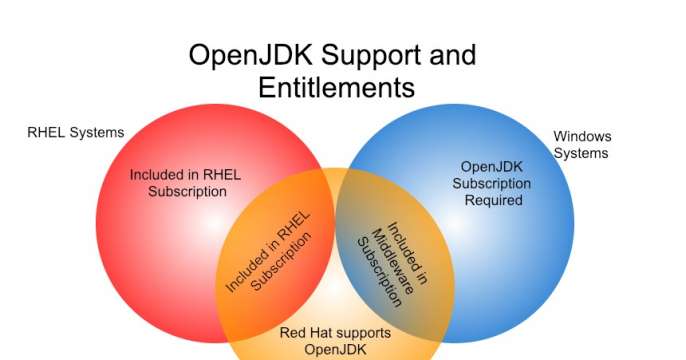
This article is an explanation of the OpenJDK Life Cycle and Support Policy...
Ready for supported production use?
Take your deployment to the next level. Moving your Java applications to supported production offers enhanced stability, security, and support. Adding Lightwell also extends our maintenance capabilities to help secure the open source software underpinning environments and applications running in production.


