AI
  • Get started with AI

    • Red Hat AI

      Accelerate the development and deployment of enterprise AI solutions.

    • AI learning hub

      Explore learning materials and tools, organized by task.

    • AI interactive demos

      Click through scenarios with Red Hat AI, including training LLMs and more.

    • AI/ML learning paths

      Expand your Red Hat OpenShift AI knowledge using these learning resources.

    • AI quickstarts

      Focused AI use cases designed for fast deployment on Red Hat AI platforms.

    • No-cost AI training

      Foundational Red Hat AI training.

  • Featured resources

    • Red Hat OpenShift AI
    • Open source AI for developers
    • AI product application development
    • Open source-powered AI/ML for hybrid cloud
    • AI and Node.js cheat sheet

Red Hat AI Factory with NVIDIA

Red Hat AI Factory with NVIDIA is a co-engineered, enterprise-grade AI solution for building, deploying, and managing AI at scale across hybrid cloud environments.

Learn
  • Self-guided

    • Documentation

      Find answers, get step-by-step guidance, and learn how to use Red Hat products.

    • Learning paths

      Explore curated walkthroughs for common development tasks.

    • Guided learning

      Receive custom learning paths powered by our AI assistant.

    • See all learning
  • Hands-on

    • Developer Sandbox

      Spin up Red Hat's products and technologies without setup or configuration.

    • Interactive labs

      Learn by doing in these hands-on, browser-based experiences.

    • Interactive demos

      Click through product features in these guided tours.

  • Browse by topic

    • AI/ML
    • Automation
    • Java
    • Kubernetes
    • Linux
    • See all topics
  • Training & certifications

    • Courses and exams
    • Certifications
    • Skills assessments
    • Red Hat Academy
    • Learning subscription
    • Explore training
Build
  • Get started

    • Red Hat build of Podman Desktop

      A downloadable, local development hub to experiment with our products and builds.

    • Developer Sandbox

      Spin up Red Hat's products and technologies without setup or configuration.

  • Download products

    • Red Hat Enterprise Linux
    • Red Hat AI
    • Red Hat OpenShift
    • Red Hat Ansible Automation Platform
    • See all products
  • Featured

    • Red Hat build of OpenJDK
    • Red Hat JBoss Enterprise Application Platform
    • Red Hat OpenShift Dev Spaces
    • Red Hat Developer Toolset
  • References

    • E-books
    • Documentation
    • Cheat sheets
    • Architecture center
Community
  • Get involved

    • Events
    • Live AI events
    • Red Hat Summit
    • Red Hat Accelerators
    • Community discussions
  • Follow along

    • Articles & blogs
    • Developer newsletter
    • Videos
    • Github
  • Get help

    • Customer service
    • Customer support
    • Regional contacts
    • Find a partner

Join the Red Hat Developer program

Download Red Hat products and project builds, access support documentation, learning content, and more.

ConsoleDocsSupport Search
New For you

Recommended

We'll recommend resources you may like as you browse. Try these suggestions for now.

  • Product downloads
  • Cheat sheets
  • Red Hat Developer learning portal
  • Developer blog
  • E-books
  • Developer Sandbox
Log in

Get more with a Red Hat Developer account

  • Product downloads
  • Console access
  • Event registration
  • Training & trials
Explore more account benefitsLog in or register

A subscription may be required for some services.

Contact us

What's happening in the Node.js community

April 8, 2021
Bethany Griggs
Related topics:
Node.jsOpen source
Related products:
Red Hat build of Node.js

    Curious about what’s going on in the Node.js community?

    Node.js 16 will be released in April 2021 and promoted to long-term support in October 2021. We’re also rapidly approaching the end-of-life date for Node.js 10. After April 2021, there will be no further patches or security fixes made available for the Node.js 10 release line. If you haven’t already, you should plan to upgrade to Node.js 12 or Node.js 14 as soon as possible. See the Node.js release schedule in Figure 1.
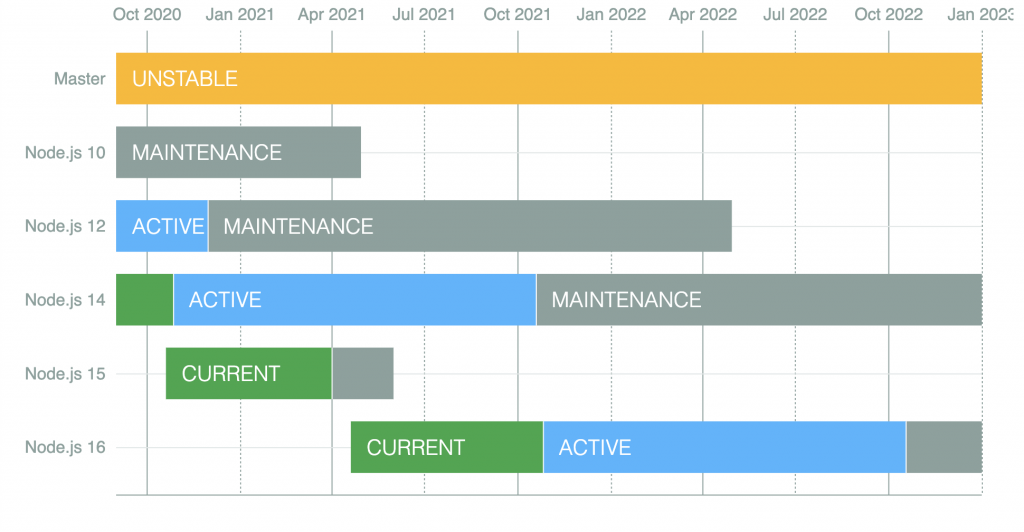
    Node.js release timeline spanning October 2020 to January 2023.
    Figure 1: An overview of the Node.js release timeline.

    New features in Node.js 15

    The “current” release line, Node.js 15, picks up the new features that are contributed to the runtime first. Features now available in Node.js 15 include:

    • crypto.randomUUID()
    • fsPromises.watch(), an alternative version of fs.watch() that returns an AsyncIterator
    • New perf_hooks.createHistogram() API for creating histogram instances that allow user recording
    • npm 7.5, including the new npm diff command
    • Support for source maps has graduated from experimental status to stable (proposed by Benjamin Coe)

    Hot topics in the Node.js community

    The following issues have sparked discussion in the Node.js community recently:

    • Work progressing toward producing native Node.js binaries for Apple Silicon, to be distributed as a single “fat” (multi-architecture) binary for macOS
    • Renewed discussion around including fetch() or a fetch()-like API in Node.js core
    • A proposal to promote the experimental APIs AsyncResource and AsyncLocalStorage to stable status

     The Node.js package maintenance ecosystem

    The Node.js Package Maintenance Working Group aims to help maintainers in a number of ways. Two active efforts are:

    • Encouraging the publishing of package support information: Publishing package support information helps maintainers set expectations in terms of supported Node.js versions, general support availability, and the backing behind a given package. The Working Group has defined the recommended metadata in PACKAGE-SUPPORT.md. New this month: The addition of a create command to the support tool, which makes it easier for maintainers to add this metadata to their packages. npx @pkgjs/support create will guide you through adding the recommended metadata to your package. The Nodeshift project recently added package support information to our modules. You can read more about our experience in this article.
    • The wiby testing tool: The Working Group continues to develop wiby (“Will I break you?”). Still in early development, this tool helps package maintainers test whether changes in their packages break other packages that depend on them. If you’re interested in module testing or you’re a module maintainer wanting to test the impact of your changes on your downstream dependents, you can watch a demo and/or follow the progress in the GitHub repository.

    The next 10 years of Node.js

    The Node.js project is documenting what we think is important to make the next 10 years of Node.js as successful as the first 10 years. The Next-10 effort is focused on defining the project’s technical values and constituencies to set the foundation for future discussions. We’ve had many conversations and documented our initial thoughts, but now we need your help. The project has launched a survey to confirm that these values and constituencies align with our users' needs. You can help guide the future of Node.js by taking part in the survey.

    Upcoming virtual events

    Although we’ve been unable to meet in person over the past year, the Node.js community is still getting together at virtual events. Upcoming events include:

    • OpenJS World (June 2, 2021)
    • NodeConf Remote (October 18-21, 2021)

    Stay up to date on Node.js

    • Node.js on Red Hat Developer
    • Node.js on IBM Developer
    • The Node.js project blog
    Last updated: February 11, 2024

    Recent Posts

    • A day in the life of an NVIDIA H100 on Red Hat OpenShift 5

    • Migrate BuildConfigs to builds for Red Hat OpenShift with one plug-in install

    • Run Red Hat Enterprise Linux CoreOS on NVIDIA BlueField DPUs

    • Agent harness engineering: Separating model capabilities from enforcement

    • What's new for developers in Red Hat Enterprise Linux 10.3 and 9.9

    Red Hat Developers logo

    Platforms

    • Red Hat AI
    • Red Hat Enterprise Linux
    • Red Hat OpenShift
    • Red Hat Ansible Automation Platform
    • See all products

    Build

    • Developer Sandbox
    • Developer tools
    • Interactive tutorials
    • API catalog

    Quicklinks

    • Learning resources
    • E-books
    • Cheat sheets
    • Blog
    • Events
    • Newsletter

    Communicate

    • About us
    • Contact sales
    • Find a partner
    • Report a website issue
    • Site status dashboard
    • Report a security problem

    Red Hat Developer

    Build here. Go anywhere.

    We serve the builders. The problem solvers who create careers with code.

    Join us if you’re a developer, software engineer, web designer, front-end designer, UX designer, computer scientist, architect, tester, product manager, project manager or team lead.

    Sign me up

    Red Hat legal and privacy links

    • About Red Hat
    • Jobs
    • Events
    • Locations
    • Contact Red Hat
    • Red Hat Blog
    • Inclusion at Red Hat
    • Cool Stuff Store
    • Red Hat Summit
    © 2026 Red Hat

    Red Hat legal and privacy links

    • Privacy statement
    • Terms of use
    • All policies and guidelines
    • Digital accessibility
    Ask AI
