Redhat Developers  Logo
  • AI

    Get started with AI

    • Red Hat AI
      Accelerate the development and deployment of enterprise AI solutions.
    • AI learning hub
      Explore learning materials and tools, organized by task.
    • AI interactive demos
      Click through scenarios with Red Hat AI, including training LLMs and more.
    • AI/ML learning paths
      Expand your OpenShift AI knowledge using these learning resources.
    • AI quickstarts
      Focused AI use cases designed for fast deployment on Red Hat AI platforms.
    • No-cost AI training
      Foundational Red Hat AI training.

    Featured resources

    • OpenShift AI learning
    • Open source AI for developers
    • AI product application development
    • Open source-powered AI/ML for hybrid cloud
    • AI and Node.js cheat sheet

    Red Hat AI Factory with NVIDIA

    • Red Hat AI Factory with NVIDIA is a co-engineered, enterprise-grade AI solution for building, deploying, and managing AI at scale across hybrid cloud environments.
    • Explore the solution
  • Learn

    Self-guided

    • Documentation
      Find answers, get step-by-step guidance, and learn how to use Red Hat products.
    • Learning paths
      Explore curated walkthroughs for common development tasks.
    • Guided learning
      Receive custom learning paths powered by our AI assistant.
    • See all learning

    Hands-on

    • Developer Sandbox
      Spin up Red Hat's products and technologies without setup or configuration.
    • Interactive labs
      Learn by doing in these hands-on, browser-based experiences.
    • Interactive demos
      Click through product features in these guided tours.

    Browse by topic

    • AI/ML
    • Automation
    • Java
    • Kubernetes
    • Linux
    • See all topics

    Training & certifications

    • Courses and exams
    • Certifications
    • Skills assessments
    • Red Hat Academy
    • Learning subscription
    • Explore training
  • Build

    Get started

    • Red Hat build of Podman Desktop
      A downloadable, local development hub to experiment with our products and builds.
    • Developer Sandbox
      Spin up Red Hat's products and technologies without setup or configuration.

    Download products

    • Access product downloads to start building and testing right away.
    • Red Hat Enterprise Linux
    • Red Hat AI
    • Red Hat OpenShift
    • Red Hat Ansible Automation Platform
    • See all products

    Featured

    • Red Hat build of OpenJDK
    • Red Hat JBoss Enterprise Application Platform
    • Red Hat OpenShift Dev Spaces
    • Red Hat Developer Toolset

    References

    • E-books
    • Documentation
    • Cheat sheets
    • Architecture center
  • Community

    Get involved

    • Events
    • Live AI events
    • Red Hat Summit
    • Red Hat Accelerators
    • Community discussions

    Follow along

    • Articles & blogs
    • Developer newsletter
    • Videos
    • Github

    Get help

    • Customer service
    • Customer support
    • Regional contacts
    • Find a partner

    Join the Red Hat Developer program

    • Download Red Hat products and project builds, access support documentation, learning content, and more.
    • Explore the benefits

Managed File Transfer (MFT) 2.0 with Fuse, 3scale and AMQ

November 6, 2017
Simon Green
Related products:
Streams for Apache KafkaRed Hat FuseRed Hat 3scale API Management

    It was more than 2 years ago that I blogged about building a Managed File Transfer (MFT) solution using Fuse and AMQ. First, many things have progressed, particularly the technology landscape. Second, MFT protocols have evolved. AS4 provides a new and improved way of securely exchanging documents over HTTP. In addition, the OASIS consortium governs a vendor-neutral open standard. This is great news, but how do we achieve support for these new standards and transports with our antiquated, legacy, and proprietary MFT software?

    The Solution

    The answer is to architect your own MFT solution using JBoss Fuse, AMQ, and 3scale. The figure below depicts what this might look like:
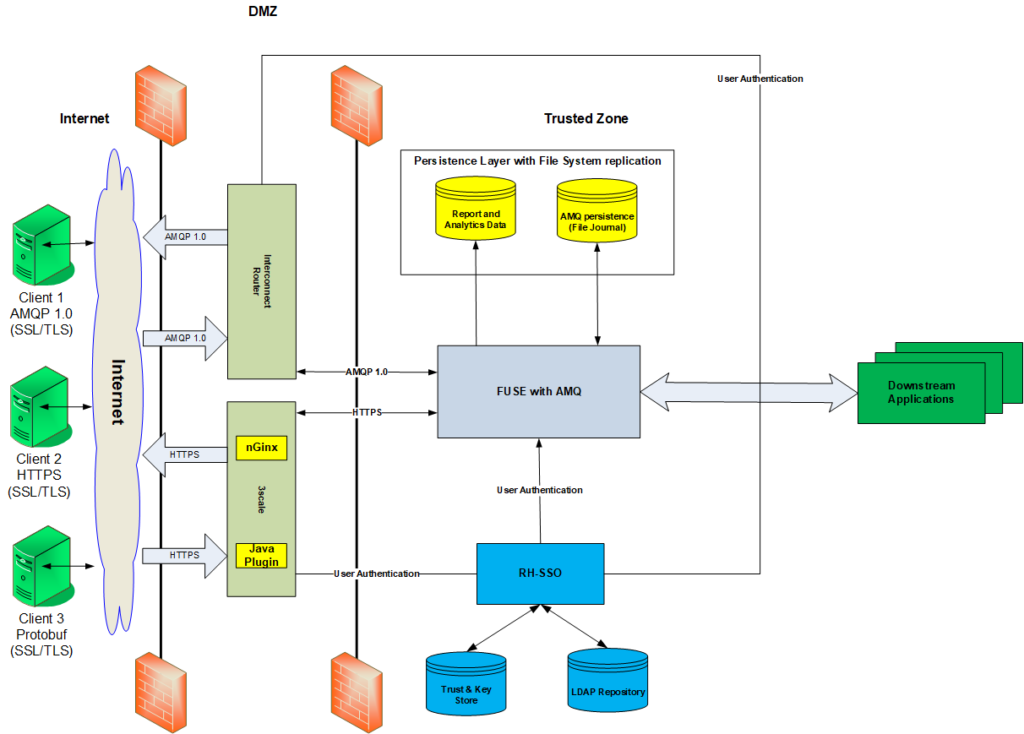
    Legacy transports like FTPS/SFTP are replaced by modern, efficient protocols like AMQP 1.0 and Protobuf. These highly optimized protocols are not only more efficient but give us metrics and visibility via the API Management platform. Or, in the case of AMQP, the AMQ Interconnect Router component (acting as a secure proxy).

    But what happens if we still need to support a small bunch of legacy clients? Some clients might be unwilling (or reluctant) to upgrade to a more modern transport/protocol. If that's the case, take a look at what my colleague Joe Butler suggests in his post on the 3scale Java plugin. Using a custom Camel component, we can consume large files from clients using legacy protocols. We then run this through the 3scale API management platform, as if it were a regular API call. That will give us instant visibility of the file transfer, and additional added benefits that an API Management platform brings including:

    • Security
    • Key management
    • Rate limiting
    • Policy enforcement
    • App and user management
    • Provisioning
    • Analytics
    • App tracking
    • User tracking
    • Traffic alerts
    • Engagement
    • Developer support

    Red Hat SSO is one new product that was introduced since my last post. Included with any JBoss subscription, it's a federated IAM provider for all JBoss products; making it easy to exchange SSO tokens while interfacing with your enterprise identify providers. This drastically simplifies RBAC enforcement and makes it easy to administer user credentials and role mapping via your existing IAM tool.

    Where do we go from here?

    The time has come to break free of your proprietary MFT solution and introduce more modern, standard-based transports and protocols. Using open source, vendor-neutral building blocks like Fuse, 3scale and AMQ, we now have a modern platform for exchanging large files with partners. We no longer have a legacy monolithic application, but a more modern agile integration solution.


    Click here to download and quickly get started with  Red Hat JBoss AMQ.

    Last updated: September 3, 2019

    Recent Posts

    • Debugging image mode with Red Hat OpenShift 4.20: A practical guide

    • EvalHub: Because "looks good to me" isn't a benchmark

    • SQL Server HA on RHEL: Meet Pacemaker HA Agent v2 (tech preview)

    • Deploy with confidence: Continuous integration and continuous delivery for agentic AI

    • Every layer counts: Defense in depth for AI agents with Red Hat AI

    Red Hat Developers logo LinkedIn YouTube Twitter Facebook

    Platforms

    • Red Hat AI
    • Red Hat Enterprise Linux
    • Red Hat OpenShift
    • Red Hat Ansible Automation Platform
    • See all products

    Build

    • Developer Sandbox
    • Developer tools
    • Interactive tutorials
    • API catalog

    Quicklinks

    • Learning resources
    • E-books
    • Cheat sheets
    • Blog
    • Events
    • Newsletter

    Communicate

    • About us
    • Contact sales
    • Find a partner
    • Report a website issue
    • Site status dashboard
    • Report a security problem

    RED HAT DEVELOPER

    Build here. Go anywhere.

    We serve the builders. The problem solvers who create careers with code.

    Join us if you’re a developer, software engineer, web designer, front-end designer, UX designer, computer scientist, architect, tester, product manager, project manager or team lead.

    Sign me up

    Red Hat legal and privacy links

    • About Red Hat
    • Jobs
    • Events
    • Locations
    • Contact Red Hat
    • Red Hat Blog
    • Inclusion at Red Hat
    • Cool Stuff Store
    • Red Hat Summit
    © 2026 Red Hat

    Red Hat legal and privacy links

    • Privacy statement
    • Terms of use
    • All policies and guidelines
    • Digital accessibility

    Chat Support

    Please log in with your Red Hat account to access chat support.