Redhat Developers  Logo
  • AI

    Get started with AI

    • Red Hat AI
      Accelerate the development and deployment of enterprise AI solutions.
    • AI learning hub
      Explore learning materials and tools, organized by task.
    • AI interactive demos
      Click through scenarios with Red Hat AI, including training LLMs and more.
    • AI/ML learning paths
      Expand your OpenShift AI knowledge using these learning resources.
    • AI quickstarts
      Focused AI use cases designed for fast deployment on Red Hat AI platforms.
    • No-cost AI training
      Foundational Red Hat AI training.

    Featured resources

    • OpenShift AI learning
    • Open source AI for developers
    • AI product application development
    • Open source-powered AI/ML for hybrid cloud
    • AI and Node.js cheat sheet

    Red Hat AI Factory with NVIDIA

    • Red Hat AI Factory with NVIDIA is a co-engineered, enterprise-grade AI solution for building, deploying, and managing AI at scale across hybrid cloud environments.
    • Explore the solution
  • Learn

    Self-guided

    • Documentation
      Find answers, get step-by-step guidance, and learn how to use Red Hat products.
    • Learning paths
      Explore curated walkthroughs for common development tasks.
    • Guided learning
      Receive custom learning paths powered by our AI assistant.
    • See all learning

    Hands-on

    • Developer Sandbox
      Spin up Red Hat's products and technologies without setup or configuration.
    • Interactive labs
      Learn by doing in these hands-on, browser-based experiences.
    • Interactive demos
      Click through product features in these guided tours.

    Browse by topic

    • AI/ML
    • Automation
    • Java
    • Kubernetes
    • Linux
    • See all topics

    Training & certifications

    • Courses and exams
    • Certifications
    • Skills assessments
    • Red Hat Academy
    • Learning subscription
    • Explore training
  • Build

    Get started

    • Red Hat build of Podman Desktop
      A downloadable, local development hub to experiment with our products and builds.
    • Developer Sandbox
      Spin up Red Hat's products and technologies without setup or configuration.

    Download products

    • Access product downloads to start building and testing right away.
    • Red Hat Enterprise Linux
    • Red Hat AI
    • Red Hat OpenShift
    • Red Hat Ansible Automation Platform
    • See all products

    Featured

    • Red Hat build of OpenJDK
    • Red Hat JBoss Enterprise Application Platform
    • Red Hat OpenShift Dev Spaces
    • Red Hat Developer Toolset

    References

    • E-books
    • Documentation
    • Cheat sheets
    • Architecture center
  • Community

    Get involved

    • Events
    • Live AI events
    • Red Hat Summit
    • Red Hat Accelerators
    • Community discussions

    Follow along

    • Articles & blogs
    • Developer newsletter
    • Videos
    • Github

    Get help

    • Customer service
    • Customer support
    • Regional contacts
    • Find a partner

    Join the Red Hat Developer program

    • Download Red Hat products and project builds, access support documentation, learning content, and more.
    • Explore the benefits

Announcing resource optimization for Red Hat OpenShift GA

July 4, 2024
Pau Garcia Quiles
Related topics:
Application modernizationContainersKubernetes
Related products:
Microsoft Azure Red Hat OpenShiftRed Hat OpenShiftRed Hat OpenShift Container PlatformRed Hat OpenShift Service on AWS

    Allocating the right amount of resources for your containers is tough. Where to start? Should you allocate resources based on what you see in development? Perhaps you should allocate based on your best judgment for what may happen in a production environment? What should you do if your workload has some seasonality and resource utilization might fluctuate?

    In May 2023, we introduced a limited preview of resource optimization for Red Hat OpenShift as part of Red Hat Lightspeed cost management, to answer these types of questions. No need to guess anymore: just install the Cost Management Metrics Operator and let our recommendation engine advise you on proper resource allocation.

    We are pleased to announce that resource optimization for Red Hat OpenShift is generally available to every Red Hat Lightspeed cost management user. 

    Features of resource optimization for OpenShift include:

    • Recommendations for containers, deployments, StatefulSets, DaemonSets, etc.
    • 1, 7, and 14-day recommendations.
    • Profile-based recommendations (cost-oriented and performance-oriented).
    • Raw YAML displayed, for easier copy and paste.
    • Boxplots explaining why a recommendation was generated.
    • Labeling namespaces to enable recommendation generation.
    • Available on all the architectures supported by Red Hat Lightspeed cost management: x86-64, ARM, IBM Z and POWER.

    You can provide feedback or request enhancements through the feedback form in the Red Hat Hybrid Cloud Console, or via your account representatives.

    Resource optimization will generate recommendations for all namespaces carrying the insights_cost_management_optimizations='true' label. This label has been enforced since Cost Management Metrics Operator version 3.3.0, which has recently been released. Check our documentation for full details.

     If you are not yet using resource optimization for OpenShift, get started with a few easy steps:

    1. Label the namespaces you want recommendations for with insights_cost_management_optimizations='true'.
    2. Install the Cost Management Metrics Operator.
    3. Connect your cloud accounts.
    4. Wait a few hours.

    Go to the Hybrid Cloud Console and look for Red Hat Lightspeed cost management. You will find the Optimizations page on the left navigation bar. See Figure 1.
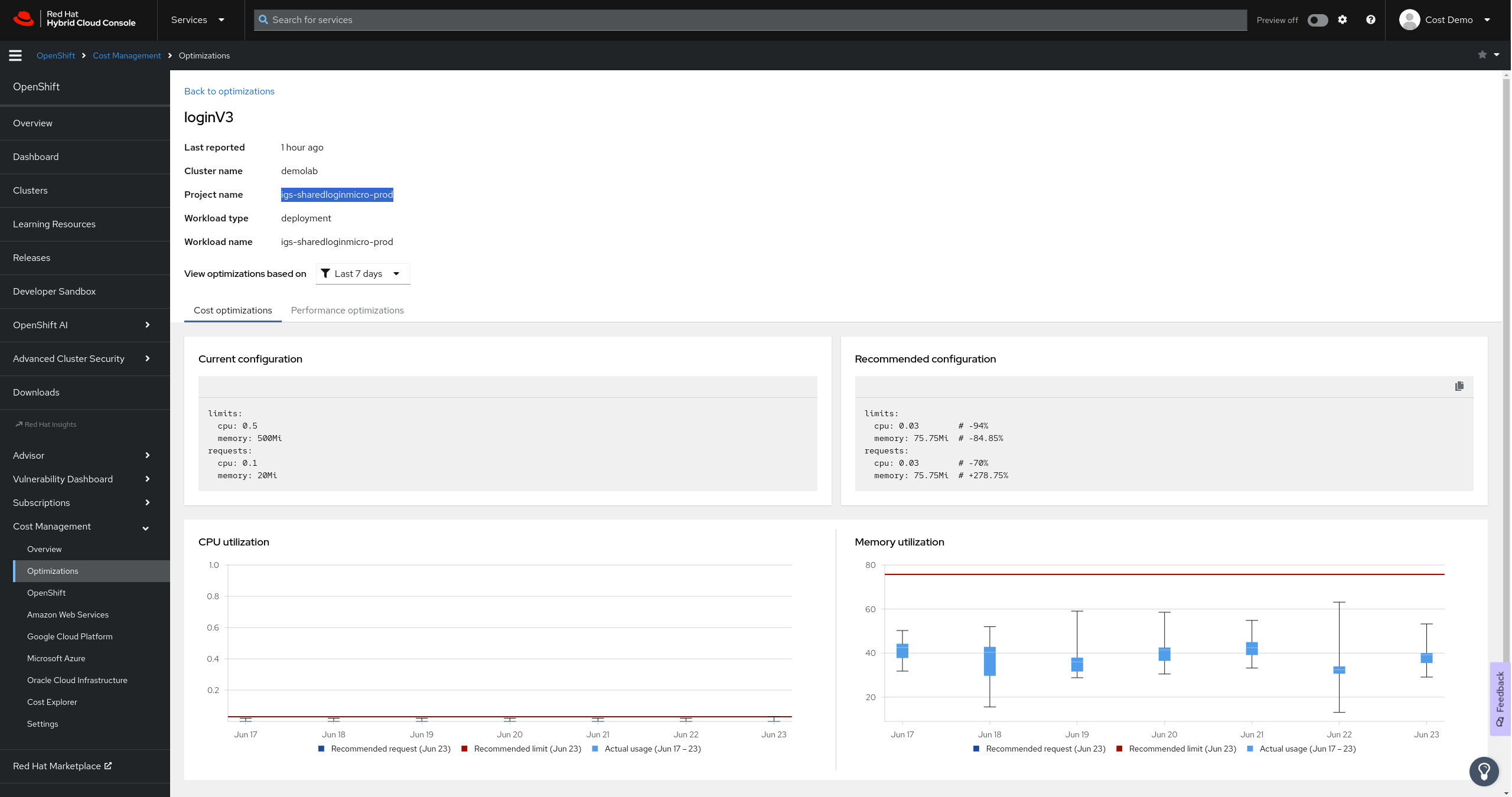
    A screenshot of the Hybrid Cloud Console homepage with the Cost optimization tab visible on the far left of the navigation bar.
    Figure 1: Red Hat Lightspeed cost management with Cost optimizations tab.
    Last updated: November 7, 2025

    Related Posts

    • Detect network issues in Open vSwitch using Red Hat Lightspeed

    • Convert CentOS Linux to RHEL using Red Hat Lightspeed

    • Synchronize instance tags from Amazon EC2 and Microsoft Azure with Red Hat Lightspeed

    • Extend Red Hat Lightspeed client to execute custom automation

    Recent Posts

    • Every layer counts: Defense in depth for AI agents with Red Hat AI

    • Fun in the RUN instruction: Why container builds with distroless images can surprise you

    • Trusted software factory: Building trust in the agentic AI era

    • Build a zero trust AI pipeline with OpenShift and RHEL CVMs

    • Red Hat Hardened Images: Top 5 benefits for software developers

    What’s up next?

    Looking to better understand and track costs for clouds and containers? Download the Red Hat Lightspeed cost management cheat sheet to learn how to get started.

    Get the cheat sheet
    Red Hat Developers logo LinkedIn YouTube Twitter Facebook

    Platforms

    • Red Hat AI
    • Red Hat Enterprise Linux
    • Red Hat OpenShift
    • Red Hat Ansible Automation Platform
    • See all products

    Build

    • Developer Sandbox
    • Developer tools
    • Interactive tutorials
    • API catalog

    Quicklinks

    • Learning resources
    • E-books
    • Cheat sheets
    • Blog
    • Events
    • Newsletter

    Communicate

    • About us
    • Contact sales
    • Find a partner
    • Report a website issue
    • Site status dashboard
    • Report a security problem

    RED HAT DEVELOPER

    Build here. Go anywhere.

    We serve the builders. The problem solvers who create careers with code.

    Join us if you’re a developer, software engineer, web designer, front-end designer, UX designer, computer scientist, architect, tester, product manager, project manager or team lead.

    Sign me up

    Red Hat legal and privacy links

    • About Red Hat
    • Jobs
    • Events
    • Locations
    • Contact Red Hat
    • Red Hat Blog
    • Inclusion at Red Hat
    • Cool Stuff Store
    • Red Hat Summit
    © 2026 Red Hat

    Red Hat legal and privacy links

    • Privacy statement
    • Terms of use
    • All policies and guidelines
    • Digital accessibility

    Chat Support

    Please log in with your Red Hat account to access chat support.
