Redhat Developers  Logo
  • AI

    Get started with AI

    • Red Hat AI
      Accelerate the development and deployment of enterprise AI solutions.
    • AI learning hub
      Explore learning materials and tools, organized by task.
    • AI interactive demos
      Click through scenarios with Red Hat AI, including training LLMs and more.
    • AI/ML learning paths
      Expand your OpenShift AI knowledge using these learning resources.
    • AI quickstarts
      Focused AI use cases designed for fast deployment on Red Hat AI platforms.
    • No-cost AI training
      Foundational Red Hat AI training.

    Featured resources

    • OpenShift AI learning
    • Open source AI for developers
    • AI product application development
    • Open source-powered AI/ML for hybrid cloud
    • AI and Node.js cheat sheet

    Red Hat AI Factory with NVIDIA

    • Red Hat AI Factory with NVIDIA is a co-engineered, enterprise-grade AI solution for building, deploying, and managing AI at scale across hybrid cloud environments.
    • Explore the solution
  • Learn

    Self-guided

    • Documentation
      Find answers, get step-by-step guidance, and learn how to use Red Hat products.
    • Learning paths
      Explore curated walkthroughs for common development tasks.
    • Guided learning
      Receive custom learning paths powered by our AI assistant.
    • See all learning

    Hands-on

    • Developer Sandbox
      Spin up Red Hat's products and technologies without setup or configuration.
    • Interactive labs
      Learn by doing in these hands-on, browser-based experiences.
    • Interactive demos
      Click through product features in these guided tours.

    Browse by topic

    • AI/ML
    • Automation
    • Java
    • Kubernetes
    • Linux
    • See all topics

    Training & certifications

    • Courses and exams
    • Certifications
    • Skills assessments
    • Red Hat Academy
    • Learning subscription
    • Explore training
  • Build

    Get started

    • Red Hat build of Podman Desktop
      A downloadable, local development hub to experiment with our products and builds.
    • Developer Sandbox
      Spin up Red Hat's products and technologies without setup or configuration.

    Download products

    • Access product downloads to start building and testing right away.
    • Red Hat Enterprise Linux
    • Red Hat AI
    • Red Hat OpenShift
    • Red Hat Ansible Automation Platform
    • See all products

    Featured

    • Red Hat build of OpenJDK
    • Red Hat JBoss Enterprise Application Platform
    • Red Hat OpenShift Dev Spaces
    • Red Hat Developer Toolset

    References

    • E-books
    • Documentation
    • Cheat sheets
    • Architecture center
  • Community

    Get involved

    • Events
    • Live AI events
    • Red Hat Summit
    • Red Hat Accelerators
    • Community discussions

    Follow along

    • Articles & blogs
    • Developer newsletter
    • Videos
    • Github

    Get help

    • Customer service
    • Customer support
    • Regional contacts
    • Find a partner

    Join the Red Hat Developer program

    • Download Red Hat products and project builds, access support documentation, learning content, and more.
    • Explore the benefits

Kafka Monthly Digest: December 2021

January 11, 2022
Mickael Maison
Related topics:
Event-drivenKafkaKubernetes
Related products:
Streams for Apache KafkaRed Hat OpenShift

    This edition of the Kafka Monthly Digest covers what happened in the Apache Kafka community in December 2021. We will also look back at some of the milestones that the Kafka project and community reached over the past year, and we'll look ahead to two of the most anticipated Kafka features coming in 2022.

    For last month’s digest, see Kafka Monthly Digest: November 2021.

    Releases: Apache Kafka 3.1.0

    The only release in progress at this moment is Apache Kafka 3.1.0.

    David Jacot published the 3.1.0 RC0 (Release Candidate 0) on December 23. The vote on this first release candidate is currently ongoing. This release is a bit behind schedule but should be available in early January.

    Kafka Improvement Proposals

    Last month, the community submitted five KIPs (KIP-806 to KIP-811). Two particularly caught my eye.

    • KIP-808: Add support for Unix epoch precision in TimestampConverter SMT: TimestampConverter is one of the built-in Single Message Transformations (SMTs) for Kafka Connect. It supports the conversion of dates and timestamps in messages flowing through Kafka Connect. At the moment, this SMT only supports timestamps in milliseconds. The KIP's goal is to allow developers to specify the unit of timestamps in order to support seconds, microseconds, and nanoseconds.
    • KIP-810: Allow producing records with null values in Kafka Console Producer: In order to clear a key in a compacted topic, users currently need to produce a message with that key and the value set to null. Such a record is called a tombstone. As this is a relatively common operation when using compacted topics, this KIP proposes allowing the production of such records using the kafka-console-producer tool.

    Community releases

    December brought us a couple of notable open source community project updates:

    • Debezium 1.8: This newest release of the change data capture platform brings numerous improvements to the MongoDB connector. The Debezium UI also now supports configuring SMTs and topic creation options.
    • strimzi-kafka-operator 0.27: Strimzi is a Kubernetes Operator for running Kafka. Strimzi 0.27 brings multi-arch container images with support for AArch64. The ControlPlaneListener feature gate is now enabled by default to have a separate listener for controller-to-broker communications, and a few dependencies such as Cruise Control, Log4j2, and OPA Authorizer have been updated to the latest versions.

    Blogs

    Check out these interesting blog articles that were published last month:

    • Deep dive into Apache Kafka storage internals: Segments, rolling, and retention
    • Scheduling millions of messages with Kafka & Debezium
    • Kafka and .NET, Part 3: Finally at .NET
    • Visualize your Apache Kafka Streams using the Quarkus Dev UI
    • Announcing the First Release of kcctl

    Kafka project milestones in 2021

    As a new year begins, let's look back at some of the milestones Apache Kafka achieved in 2021.

    Releases

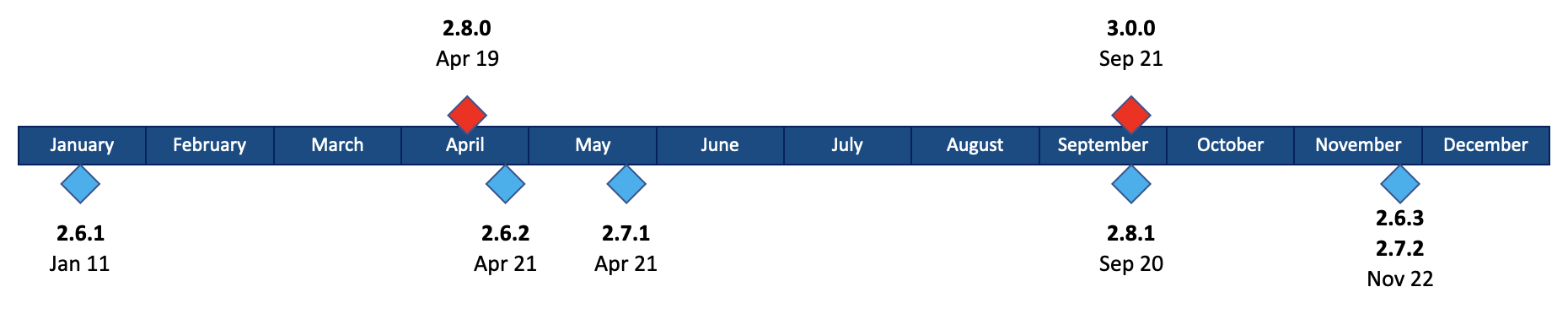
    The Kafka project followed its time-based release plan in 2021. Consequently, it released two versions—2.8.0 and 3.0.0—as well as six bugfix releases: 2.6.1, 2.6.2, 2.6.3, 2.7.1, 2.7.2 and 2.8.1. Figure 1 shows the timeline for these releases.
    Kafka releases in 2021.
    Figure 1. Kafka releases in 2021 (click to enlarge).

    KIPs

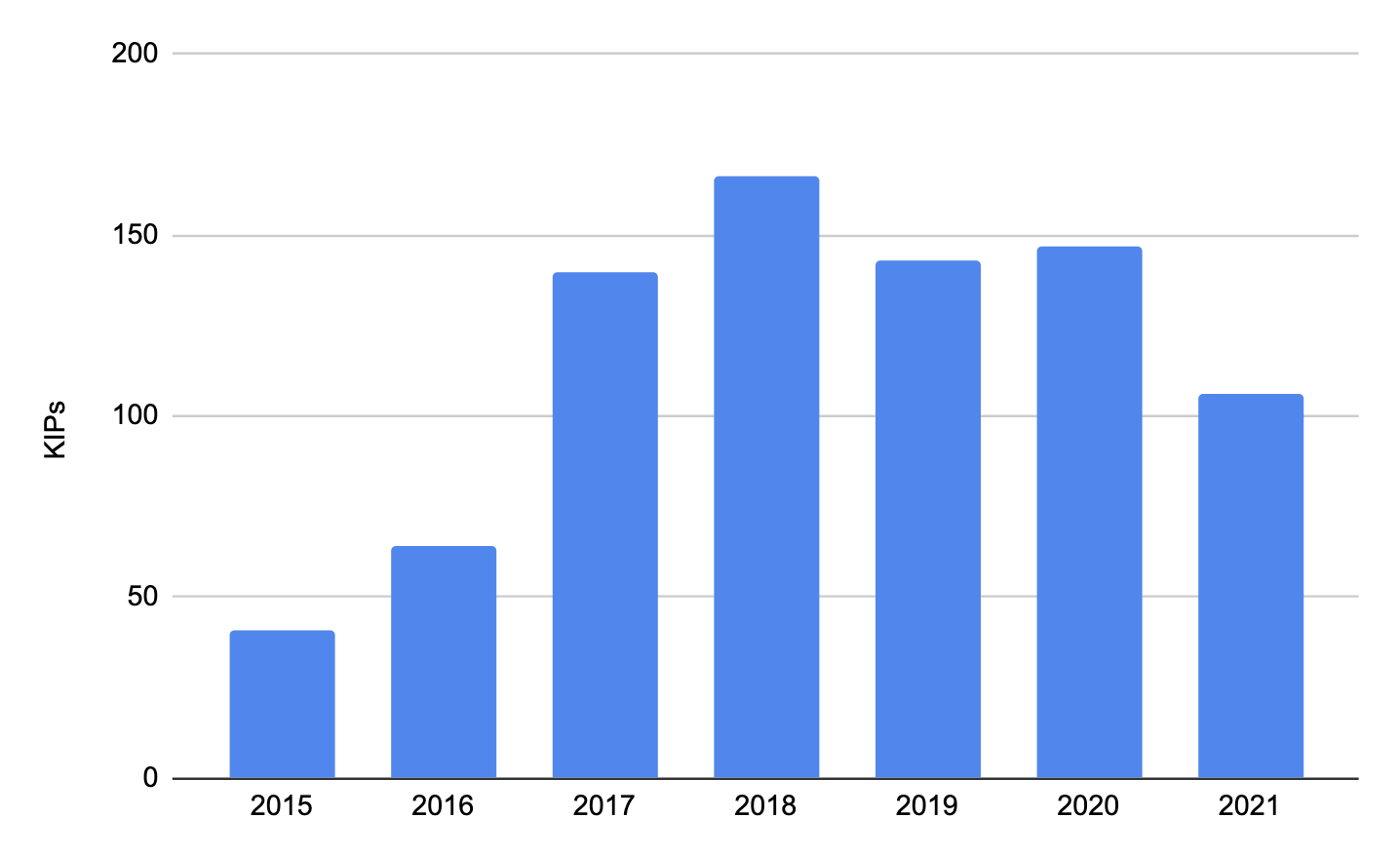
    In the past 12 months, the community raised 106 KIPs. Figure 2 shows how this compares to previous years.
    Kafka improvement projects in 2021.
    Figure 2. KIPs raised from 2015 to 2021.

    Code and contributors

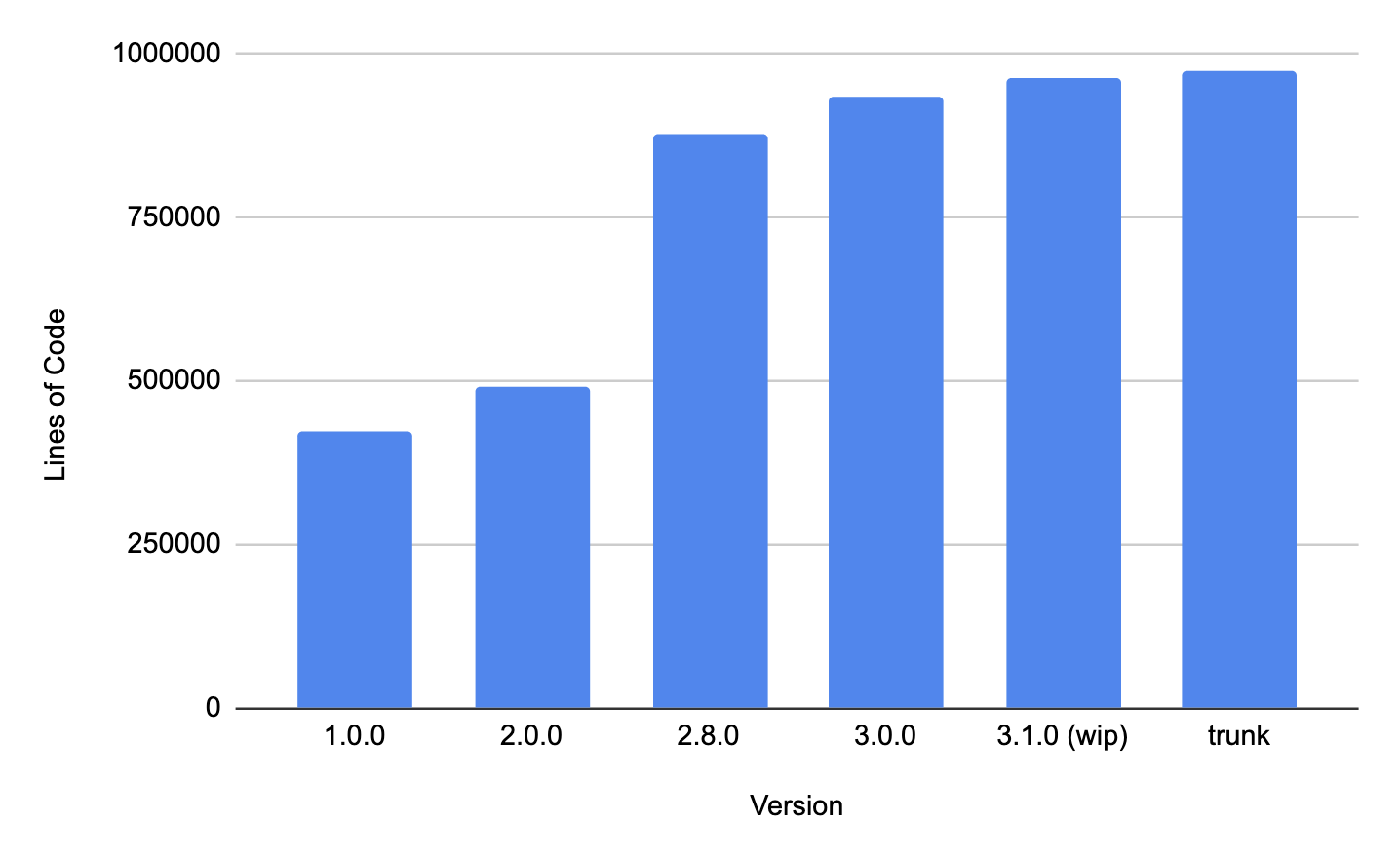
    Over 190 unique contributors made more than 1,200 Kafka commits in 2021. Figure 3 shows the size of the codebase, in lines of code, for a few releases.
    A bar graph showing lines of code per Kafka release.
    Figure 3. Lines of code per Kafka release.

    New committers and PMC members

    In 2021, three contributors were invited to become Kafka committers:

    • Tom Bentley
    • Bruno Cadonna
    • José Armando García Sancio

    These six committers also joined the Apache Kafka project management committee (PMC):

    • Chia-Ping Tsai
    • Bill Bejeck
    • Randall Hauch
    • Konstantine Karantasis
    • Tom Bentley
    • David Jacot

    The current roster of committers and PMC members is available on the Kafka website.

    What's coming for Kafka in 2022

    The Kafka project is still evolving and improving at breakneck speed. Out of the dozens of new features being worked on, the two most awaited features are:

    • KIP-500: Replace ZooKeeper with a Self-Managed Metadata Quorum(KRaft): This is the removal of ZooKeeper. Kafka 2.8.0 introduced KRaft in early access. It is expected to stay in early access for a few more releases to leave time to implement features that are still missing in this mode, such as zero-downtime upgrades (KIP-778) and authorizations (KIP-801) but also to ensure it's tested at scale before being ready for production.
    • KIP-405: Kafka Tiered Storage: This enables storing old segments onto remote storage such as Amazon S3 or Hadoop Distributed File System. This KIP was first proposed in January 2019 and after many discussions, it was finally voted in early 2021! The implementation is currently in progress so expect to hear about it again this year.

    Conclusion

    To learn more about Kafka, visit Red Hat Developer's Apache Kafka topic page.

    Last updated: May 31, 2024

    Related Posts

    • Kubernetes-native Apache Kafka with Strimzi, Debezium, and Apache Camel (Kafka Summit 2020)

    • Accessing Apache Kafka in Strimzi: Part 1 – Introduction

    • Change data capture with Debezium: A simple how-to, Part 1

    • Visualize your Apache Kafka Streams using the Quarkus Dev UI

    • Improve your Kafka Connect builds of Debezium

    Recent Posts

    • Preventing GPU waste: A guide to JIT checkpointing with Kubeflow Trainer on OpenShift AI

    • How to manage TLS certificates used by OpenShift GitOps operator

    • Configure a split disk on OpenShift Container Platform

    • Red Hat Enterprise Linux 10.2 and 9.8: Top features for developers

    • What GPU kernels mean for your distributed inference

    Red Hat Developers logo LinkedIn YouTube Twitter Facebook

    Platforms

    • Red Hat AI
    • Red Hat Enterprise Linux
    • Red Hat OpenShift
    • Red Hat Ansible Automation Platform
    • See all products

    Build

    • Developer Sandbox
    • Developer tools
    • Interactive tutorials
    • API catalog

    Quicklinks

    • Learning resources
    • E-books
    • Cheat sheets
    • Blog
    • Events
    • Newsletter

    Communicate

    • About us
    • Contact sales
    • Find a partner
    • Report a website issue
    • Site status dashboard
    • Report a security problem

    RED HAT DEVELOPER

    Build here. Go anywhere.

    We serve the builders. The problem solvers who create careers with code.

    Join us if you’re a developer, software engineer, web designer, front-end designer, UX designer, computer scientist, architect, tester, product manager, project manager or team lead.

    Sign me up

    Red Hat legal and privacy links

    • About Red Hat
    • Jobs
    • Events
    • Locations
    • Contact Red Hat
    • Red Hat Blog
    • Inclusion at Red Hat
    • Cool Stuff Store
    • Red Hat Summit
    © 2026 Red Hat

    Red Hat legal and privacy links

    • Privacy statement
    • Terms of use
    • All policies and guidelines
    • Digital accessibility

    Chat Support

    Please log in with your Red Hat account to access chat support.