Redhat Developers  Logo
  • AI

    Get started with AI

    • Red Hat AI
      Accelerate the development and deployment of enterprise AI solutions.
    • AI learning hub
      Explore learning materials and tools, organized by task.
    • AI interactive demos
      Click through scenarios with Red Hat AI, including training LLMs and more.
    • AI/ML learning paths
      Expand your OpenShift AI knowledge using these learning resources.
    • AI quickstarts
      Focused AI use cases designed for fast deployment on Red Hat AI platforms.
    • No-cost AI training
      Foundational Red Hat AI training.

    Featured resources

    • OpenShift AI learning
    • Open source AI for developers
    • AI product application development
    • Open source-powered AI/ML for hybrid cloud
    • AI and Node.js cheat sheet

    Red Hat AI Factory with NVIDIA

    • Red Hat AI Factory with NVIDIA is a co-engineered, enterprise-grade AI solution for building, deploying, and managing AI at scale across hybrid cloud environments.
    • Explore the solution
  • Learn

    Self-guided

    • Documentation
      Find answers, get step-by-step guidance, and learn how to use Red Hat products.
    • Learning paths
      Explore curated walkthroughs for common development tasks.
    • Guided learning
      Receive custom learning paths powered by our AI assistant.
    • See all learning

    Hands-on

    • Developer Sandbox
      Spin up Red Hat's products and technologies without setup or configuration.
    • Interactive labs
      Learn by doing in these hands-on, browser-based experiences.
    • Interactive demos
      Click through product features in these guided tours.

    Browse by topic

    • AI/ML
    • Automation
    • Java
    • Kubernetes
    • Linux
    • See all topics

    Training & certifications

    • Courses and exams
    • Certifications
    • Skills assessments
    • Red Hat Academy
    • Learning subscription
    • Explore training
  • Build

    Get started

    • Red Hat build of Podman Desktop
      A downloadable, local development hub to experiment with our products and builds.
    • Developer Sandbox
      Spin up Red Hat's products and technologies without setup or configuration.

    Download products

    • Access product downloads to start building and testing right away.
    • Red Hat Enterprise Linux
    • Red Hat AI
    • Red Hat OpenShift
    • Red Hat Ansible Automation Platform
    • See all products

    Featured

    • Red Hat build of OpenJDK
    • Red Hat JBoss Enterprise Application Platform
    • Red Hat OpenShift Dev Spaces
    • Red Hat Developer Toolset

    References

    • E-books
    • Documentation
    • Cheat sheets
    • Architecture center
  • Community

    Get involved

    • Events
    • Live AI events
    • Red Hat Summit
    • Red Hat Accelerators
    • Community discussions

    Follow along

    • Articles & blogs
    • Developer newsletter
    • Videos
    • Github

    Get help

    • Customer service
    • Customer support
    • Regional contacts
    • Find a partner

    Join the Red Hat Developer program

    • Download Red Hat products and project builds, access support documentation, learning content, and more.
    • Explore the benefits

Assembly Line for Computations

March 4, 2016
William Cohen
Related products:
Developer Toolset

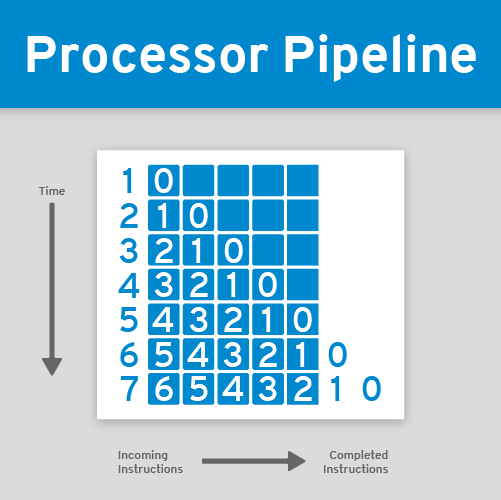
    The simple programmer's model of a processor executing machine language instructions is a loop of the following steps with each step finished before moving on the the next step:

    1. Fetch instruction
    2. Decode instruction and fetch register operands
    3. Execute arithmetic computation
    4. Possible memory access (read or write)
    5. Writeback results to register

    As mentioned in the introduction blog article even if the processor can get each step down to a single cycle that would would be 2.5ns (5*0.5ns) for a 2GHz (2x10^9 cycles per second) processor, only 400 million instructions per second. If the instructions can be processed in assembly-line fashion and the steps of instructions be overlapped, the performance could be significantly improved. Rather than completing one instruction every 2.5ns, the processor could potentially complete an instruction every clock cycle, a five-fold improvement in speed. This technique is known as pipelining.
    Possible Performance Issues of Pipelines

    Although pipelining instruction execution has the potential to greatly improve the processors performance there are a number of situations than can limit performance. This isn't an exhaustive list, but will give you some ideas why you might not be getting an instruction completed every clock cycle.

    • true dependencies (interlocks)
    • multi-cycle instructions stalls
    • branches
    • pipeline flushes

    True Dependencies (Interlocks)

    The assemly-line nature of pipelined instruction works very well if the instructions in the sequence are independent of of all the other instructions. If the results of one instruction are used by a following instruction, then there is a true dependency between the instructions. The following instruction stalls until the result is available because of the interlock. Take the simple statement that increments the variable i below:

    ++i

    It might be converted in the following sequence of instructions:

    ldr x1, [i]
    add x2, x1, 1
    str x2, [i]

    On each clock cycle an attempt is made to move each instruction down the pipeline.  However, after the add instruction is fetched the pipeline will stall until the value is loaded by the ldr instruction into x1. The store performed by the str instruction has a similar interlock waiting for the results of the add instruction to be written in x2.

    The compiler may attempt to order the instruction sequences so that instructions with true dependencies are not right next to each other to avoid these pipeline stalls due to interlocks.

    Multi-Cycle Instructions Stalls

    The pipeline can only advance as fast as the slowest step in the pipeline. Ideally each step in the pipeline is designed to take about the same amount of time. However, there are some instruction steps that might take multiple cycles. For example on most processors the divide operation takes multiple cycles and would stall the pipeline until it completes. Although caches attempt to minimize the impact memory reads and writes of the memory access step could take multiple cycles.

    Branches

    The basic assumption is that each cycle the processor is fetching the next instruction to put into the pipeline for processing. This works great for a linear sequence of instructions. In this case processor can easily fetch the next instruction in the sequence. However, all code has conditional branches to implement if-then-else statements, switch-case constructs, and loops. Which instruction is next depends on the result of a calculation. The pipeline must stall until the processor can determine what is the next instruction to fetch.

    Conditional branches are very common in code and they can have a significant impact in performance. Some processors with pipelines such as MIPS and SPARC tried to hide some of that overhead using delayed branched where the instruction following the branch instruction would always be executed to give the processor time to fetch the destination of the branch. However, delayed branches did not work so well when the processor pipelines got longer and multiple clock cycles were required for the processor to fetch the branch destination. An alternative approach, branch prediction, was developed to address this and it will be discussed in a following blog article.

    Pipeline Flushes

    In some cases the pipeline will start processing instructions, but it will need to stop the processing of the instructions and discard the completed work. The processor preserves the behavior of the simple model presented to the programmer. For example, when a processor does a memory access that causes an exception indicating that kernel assistance is required the work done on following instructions must be discarded. The exception may be just a simple fixup to properly map a page of memory or it could be a program-ending illegal memory access. The processor needs to play it safe and make it look like the instructions following the one that caused the exception never executed. The times when the stages of the processor pipeline are emptied will increase the average number of cycles per instructions (CPI).

    Where to get additional information

    Both Intel and AMD have documentation discussing performance tuning for their processors which includes suggestions on how to address some of these performance issues:

    • Advanced Micro Devices Software Optimization Guide for AMD Family 15h
    • Intel 64 and IA-32 Architectures Optimization Reference Manual
    Last updated: February 22, 2024

    Recent Posts

    • Every layer counts: Defense in depth for AI agents with Red Hat AI

    • Fun in the RUN instruction: Why container builds with distroless images can surprise you

    • Trusted software factory: Building trust in the agentic AI era

    • Build a zero trust AI pipeline with OpenShift and RHEL CVMs

    • Red Hat Hardened Images: Top 5 benefits for software developers

    Red Hat Developers logo LinkedIn YouTube Twitter Facebook

    Platforms

    • Red Hat AI
    • Red Hat Enterprise Linux
    • Red Hat OpenShift
    • Red Hat Ansible Automation Platform
    • See all products

    Build

    • Developer Sandbox
    • Developer tools
    • Interactive tutorials
    • API catalog

    Quicklinks

    • Learning resources
    • E-books
    • Cheat sheets
    • Blog
    • Events
    • Newsletter

    Communicate

    • About us
    • Contact sales
    • Find a partner
    • Report a website issue
    • Site status dashboard
    • Report a security problem

    RED HAT DEVELOPER

    Build here. Go anywhere.

    We serve the builders. The problem solvers who create careers with code.

    Join us if you’re a developer, software engineer, web designer, front-end designer, UX designer, computer scientist, architect, tester, product manager, project manager or team lead.

    Sign me up

    Red Hat legal and privacy links

    • About Red Hat
    • Jobs
    • Events
    • Locations
    • Contact Red Hat
    • Red Hat Blog
    • Inclusion at Red Hat
    • Cool Stuff Store
    • Red Hat Summit
    © 2026 Red Hat

    Red Hat legal and privacy links

    • Privacy statement
    • Terms of use
    • All policies and guidelines
    • Digital accessibility

    Chat Support

    Please log in with your Red Hat account to access chat support.
