Welcome to the Q4’25 edition of Red Hat’s quarterly newsletter, all about Apache Camel! This series aims to share all the noteworthy Camel goodness from the last quarter, so you don’t miss a thing! Be sure to read the previous editions to catch up on all the exciting updates and insights in Q1, Q2, and Q3 of 2025.
Red Hat build of Apache Camel 4.14
The Red Hat build of Apache Camel 4.14 release expands integration capabilities with newly supported OpenSearch, Azure Data Lake Storage, and Mail Microsoft OAuth (via Microsoft Exchange) components. Developers gain productivity enhancements in the Kaoto integration designer, now supporting visual data mapping for both JSON and XML, along with improved usability and automation features.
For operations, the new Camel dashboard (Developer Preview) provides real-time visibility into integration health on Red Hat OpenShift (Figure 1).
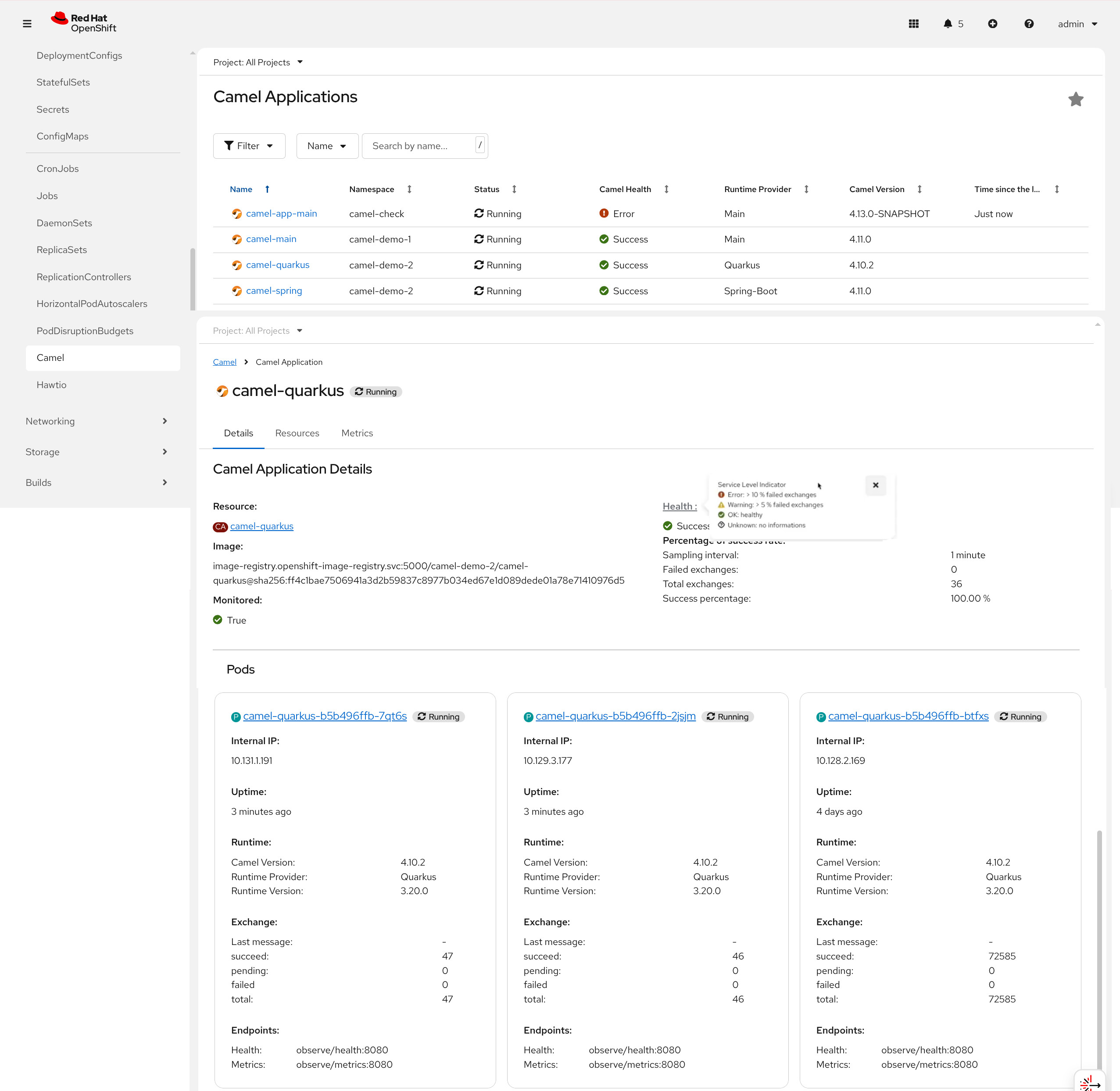
The release also adds full support for the Artemis Plugin in HawtIO, which enables direct management of AMQ brokers.
For more details, visit the What’s new in Red Hat build of Apache Camel 4.14 article.
Workshop: A day in the life of Camel Developer
Explore the newly refreshed Apache Camel workshop on the Red Hat Demo Platform, now available for partners and customers. This hands-on experience enables you to develop expertise in Apache Camel and the Kaoto graphical interface by building a multi-system messaging hub - including Discord - from the ground up. You will implement a plug-in architecture using Apache Kafka and OpenShift Data Foundation, all within a low-code environment in Red Hat Dev Spaces. It is a unique opportunity to see these powerful technologies in action through an intuitive and pleasant learning path. Do not miss your chance to try it out and transform your integration strategy!
Try it yourself or ask your account manager to organize a workshop: https://catalog.demo.redhat.com/catalog?item=babylon-catalog-prod/openshift-cnv.dil-camel3-cnv.prod
Articles
Dive into the latest developments within Apache Camel 4 through our curated selection of articles.
Camel Dashboard Now Compatible with OpenShift 4.20
Gaëlle Fournier covers the latest release of the Camel dashboard as well as HawtIO online plugins, now compatible with OpenShift 4.20.
Simple LLM Integration with Camel OpenAI Component
Ivo Bek introduces the new camel-openai component in Apache Camel 4.17, designed to provide native integration with OpenAI and compatible APIs for chat completion. He explores key features such as structured output using JSON schemas and streaming capabilities, and demonstrates a practical Personal Identifiable Information (PII) redaction use case to illustrate how developers can build sophisticated AI-powered integration flows with minimal code.
Claus Ibsen, Federico Mariani, and Gregor Zurowski outline the new features and improvements in Apache Camel 4.17, highlighting significant updates to Camel JBang such as enhanced remote debugging and history tracking. This release also brings Spring AI support including chat, tools, and vector stores alongside new components for IBM Watson, Stripe, and improved observability with OpenTelemetry metrics.
Claus Ibsen reflects on the Apache Camel project's activity in 2025, providing a statistical summary that highlights 25 Camel Core and Spring Boot releases, 18 Camel Quarkus releases, and significant community engagement with over 4,400 commits from 144 individual committers.
The Kaoto Team announces the release of version 2.9, delivering enhancements to the DataMapper and Canvas UX to improve the visual integration design experience. This update introduces a more intuitive data transformation workflow with improved document visualization, field occurrence indicators, and a new "Wrap-with-If" action. Additionally, the release features a new tree-like Integrations view for better workspace management, including new run and export commands for folders, alongside UI improvements such as route auto-startup indicators and updated EIP icons.
Making Apache Camel Documentation Accessible to LLMs
Federico Mariani introduces the implementation of the llms.txt specification on the Apache Camel website, designed to make documentation easily accessible to Large Language Models (LLMs) and AI coding agents. He explains how the site now exposes a standardized file that allows tools like Claude Code and GitHub Copilot to discover and consume over 5,000 markdown-optimized pages for better code suggestions and troubleshooting. The post also details how this process is automated within the build pipeline, ensuring the content remains accurate and maintenance-free.
Manage your Camel fleet on OpenShift
Pasquale Congiusti introduces the Camel dashboard, a targeted solution for visualizing and monitoring large fleets of Camel applications on OpenShift. The article details how to use the new camel-observability-services component to centralize health checks and Service Level Indicators (SLIs), enabling operators to quickly identify failed exchanges or idle workloads through a unified graphical interface.
The Kaoto Team announces the release of Kaoto 2.8, marking a major step forward in Data Mapper maturity with extensive XML Schema support and enhanced visual feedback. This release introduces advanced schema features, including support for xs:extension and xs:restriction, alongside canvas improvements such as contextual menus and keyboard shortcuts for faster step management.
Claus Ibsen and Pasquale Congiusti outline the new features in Apache Camel 4.16, highlighting the ability to add maintenance notes to EIPs and the inclusion of telemetry tracing information directly in exchange headers. This release also brings updates to Camel JBang, including better detection of kamelets in dynamic EIPs, and the introduction of new components for IBM Watson and Post-Quantum Cryptography.
Demos and Presentations
See Apache Camel 4 in action in the following new demos and presentations:
- MCP in Action: Connecting AI to Enterprise Systems (Camel, Wanaku.ai, Quarkus/Langchain4j) by Zineb Bendhiba
- Enterprise Integration Patterns (EIP) | What is Apache Camel and how to use it? - Jasvinder Singh Saggu provides a great introduction to enterprise integration patterns and Apache Camel.
Upcoming
Here’s a look at our key planned milestones and where you can connect with us at upcoming conferences:
January
27 Jan - Orchestrating intelligence (online, in Portuguese) on Quarkus Club YouTube about Camel + Quarkus + Wanaku
April
- 20 Apr - JCON Europe
- AI-driven unstructured data extraction using Apache Camel and LangChain4J by Alexandre Gallice
May
- Red Hat build of Apache Camel 4.18 GA
- 4-7 May - IBM Think 2026 in Boston
- 11-14 May - Red Hat Summit 2026 in Atlanta

