Redhat Developers  Logo
  • AI

    Get started with AI

    • Red Hat AI
      Accelerate the development and deployment of enterprise AI solutions.
    • AI learning hub
      Explore learning materials and tools, organized by task.
    • AI interactive demos
      Click through scenarios with Red Hat AI, including training LLMs and more.
    • AI/ML learning paths
      Expand your OpenShift AI knowledge using these learning resources.
    • AI quickstarts
      Focused AI use cases designed for fast deployment on Red Hat AI platforms.
    • No-cost AI training
      Foundational Red Hat AI training.

    Featured resources

    • OpenShift AI learning
    • Open source AI for developers
    • AI product application development
    • Open source-powered AI/ML for hybrid cloud
    • AI and Node.js cheat sheet

    Red Hat AI Factory with NVIDIA

    • Red Hat AI Factory with NVIDIA is a co-engineered, enterprise-grade AI solution for building, deploying, and managing AI at scale across hybrid cloud environments.
    • Explore the solution
  • Learn

    Self-guided

    • Documentation
      Find answers, get step-by-step guidance, and learn how to use Red Hat products.
    • Learning paths
      Explore curated walkthroughs for common development tasks.
    • Guided learning
      Receive custom learning paths powered by our AI assistant.
    • See all learning

    Hands-on

    • Developer Sandbox
      Spin up Red Hat's products and technologies without setup or configuration.
    • Interactive labs
      Learn by doing in these hands-on, browser-based experiences.
    • Interactive demos
      Click through product features in these guided tours.

    Browse by topic

    • AI/ML
    • Automation
    • Java
    • Kubernetes
    • Linux
    • See all topics

    Training & certifications

    • Courses and exams
    • Certifications
    • Skills assessments
    • Red Hat Academy
    • Learning subscription
    • Explore training
  • Build

    Get started

    • Red Hat build of Podman Desktop
      A downloadable, local development hub to experiment with our products and builds.
    • Developer Sandbox
      Spin up Red Hat's products and technologies without setup or configuration.

    Download products

    • Access product downloads to start building and testing right away.
    • Red Hat Enterprise Linux
    • Red Hat AI
    • Red Hat OpenShift
    • Red Hat Ansible Automation Platform
    • See all products

    Featured

    • Red Hat build of OpenJDK
    • Red Hat JBoss Enterprise Application Platform
    • Red Hat OpenShift Dev Spaces
    • Red Hat Developer Toolset

    References

    • E-books
    • Documentation
    • Cheat sheets
    • Architecture center
  • Community

    Get involved

    • Events
    • Live AI events
    • Red Hat Summit
    • Red Hat Accelerators
    • Community discussions

    Follow along

    • Articles & blogs
    • Developer newsletter
    • Videos
    • Github

    Get help

    • Customer service
    • Customer support
    • Regional contacts
    • Find a partner

    Join the Red Hat Developer program

    • Download Red Hat products and project builds, access support documentation, learning content, and more.
    • Explore the benefits

Getting MusicStore to run on RHEL

June 2, 2016
Don Schenck
Related topics:
.NETLinux
Related products:
Red Hat Enterprise Linux

    The ASPNET Music Store application was built to demonstrate MVC and Entity Framework running on the newest .NET platform, including .NET Core. If you visit the link, you'll see that various platforms are mentioned, including Mono. However, you'll also notice that the instructions are dated: references to dnx and dnu are throughout the README file.

    This blog post will show how to bring MusicStore up-to-date and run it on Red Hat Enterprise Linux (RHEL).

    (If you don't have RHEL, you can get your zero-dollar developer's edition of RHEL)

    The first step is to download, or fork and clone, the MusicStore repo from github. In my case, I forked the repo to my github account and then ran git clone https://github.com/donschenck/MusicStore.git so I'd have a copy of the source code.
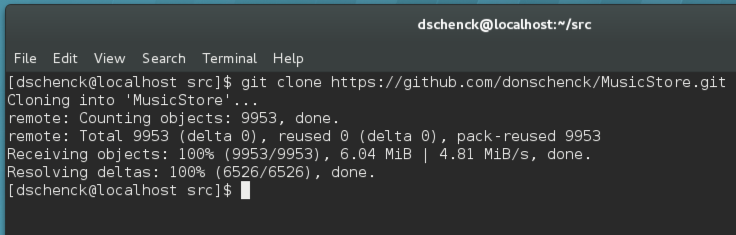
    At this point, I want to move into the directory and run dotnet restore. This will pull down the referenced libraries (DLLs) used by the project.

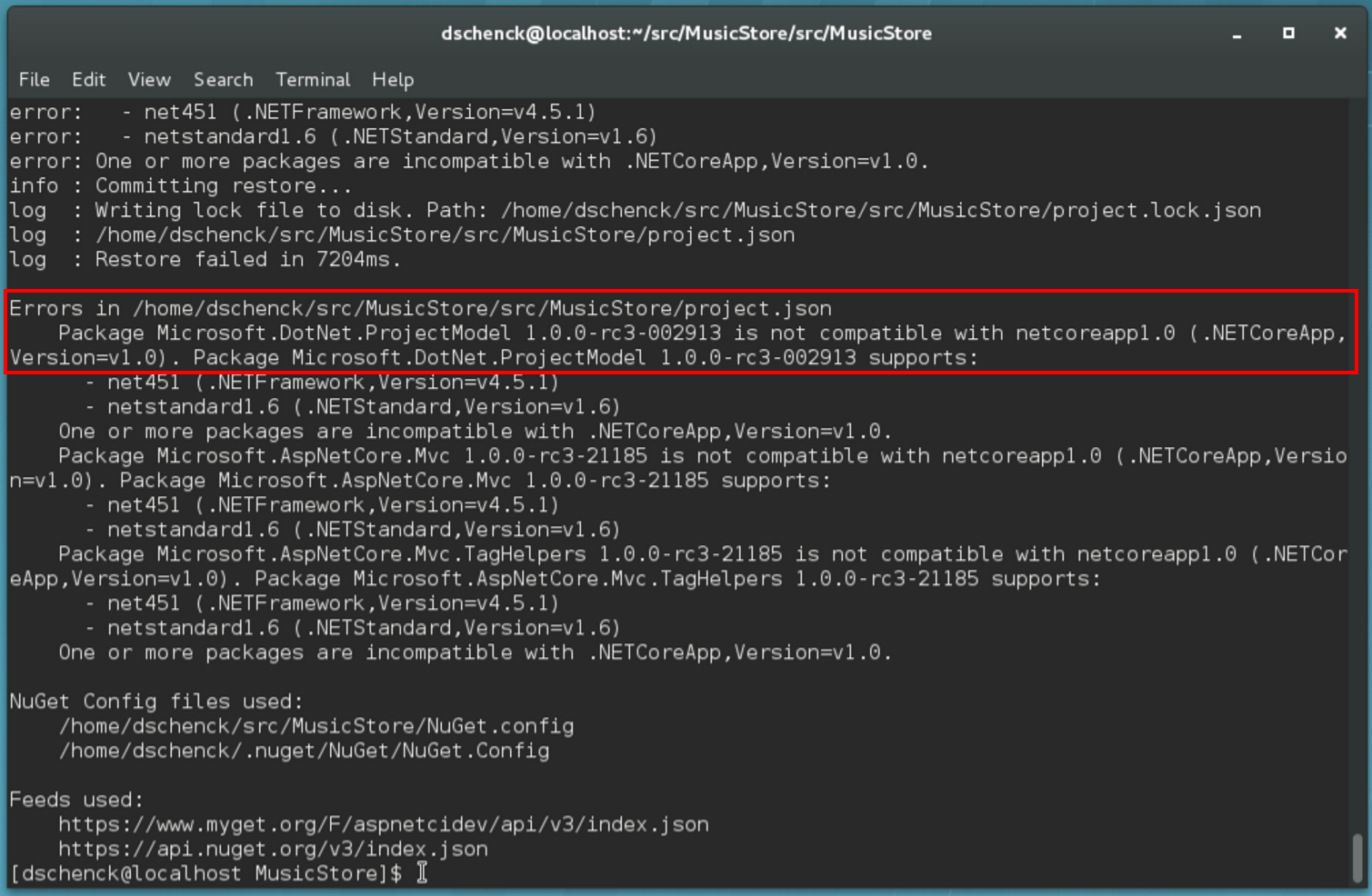
    But wait; it didn't work. There's an error. For some reason, it's referencing RC3 bits, where I want only the RC2 bits. Perhaps there's a release targeted only to RC2. I run git tag --list and, sure enough, there it is:
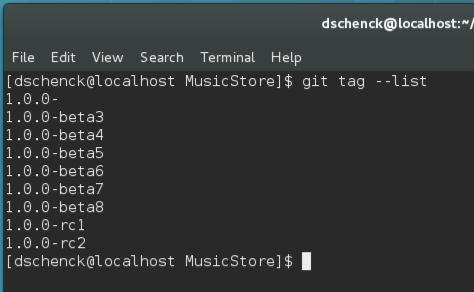
    The next step is to check out the tag, which will make only the RC2 code available to me. This is done with the command git checkout tags/1.0.0-rc2.

    Now I can run dotnet restore and can expect successful results:
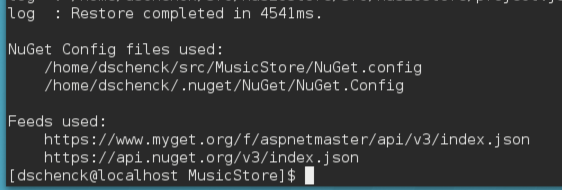
    Success! Now all I need to do is run dotnet build and I'll have the binaries necessary to run this web site:
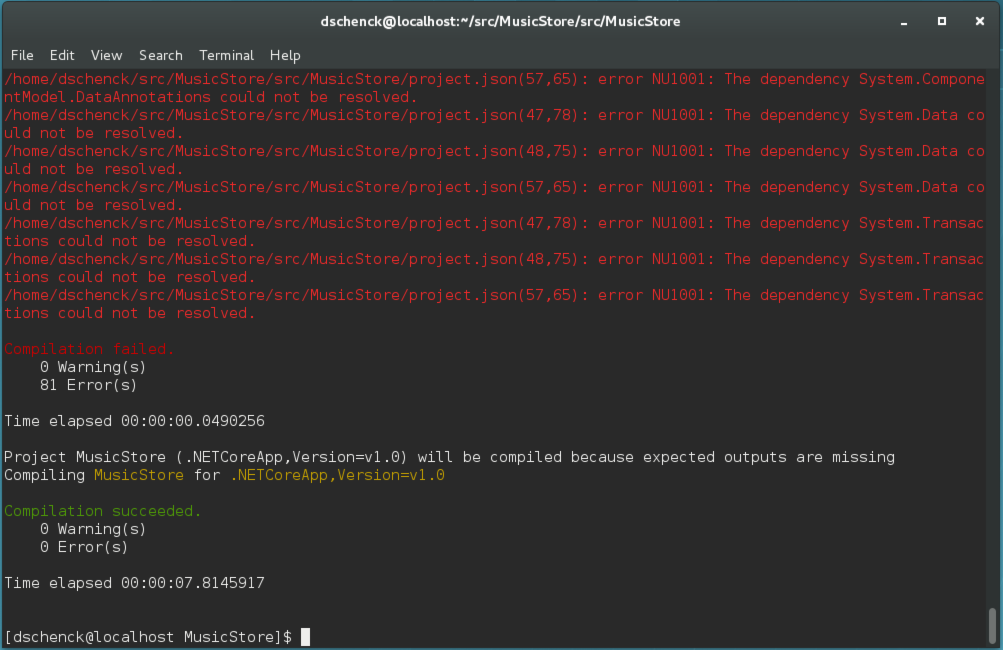
    Wait. What's all that red, error message stuff? Let's scroll up and see if we can find what's going on:
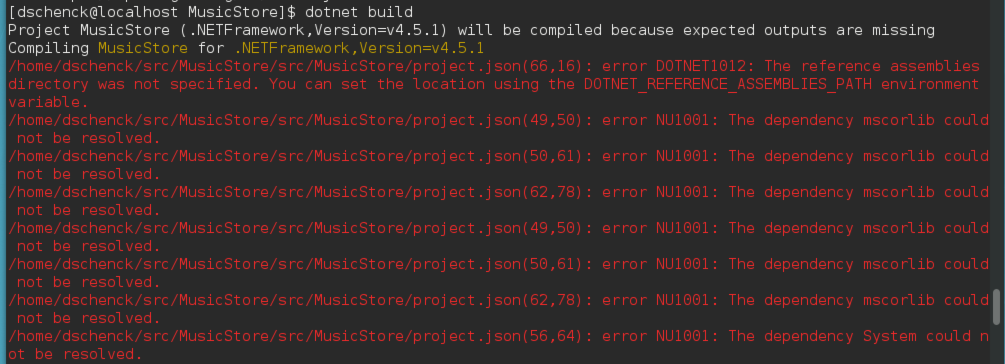
    There is it. It's attempting to compile this program for framework v4.5.1, which is a framework that works on Windows, but not Linux. Remember; we want .NET Core 1.0. If only there was a way to specify the framework we're targeting when calling the build command.

    And, alas, there is! Running dotnet build --framework netcoreapp1.0 will skip the v4.5.1 build and build for .NET Core 1.0 only:
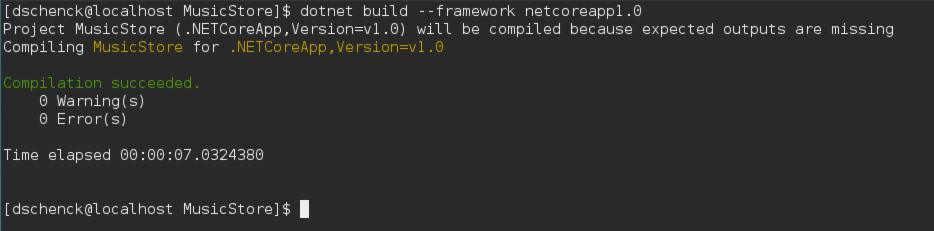
    Now we finally have the bits we need (by the way, they're at bin/Debug/netcoreapp1.0/MusicStore.dll). We can run dotnet run to fire up the web server...

    ...and point our browser to http://localhost:5000 and voilà:
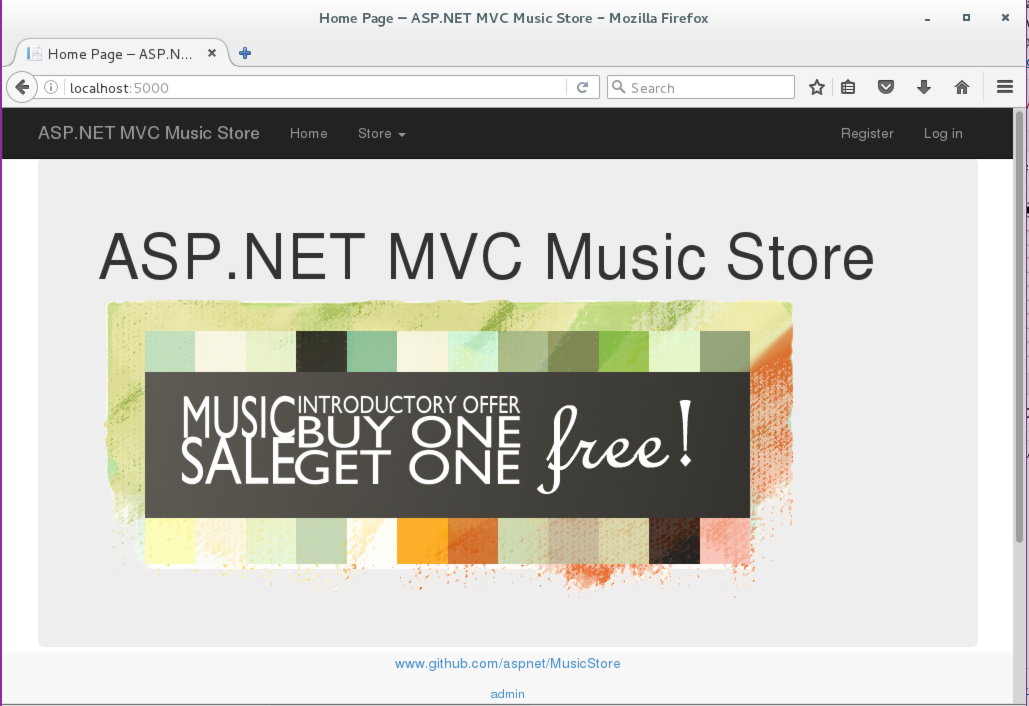
    So, even though the MusicStore github repo mentions dnx and dnu and seems to favor not-RHEL platforms, we've seen how we can easily tweak the code to run on RHEL.

    Now, wouldn't it be cool to be able to debug this code from, say, within an IDE? Check back soon, because that's my next blog post.

    All The Best,

    -- Don

    For additional information and articles on .NET Core visit our .NET Core web page for more on this topic.

    Last updated: March 15, 2023

    Recent Posts

    • Optimizing distributed AI inference: Advanced deployment patterns

    • Beyond regex: Harvesting security logic with LLMs

    • Build a Red Hat Enterprise Linux EUS image with image-builder CLI

    • Connect EvalHub to protected production model servers

    • Building a custom Red Hat Enterprise Linux kernel for NVIDIA DGX Spark

    Red Hat Developers logo LinkedIn YouTube Twitter Facebook

    Platforms

    • Red Hat AI
    • Red Hat Enterprise Linux
    • Red Hat OpenShift
    • Red Hat Ansible Automation Platform
    • See all products

    Build

    • Developer Sandbox
    • Developer tools
    • Interactive tutorials
    • API catalog

    Quicklinks

    • Learning resources
    • E-books
    • Cheat sheets
    • Blog
    • Events
    • Newsletter

    Communicate

    • About us
    • Contact sales
    • Find a partner
    • Report a website issue
    • Site status dashboard
    • Report a security problem

    RED HAT DEVELOPER

    Build here. Go anywhere.

    We serve the builders. The problem solvers who create careers with code.

    Join us if you’re a developer, software engineer, web designer, front-end designer, UX designer, computer scientist, architect, tester, product manager, project manager or team lead.

    Sign me up

    Red Hat legal and privacy links

    • About Red Hat
    • Jobs
    • Events
    • Locations
    • Contact Red Hat
    • Red Hat Blog
    • Inclusion at Red Hat
    • Cool Stuff Store
    • Red Hat Summit
    © 2026 Red Hat

    Red Hat legal and privacy links

    • Privacy statement
    • Terms of use
    • All policies and guidelines
    • Digital accessibility

    Chat Support

    Please log in with your Red Hat account to access chat support.