
Article
Improved navigation in the OpenShift 4.5 Developer perspective
Red Hat OpenShift 4.5 brings a more streamlined and customizable navigation experience—based on user feedback—in the web console's Developer perspective.
Red Hat OpenShift 4.5 brings a more streamlined and customizable navigation experience—based on user feedback—in the web console's Developer perspective.

Learn how to build, manage, and load balance clustered environments using subclusters with the Apache HTTP Server mod_cluster module and JBoss EAP.

Are you productive when working on your microservices-based project, or is your laptop on fire? Learn why testing on production matters and how to do it.

Install Apache Tomcat from a Docker image, and then use it to deploy and manage a Java web application on Red Hat OpenShift.

Build Java applications that run inside containers in a secure, stable, and tested manner in Red Hat Enterprise Linux 8.2 with the Red Hat build of OpenJDK.

Discover how GraalVM adding DWARF debug information to its Linux images enables effective source-level Java-native image debugging through gdb.

Securing distributed software systems might seem more complex than ever, but the working principles of good software security haven't really changed.

Check out the Open Data Hub team's plans for upcoming releases: making Kubeflow 1.0 available on Red Hat OpenShift, improving Kubeflow CI, and more.
Java & containers: What I wish I knew before I used it | DevNation Tech Talk

Get started using MicroProfile 3.3 APIs while also supporting Jakarta EE 8 with Red Hat JBoss Enterprise Application Platform expansion pack 1.0.

Learn how to install Red Hat JBoss Enterprise Application Platform (JBoss EAP) XP 1.0.0.GA and enable Eclipse MicroProfile support on JBoss EAP.

In part one of this series, learn how to implement multitenancy with a database using the Jakarta Persistence API (JPA) running on WildFly.

Learn how to install CodeReady Workspaces in a restricted Red Hat OpenShift 4 environment by pulling images into a private registry.

A quick introduction to Apicurio Registry 1.2.2's new web-based UI and Operator, which make it easier to store and retrieve service artifacts.

Learn how IBM Security Verify provides advanced authentication to Red Hat SSO environments while also balancing id-less and password-less experiences.

This video walks you through the "why" and "how" of Java in containers, from image sizes to the development and deployment processes.

Learn how to quickly and easily create a custom Jenkins container by aggregating readily available containers in a pod template.

To build and deliver a Go RESTful service using OpenShift Pipelines, read this pre-tutorial and then follow the OpenShift Pipelines Workshop tutorial.
odo: Iterative container-based development made simple | DevNation Tech Talk

Red Hat will release a Universal Base Image for Node.js 14 for Red Hat OpenShift and Red Hat Enterprise Linux, but this article gets you started today.

Kubernetes made easy with OpenShift | DevNation Tech Talk

Explore Open Liberty 20.0.0.5: Failover EJB persistent timers, JAAS classes from resource adapters, logs to JSON or dev, and omit JSON fields.

Discover 10 design patterns from the Kubernetes Patterns book that will help you follow basic Kubernetes concepts and design Kubernetes-based applications.

This blog explores concepts and techniques around automated API testing of business rules and processes deployed in a KIE Server.
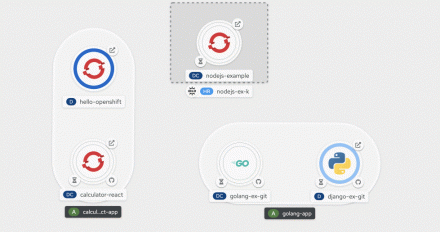
Explore the new application deployment features in OpenShift 4.4 to the Developer Catalog, plus the Helm 3 GA, and an add context option in Topology.

Build here. Go anywhere.
We serve the builders. The problem solvers who create careers with code.
Join us if you’re a developer, software engineer, web designer, front-end designer, UX designer, computer scientist, architect, tester, product manager, project manager or team lead.
 Ask AI