
Article
Role-based access control behind a proxy in an OAuth access delegation
Find out how NGINX can act as a reverse proxy server for back-end applications, which can be hosted on an enterprise application server.
Find out how NGINX can act as a reverse proxy server for back-end applications, which can be hosted on an enterprise application server.

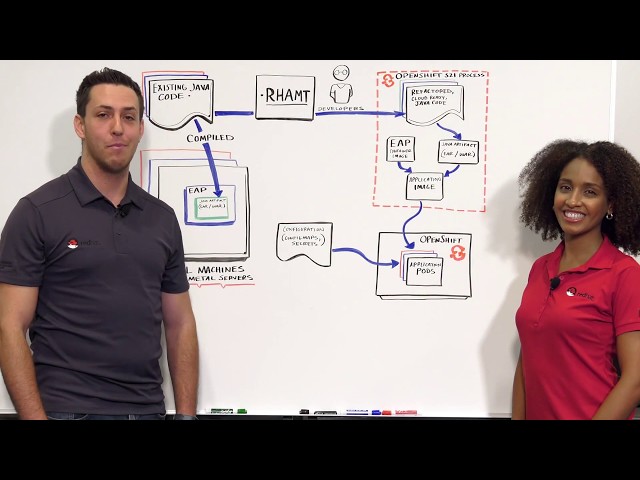
Moving Java applications to Red Hat OpenShift can seem daunting, but it can be worthwhile.

Learn how to set up your Dev Environment with EAP, install, configure and verify EAP and build your first JBoss EAP application.

Open Liberty 19.0.0.12 provides support for MicroProfile 3.2, allowing users to provide their own health check procedures and monitor microservice applications easily with metrics.

We cover the highlights of the latest JBoss Tools 4.13.0 and Red Hat CodeReady Studio 12.13 for Eclipse 2019-09 and show how to get started.

Watch this live coding session to learn more about Quarkus and see to make your APIs start in a matter of milliseconds and consume tiny amounts of memory.

Rhuan Rocha shares opinions about how Enterprise JavaBeans (EJB) fits into the new cloud-native world.

The latest update to Red Hat Runtimes has arrived and now supports Eclipse Vert.x 3.8.1; learn about the new features here.

In this video, Burr Sutter discusses the key microservices architecture principles and explains how and why to evolve to this approach.

We look at what to expect from Jakarta EE 8 -- the latest iteration of Java EE.


See how the keycloak-saml adapter can be configured in the place of Picketlink to enable SAML-based authentication with a third-party identity provider.

An emoji is a Unicode character with a value larger than a Java char can handle. This article shows you how emojis work in Java.
Born of the browser wars of the 1990s, JavaScript has gone from a simple scripting language to be the most important ecosystem of the development world.

JBoss Tools 4.12.0 and Red Hat CodeReady Studio 12.12 for Eclipse 2019-06 are here; we cover the highlights and show how to get started.

This article explains how the use of lightweight threads, supported by Project Loom, can help you write scalable code in Java.

In this article, I’ll show performance comparisons for building and running a Java application before and after using Quarkus.
This article describes some of the problems that may be encountered when migrating a Java application to Quarkus and how to resolve them.

Updating Drools, the world's most popular open source rule engine, to make it part of the cloud and serverless revolution.

This article gives a quick tour of how to use the new MicroProfile Starter (Beta) site to generate, download, and build a Maven-based MicroProfile project with just a few clicks.
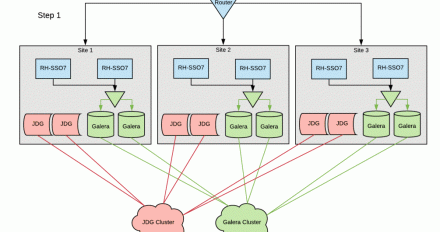
This article describes how Red Hat Single Sign-On uses open source technology to provide a true multi-site single sign-on authentication platform capable of handling next-generation applications.

Second half of a walk-through using Red Hat CodeReady Workspaces to develop a Java EE application in the cloud using JBoss EAP. It shows how to configure a workspace, use JBoss EAP for deploying and debugging, and how to create a factory so that the development environment can be shared with others who need to collaborate on the project.
Walkthrough of using Red Hat CodeReady Workspaces to develop a Java EE application using JBoss EAP. It gives details on how to bring your own tools, configure your workspace with helpful commands for JBoss EAP, and share everything for easily onboarding new developers.

This article describes in detail how to integrate a remote Red Hat AMQ 7 cluster on a Red Hat JBoss Enterprise Application Platform 7 server, including the different configurations and components and some tips to improve your message-driven beans (MDB) applications.

Build here. Go anywhere.
We serve the builders. The problem solvers who create careers with code.
Join us if you’re a developer, software engineer, web designer, front-end designer, UX designer, computer scientist, architect, tester, product manager, project manager or team lead.