Video
JBoss@JavaOne 2014: Going Native: Bringing FFI to the JVM - Charles Nutter
JBoss@JavaOne 2014: Going Native: Bringing FFI to the JVM - Charles Nutter
JBoss@JavaOne 2014: Going Native: Bringing FFI to the JVM - Charles Nutter

In this mini-session we will present Ceylon's fast growing ecosystem. Ceylon is a new modern JVM and JSVM language with a nice blend of functional and object, modularity and great tooling, designed first and foremost for team work.

JBoss@JavaOne 2014: Test ride of the Arquillian Universe - A. Knutsen & B. Majsak
George and Lincoln will demonstrate the power of JBoss Forge, while creating an end-to-end Java EE application in mere minutes.
CDI has proven itself to be a great asset for Java. The many features it provides (dependency injection, contextual lifecycle, configuration, interception, event notification, and more) and the innovative way it provides them (through the use of meta-annotations) explain its rapid adoption. This session reviews the features introduced in CDI 1.1 and 1.2 and discusses improvements planned for CDI 2.0.

Mircea Markus will talk about ways of scaling out database systems using the Infinispan data grid.
Are you a Java developer and want to develop a mobile app that connects to a secured Java EE back end, but you don’t know where to start? This session is tailored for you. This live coding session, driven by Java and using a familiar development environment, goes step by step through building a complete mobile, hybrid, multiplatform application ready to be distributed on different vendors’ stores, such as the Apple store or Google Play. Starting from scratch, the tutorial takes you through building a simple Java EE application and, from there, scaffolding a mobile web client and turning it into a native app, including Android and iOS. This is an in-depth session in which the attendees will learn concretely, and without using hipster tools, how to enter the mobile world.
Java is an object-oriented kingdom where ORMs have flourished. This episode explores key myths and preconceptions about ORMs in a NoSQL and polyglot era. Join this journey to challenge these myths and find out if they are busted, plausible, or confirmed.

(Part 1)Containers are enabling developers to package their applications in new ways that are portable and work consistently everywhere: on your machine, in production, in your data center, and in the cloud. And Docker has become the de facto standard for those portable containers in the cloud. This lab offers developers an intro-level hands-on session with Docker, from installation to exploring Docker Hub, to crafting their own images, to adding Java apps and running custom containers. This is a BYOL (bring your own laptop) session, so bring your Windows, OS X, or Linux laptop and be ready to dig into a tool that promises to be at the forefront of our industry for some time to come.
Technical backgrounds to a recent webinar. Learn how to achieve continuous delivery with docker and Java EE. Topics will include: A developer's introduction to docker. Best practices and recipes for docker and Java EE. How to setup a delivery pipeline for a Java EE application running on Red Hat® JBoss® Enterprise Application Platform using docker (live demo). http://www.redhat.com/en/about/events/continuous-delivery-docker-containers-and-java-ee

I talked to Niko about why and how he measured JAX-RS non-blocking performance for a customer and how he implemented everything based on WildFly.

Yesterday evening I had the pleasure to talk to Görkem Ercan (@gorkemercan, blog) who is a Toronto based software engineer with Red Hat. has tens of years of experience working on software projects with different technologies ranging from enterprise and mobile Java to Symbian and Qt C++. He specializes on providing tools and APIs for developers. He works in the JBoss Developer Studio (JBDS) and is focused on the Cordova tooling. After my first experiences with mobile and such with the Devoxx keynote team, I thought it might be a good idea to look into what JBDS offers and if he can get me excited about it. I can tell you one thing: He made it.

Antoine Sabot-Durand is a senior software Engineer at Red Hat. He is the co-spec lead of the CDI specification and working on the reference implementation Weld.
In 2003 the Java EE ecosystem received a gift with extensions: JCA 1.5 support in J2EE 1.4. However, it wasn’t until Java EE 5, in 2006, that extensions were really talked about. In Java EE 5, we received Contexts and Dependency Injection (CDI). Along with the namesake of the specification, extensions were introduced. Together we have the ability to extend the platform to do whatever we need. The possibilities of these extensions are limited only by your imagination. You’ve heard about CDI and the extensibility of Java EE 6 and seen enough to pique your curiosity. This session will sate that curiosity and give you enough information to build great extensions for your application and business.

Containers are enabling developers to package their applications in new ways that are portable and work consistently everywhere: on your machine, in production, in your data center, and in the cloud. And Docker has become the de facto standard for those portable containers in the cloud. This lab offers developers an intro-level hands-on session with Docker, from installation to exploring Docker Hub, to crafting their own images, to adding Java apps and running custom containers. This is a BYOL (bring your own laptop) session, so bring your Windows, OS X, or Linux laptop and be ready to dig into a tool that promises to be at the forefront of our industry for some time to come.
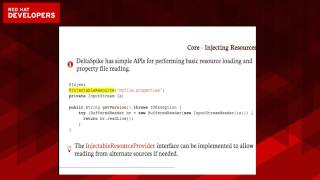
CDI portable extensions are among the greatest features of Java EE, enabling the platform to be extended in a clean and portable way. But allowing extension is just part of the story. CDI opens the door to a whole new ecosystem for Java EE, but it’s not the role of the specification to create these extensions. Apache DeltaSpike is the project that leads this brand new ecosystem by providing useful extension modules for CDI applications as well as tools to ease the creation of new ones. This session starts by presenting the DeltaSpike toolbox and shows how it helps you develop for CDI. Then it describes the major extensions included in DeltaSpike, including “configuration,” “scheduling,” and “data.”
In the 1990s, the World Wide Web was just a collection of static pages with zero interactivity. Today the "new" web has a plethora of emerging frameworks and tools, simply increasing the number of threats. The complexity of software development has also grown with the need for things like single-sign-on support, LDAP integration, social identity providers, and SAML v2.0 authentication. Delegating the security logic to an external framework is the way to ensure some best practices. This technical tutorial guides the participants through all the common vulnerabilities and how to secure their applications in practice with Keycloak. The tutorial is meant for Java EE developers and has a really low learning curve.
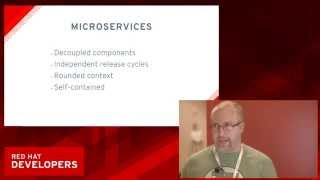
So you've heard about the Netflix OSS coolness, but you're still in a Java EE centric world. Come find out how easy it can be to take advantage of Ribbon for client side load balancing across JAX-RS services! Bringing together Java EE and Netflix OSS allows us to build best of breed microservices for the enterprise without throwing away all the Java EE knowledge from the last decade.

Apache Lucene is the de facto standard open source library for Java developers implementing full-text-search capabilities. Although it’s thriving in its field, it is rarely mentioned in the scope of Java EE development. This session shows the features that make many developers love Lucene, with some concrete examples of common problems it elegantly solves. You’ll see some best practices for using it in a Java EE stack and how some popular OSS projects such as Hibernate ORM (JPA provider), WildFly (Java EE runtime), and Infinispan (in-memory data grid, JCache implementer) actually provide great Lucene integration capabilities and how they can help resolve some modern challenges such as deployment in the cloud.
Are you a Java developer and want to develop a mobile app that connects to a secured Java EE backend, but you don’t know where to start? This session is tailored for you. This hands on session, using a familiar development environment, goes step by step through building a complete mobile, hybrid, multiplatform application. Starting from scratch, the tutorial takes you through building a simple Java EE application and, from there, scaffolding a mutliplatform mobile client by using Cordova. Finally we will show how to implement sending Push Notifications from the backend to be received on the mobile client. This is an in-depth session in which the attendees will learn concretely, and without using hipster tools, how to enter the mobile world.
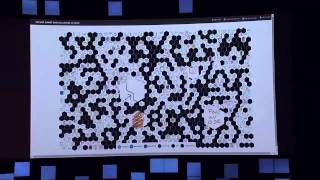
For the 2015 demonstration, we really wished to stretch ourselves by creating multiple applications that the audience was to touch. To illustrate IoT (Internet of Things), we specifically fielded several hundred bluetooth beacons and several Raspberry Pi-based sensors/scanners to demonstrate how to track movement inside of a physical space (where GPS is not appropriate). We combined this technology with a mobile application (based on the announced Red Hat Mobile Application Platform) so the moving objects (people) could see their current status, their arrivals/departures from a particular room. Also, via this same mobile application, we invited the audience to submit a finger drawn sketch to claim one of 1000+ containers we launched live on stage via Openshift (based on Docker & Kubernetes)
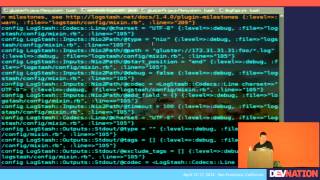
Recent developments in Java and Gluster have given us a new way to connect these two technologies: Java 7 paved the way for file system provider plug-ins, while GlusterFS 3.4 provides a new client software interface. This session introduces glusterfs-java-filesystem, a new open source project that connects applications running on the Java platform to GlusterFS storage. Join Louis Zuckerman, founder of the glusterfs-java-filesystem project, for a deep dive into: * What it means to access GlusterFS directly from Java, and why it matters. * Writing and testing a Java file system provider. * Using file system provider plug-ins in Java applications. * Accessing GlusterFS from other languages on the Java platform (jython, jruby, scala, clojure, groovy, etc.). The presentation includes slides, a live demonstration, and Q and A. After attending the session, you'll be able to use GlusterFS in your own Java platform applications.
The Java EE 7 platform has four new components (WebSocket, JSON-P, batch, and concurrency), three that are significantly updated (JAX-RS 2, JMS, and EL), and several others that bring significant changes to the platform. As you can imagine, a lot of new functionality has been introduced in the platform. In this fast-paced session, you will learn about 50 new features introduced in the Java EE 7 platform. @ClientEndpoint, chunk-style batch processing, @FlowScoped, @AroundConstruct, @JMSDestinationDefinition, and @Transactional are some of features the presentation covers. It explains each feature with a code snippet and provides details on where and how you can use it in your applications.
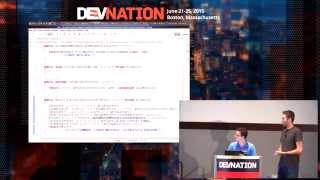
Automating tedious user tasks can increase productivity and save you money. While there are numerous tools for the continuous integration of software, many developers still rely on hand-made shell scripts, clumsy integrated development environment (IDE) wizards, or endless Google searches for generating companion project artifacts like dependency-management settings, database and ORM configuration, simple CRUD services, test-environment setup, or deploying into the cloud. JBoss Forge fills that niche in the software-development life cycle. JBoss Forge offers: A simple, modular, easy-to-grasp model for developing pluggable components that can fit in any phase of a programmer's daily life. The ability to use any programming language, database, or server you choose. An easy, testable way to define your own tools, wizards, and extensions. In this session, you will learn about JBoss Forge 2, how to extend it, and how to make commands that run on the native Shell and your favorite IDE without any code changes.
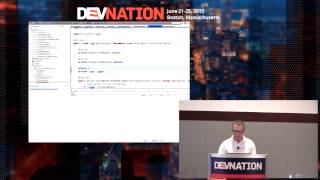
During this session, we'll demonstrate how you can be productive when building Java EE+ HTML5 applications in Eclipse with JBoss Developer Studio. We'll show you how to: Use the tools to scaffold from from an existing database using JPA. Expose the entities via JAX-RS with the integrated JBoss Forge tooling. Display the content in the browser using HTML5 + AngularJS. Automatically refresh the page templates thanks to the LiveReload integration. If time and our network allows, we'll deploy the application on OpenShift, without leaving the IDE. You should expect (almost) no slides, with an emphasis on coding and talking.

Build here. Go anywhere.
We serve the builders. The problem solvers who create careers with code.
Join us if you’re a developer, software engineer, web designer, front-end designer, UX designer, computer scientist, architect, tester, product manager, project manager or team lead.