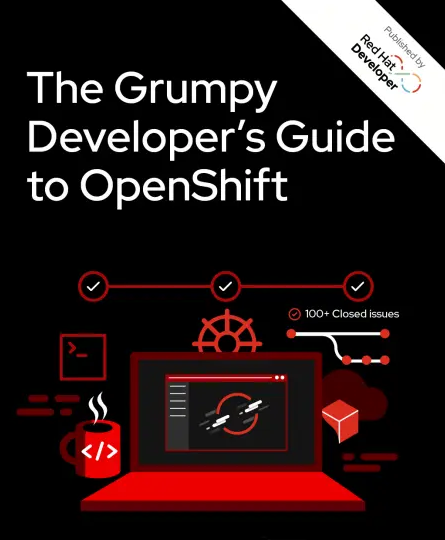
The Grumpy Developer's Guide to OpenShift
Overview
Have you ever wanted to build an application on Red Hat OpenShift, but didn't know where to begin? Whether you're a seasoned developer or just starting out, The Grumpy Developer's Guide to OpenShift will fast-track your path to success and help you get straight to coding.
This hands-on, no-nonsense guide offers practical recipes and time-saving tips that get you from first deploy to advanced CI/CD in no time.
- Get productive fast with essential tools, commands, and deployment workflows tailored for developers—no Kubernetes expertise required.
- Build smarter applications using OpenShift's developer-friendly features like Source-to-Image builds, environment injection, and persistent storage.
- Get hands-on recipes for CI/CD pipelines, observability, scaling, and infrastructure configuration.
- Explore advanced capabilities like GitOps with Argo CD, serverless architecture with Knative, and managing legacy virtual machines.
Written by a grumpy developer so you don't have to be one
Armed with decades of experience and a healthy dose of cynicism, Ian Lawson explains the how and the why behind the tooling to help you cut through the clutter of modern development. OpenShift makes it harder to be grumpy, and this book shows you how.
Excerpt
It's easy to get mired in the cognitive overload of modern day development. This is where your tools should help you, rather than hinder you (looking at you, Maven and POM files).
One of the best side effects of how Kubernetes and OpenShift work is that OpenShift, once you understand the nature of the object model, makes sense from a developer perspective. The fact that OpenShift can act as the entire platform—from build, deployment, agile configuration, framework control, the works—means that we can focus on our code, on writing something to do what we want it to do, and not on bending frameworks, wasting brain power on understanding overly complex tooling, and all the other modern-day pitfalls of working at the cutting edge.
This book was written to fast-track developers into an OpenShift way of thinking. Its goal is not to rewrite how you create your gems, but to show you the tips, tricks, shortcuts, and vast functionality you get out of the box with an OpenShift instance—purely from the developer's viewpoint.
Related E-books