This 95th edition of the Kafka Monthly Digest covers what happened in the Apache Kafka community in December 2025. We will also look back at some of the milestones the Apache Kafka project and community reached over the past year, and what's to expect next.
For last month’s digest, see Kafka Monthly Digest: November 2025.
Releases
There are 2 releases in progress:
4.2.0
The release process for Kafka 4.2.0 continued. Code freeze happened on December 10. We are now in the stabilization period that typically lasts around 4 weeks. You can find the release plan in the wiki.
3.9.2
The release was slightly delayed to include the switch to a new lz4-java dependency and a change to align topic policy behavior between ZooKeeper and KRaft. You can find the release plan in the wiki.
Kafka Improvement Proposals
Last month, the community submitted 15 KIPs (KIP-1247 to KIP-1261). I'll highlight a few of them:
- KIP-1254: Kafka Consumer Support for Remote Tiered Storage Fetch and KIP-1254: Kafka Consumer Support for Remote Tiered Storage Fetch: These 2 KIPs work together to propose a mechanism for consumers to directly read data that has been tiered from the remote storage system, instead of via a broker. This proposes updating the Fetch API so consumers could retrieve information about the location of the data they want to read, as well as a new pluggable interface for consumers to interact with remote storage systems.
- KIP-1255: Remote Read Replicas for Kafka Tiered Storage: This KIP proposes introducing a new type of broker dedicated to handling reads of data that has been tiered to remote storage. One reason is that tiered segments must be downloaded by brokers before they are served to consumers. These "cold" reads can sometimes have an impact on "hot" reads and write happening at the end of partitions, so having dedicated brokers do this task could potentially help reduce contention and better manage resource usage.
- KIP-1256 Align broker and controller behavior for the Admin.incrementalAlterConfigs API: The Admin client can interact with brokers or controllers depending on how it's configured. The
incrementalAlterConfigs()API can be used on both types of servers but currently behaves slightly differently with each type. This KIP's goal is to make this API behavior consistent across brokers and controllers.
- KIP-1261: Extend Share Group Dynamic Configurations: There are a number of configurations to control the behavior of share groups (queues). At the moment only a subset of them can be configured per share group and dynamically adjusted at runtime, the others are static and used for all share groups. This KIP aims at making all the configuration dynamic and configurable per share group.
Community Releases
I selected releases of some open source community projects:
- Debezium 3.4: Debezium is a Change Data Capture platform. This new release supports the latest Kafka version 4.1.1. It introduces a few new transformations dedicated to handling geo-spacial and timezone data. All the connectors have received many improvements. Before upgrading be sure to check the breaking changes related to IBMi, PostgreSQL, Oracle and SQL Server.
Blogs
I selected some interesting blog articles that were published last month:
Apache Kafka Milestones in 2025
As the year concludes, let's look at some of the milestone Apache Kafka achieved in 2025:
- 4.0.0: This major release marked the completion of the removal of ZooKeeper. From 4.0, Kafka only runs in KRaft mode. This has been a gigantic community effort since this was first proposed in 2019 via KIP-500. In addition, for the first time since Kafka was created, some old APIs have been removed, this allowed some nice code refactoring and simplifications.
- New consumer and Streams rebalance protocol (KIP-848 and KIP-1071): In the past, Kafka introduced improved rebalance protocols such as the incremental protocol in 2.3 and static assignment in 2.4. But this new rebalance protocol is a complete rethink from the ground up of how rebalancing works. The assignment logic used to be done on the client-side, it is now done by the coordinator on the broker side making it more reliable, fully cooperative and incremental.
- New Apache Kafka website: Previously the Apache Kafka website was entirely built and managed in raw HTML. This meant contributors had to edit HTML files directly to add sections, or for example add new blog posts. Over the years several initiatives tried to adopt other markup languages (for example with KAFKA-2967 back in 2015!). Finally this year, via KIP-1133 the website was updated and it is now built with Hugo and uses Markdown making it much simpler to update.
Releases in 2025
The project tried to followed its time-based release plan, but Kafka 4.1.0 required 4 release candidates, so the scheduled shifted a bit. Consequently, it released one major version: 4.0, one minor version: 4.1, as well as three bugfix releases (3.9.1, 4.0.1 and 4.1.2). Figure 1 shows the timeline for these releases.

KIPs in 2025
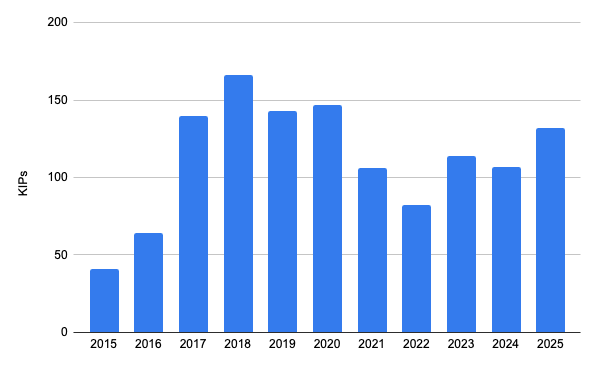
In the past 12 months, the community raised over 137 KIPs. Figure 2 shows how this compares to previous years.
Code and contributors in 2025
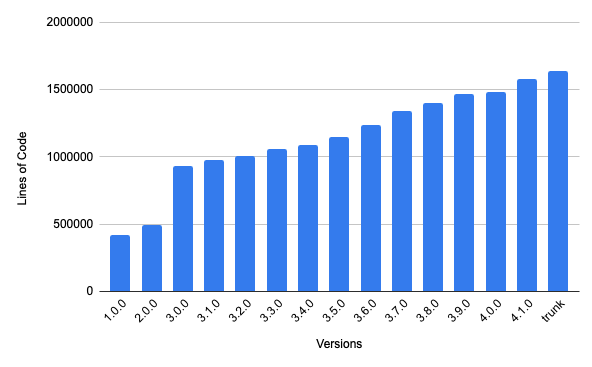
This year over 200 unique contributors made over 2100 commits. Figure 3 shows the size of the codebase, in lines of code, for a few releases.
Committers and PMC in 2025
In 2025, four contributors were invited to become Committers:
- TengYao Chi
- Apoorv Mittal
- Omnia Ibrahim
- PoAn Yang
Likewise, two Committers also joined the Apache Kafka PMC:
- José Armando García Sancio
- Lucas Brutschy
The current roster of Committers and PMC member is available on the Kafka website.
What's coming for Kafka in 2026
Looking back at the predictions I made last year:
- KIP-932: Queues for Kafka: This prediction was spot on! Queues initially released in early access in 4.0. Since then, steady improvements have been made and it reached the preview state in 4.1. The plan is to mark this feature production ready in 4.2.
- KIP-939: Support Participation in 2PC: This prediction was a miss. Work had started adding new APIs to the Producer but since it was not complete, the public API changes have been reverted for now to avoid confusion.
- Removal of Scala code: This (admittedly safe) prediction was correct. A lot more of the Scala code has been rewritten in Java. At the end of 2014, the code base contained over 200000 lines of Scala, it is now down to around 160000 lines so about 10% of the total.
I'll play the game again and here are my predictions for 2026. This is my personal point of view and does not represent Apache Kafka, nor my employer.
- Diskless topics: In 2025, the community proposed 3 competing KIPs, KIP-1150, KIP-1176, KIP-1183, all aiming at reducing inter-broker replication traffic, which can be costly in cloud environment, and extending some of the concepts of tiered storage. After many discussions some of the proposals have converged and merged. I expect the community to make a decision on the solution to pursue and start working on the actual implementation in 2026.
- Cluster mirroring: As Kafka is increasingly used to handle critical data, many users are looking at multi-cluster deployments. MirrorMaker works relatively well but can still remain hard to operate. I expect further improvements and innovations in this area to ease scenarios such as disaster recovery.
- Activity on the Apache Kafka blog: Now that it's easy to update the Apache Kafka website, I think it's possible we'll see some technical posts covering specific features or Kafka concepts on the blog in addition of the release announcements.
To learn more about Kafka, visit Red Hat Developer's Apache Kafka topic page.

