Linux

Video Thumbnail
Video

Red Hat gives Adobe a flexible IT canvas

Red Hat Developer Program

Adobe Systems, a long-time user of Red Hat® Enterprise Linux®, wanted to offer its enterprise customers easy access to sandbox resources to evaluate and prototype solutions using Adobe products. Turning to the cloud, Adobe used Red Hat Enterprise Linux and Amazon Web Services (AWS) to not only deliver a sandbox solution, but also to offer customers a Software- as-a-Service (SaaS) option for deploying Adobe-based solutions. Today, Adobe is using the Red Hat platform and Amazon Web Services to help customers simplify deployment, lower cost of ownership, and accelerate time to value.

Video Thumbnail
Video

2012 Red Hat Summit: Red Hat Enterprise Virtualization overview

Red Hat Developer Program

In this session from the 2012 Red Hat Summit, Andrew Cathrow, product manager, and Chuck Dubuque, product marketing manager for Red Hat Enterprise Virtualization. They discuss Red Hat virtualization, including Red Hat Enterprise Virtualization 3, and the past, present, and future of virtualization technology. Dubuque discusses the current environment, including virtualization competitor VMware, and the opportunity that a second source for virtualization--a open standards source--offers. He then offers details about Red Hat Enterprise Virtualization, including information about management features, hypervisor technology, specVIRT success, and opportunities for cost savings. Cathow then joins in to talk about development of Red Hat Enterprise Virtualization 3 and 3.1, and the growth of the communities surrounding it, including Fedora and oVirt. Cathow highlights features and changes in Red Hat Enteprise Virtualization, including: - OpenJDK requirement for proprietary Oracle JRE is eliminated. - Support for Jasper 4.7 and two new directory servers - Scalability to 160 Virtual CPUs per VM and 2T virtual RAM per VM - enhanced physical to virtual migration (P2V) - Live snapshots - Shared disks - SDK availability - new top-level manager for managing disks - direct LUN access Cathow details many other system and version features, including a overview of key technologies for future versions of Red Hat Enterprise Virtualization and Red Hat Enterprise Linux. He also intermittantly takes questions from the audience. Watch more 2012 Red Hat Summit and JBoss World videos from Red Hat: http://www.youtube.com/playlist?list=PL995CD1141C3330D5&feature=plcp

Video Thumbnail
Video

How code makes it into Red Hat Enterprise Linux

Red Hat Developer Program

Ever wonder how great features make it from the community into enterprise-ready technology like Red Hat(R) Enterprise Linu(R)? Fedora Project Leader Paul Friends explains how projects started upstream gain in popularity and maturity, are hardened and tested, and eventually make their way to enterprise solutions. Learn more about the Fedora Project: http://fedoraproject.org/

Video Thumbnail
Video

2012 Red Hat Summit: Red Hat Enterprise Linux 6 AD Integration/Samba Clusters Overview

Red Hat Developer Program

In this two-part session, Mark Heslin will review the various concepts, components, and configuration options available for integrating the mission-critical readiness of Red Hat Enterprise Linux 6 into Active Directory domain environments. Emphasis will be placed on understanding the pros and cons of each approach, best practices, and guidelines for selecting the best configuration.

Video Thumbnail
Video

Red Hat Taste of Training: Managing SELinux modes on your system

Red Hat Developer Program

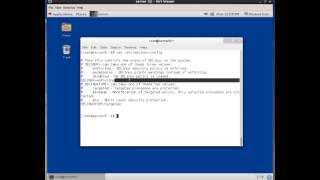
Using content from our Red Hat® System Administration II (RH134) course, this Taste of Red Hat Training video will show you how to manage SELinux modes on your system. In the complete, 4-day course, Red Hat System Administration II focuses on the key tasks needed to become a full time Linux® administrator. It is part II of the core system administration tasks needed for Red Hat Enterprise Linux 7 and is the follow-on to Red Hat System Administration I (RH124). This course goes deeper into enterprise Linux administration including file systems and partitioning, logical volumes, SELinux, firewalling, and troubleshooting. Attending both Red Hat System Administration I and Red Hat System Administration II can help you in your preparation for the Red Hat Certified System Administrator Exam (EX200).

Video Thumbnail
Video

IT Professionals worldwide are getting certified on Red Hat OpenStack Platform

Red Hat Developer Program

IT professionals around the world are getting trained and certified by Red Hat on Red Hat Enterprise Linux OpenStack Platform. We met with a few of the Red Hat Certified Professionals to see how they are leveraging the knowledge and skills from the rigorous, hands-on training and exam. An IT professional who has earned the Red Hat Certified System Administrator in Red Hat OpenStack has demonstrated the skills, knowledge, and abilities needed to create, configure, and manage private clouds using Red Hat Enterprise Linux® OpenStack® Platform. To learn more about Red Hat Enterprise Linux OpenStack Platform Training and Certification, visit us at www.redhat.com/training/paths/openstack

Video Thumbnail
Video

Open Sourcing The Enterprise: Ten Years Of Red Hat Enterprise Linux

Red Hat Developer Program

Red Hat Enterprise Linux transformed enterprise IT, and dramatically changed the software industry forever. By combining the open source development model with a customer-centric subscription based business model, Red Hat gave enterprise customers a way to leverage the value of open source in a way that made sense for them, and that spurred the adoption of Linux across the enterprise. But it wasn't easy. There were doubts and obstacles to overcome, customers and partners to convince, and millions of developers to collaborate with. But with commitment and vision, it all just worked.

Video Thumbnail
Video

2012 Red Hat Summit: Clustered Applications with Red Hat Enterprise Linux 6

Red Hat Developer Program

In this session, Red Hat's Thomas Cameron and Lon Hohberger will expand upon their 2011 Red Hat Summit presentation, "Clustering Applications with Red Hat Enterprise Linux." Thomas and Lon will discuss the theory and best practice of clustering applications with technologies available in Red Hat Enterprise Linux 6.

Video Thumbnail
Video

2012 Red Hat Summit: Part 1, Red Hat Enterprise Linux Roadmap

Red Hat Developer Program

In this 'Best of' session at the 2012 Red Hat Summit and JBoss World, Tim Burke, vice president of Linux Engineering at Red Hat, describes feature enhancements in recently released versions of Red Hat Enterprise Linux. Burke then has his team of engineering development managers highlight their technology area and key initiatives. They also discuss emerging technologies targeted for delivery in future releases. Burke first gives a brief Red Hat Enterprise Linux life cycle overview, and an explanation of various themes within Linux development today. He then explores timeframes and Red Hat Enterprise Linux 7 feature possibilities and Fedora 18 enhancements. He then turns the session over to his teams, who present technology area highlights, including information about: - virtualization - kernel and virtual memory - hardware enablement - storage and volume management - filesystem and Gluster Watch Part 2 of this session video: http://www.youtube.com/watch?v=H-cDorXHO5U&list=PL995CD1141C3330D5&index=17&feature=plpp_video Watch more 2012 Red Hat Summit and JBoss World videos: http://www.youtube.com/playlist?list=PL995CD1141C3330D5&feature=plcp

Video Thumbnail
Video

2012 Red Hat Summit: Part 2, Red Hat Enterprise Linux Roadmap

Red Hat Developer Program

This is part 2 of a 'Best of' session with Tim Burke, vice president of Linux Engineering from Red Hat, at the 2012 Red Hat Summit and JBoss World. You can see part 1 here: http://www.youtube.com/watch?v=yhQIVXrCd68&list=PL995CD1141C3330D5&index=16&feature=plpp_video Tim Burke, vice president of Linux Engineering at Red Hat, briefly summarizes the first half's content, then has a team of engineering development managers highlight their technology area and key initiatives. They also discuss emerging technologies targeted for delivery in future releases. Areas they discuss in this part include: - filesystem - base OS commands and util - security - desktop features - developer tool features Watch part 1 of this session video: http://www.youtube.com/watch?v=yhQIVXrCd68&list=PL995CD1141C3330D5&index=16&feature=plpp_video Watch more 2012 Red Hat Summit and JBoss World videos: http://www.youtube.com/playlist?list=PL995CD1141C3330D5&feature=plcp

Video Thumbnail
Video

Infosys Finacle Lite powered by Red Hat Enterprise Linux and Jboss Middleware

Red Hat Developer Program

Leading Core Banking Solution from Infosys featuring in Gartner Magic Quadrant - Finacle Lite is now powered by Red Hat Enterprise Linux and JBoss Enterprise Middleware. Finacle Lite offers a core banking solution specifically designed for Tier 2 Banks, Cooperative Banks & Credit Unions worldwide. The solution is a fully integrated, pre-configured "Bank-in-a-Box" powered by Red Hat Enterprise Linux and JBoss Enterprise Middleware designed for extremely quick deployment automating business processes across retail,wholesale, payments and services modules. Finacle Lite is available either as software as service (SaaS) or for on-premise deployments deployed universally on Red Hat Enterprise Linux and JBoss Enterprise Middleware. This video helps in understanding why Infosys chose open source based Red Hat Enterprise Linux and JBoss Enterprise Middleware Platforms for their state-of-the-art core banking solution offering, Finacle Lite, to address the business and technology challenges faced by banks worldwide. This also address the overall benefits of running Finacle Lite on Red Hat Enterprise Linux and JBoss Middleware Platforms from various dimensions including TCO, scalability and performance.

Video Thumbnail
Video

Software Collections: Easy Access To The Cutting Edge (Langdon White)

Red Hat Developer Program

In most subscriptions, Red Hat offers access to the Red Hat Software Collections (RHSCL) and Developer Toolset (DTS). RHSCL has 20+ content sets, providing recent-but-stable versions of languages, databases, web servers, etc.—like, ruby 2.2, postgresql 9.4, and nginx 1.6—that you use for development and production runtime. The DTS provides recent-but-stable content used mainly in development—for example, Eclipse, gcc, git. Come learn how and when to use this content in RPMs and Docker containers. We will show you how to launch Drupal in minutes and install Eclipse Mars. We will also demonstrate how to build containers using this content, which makes your Dockerfiles much simpler. Lastly, we will show you how OpenShift 3 can use the same content sets.

Video Thumbnail
Video

A Quick Guide To .NET Development On Red Hat Enterprise Linux (Rick Wagner)

Red Hat Developer Program

The partnership between Red Hat and Microsoft brings new possibilities for application development and deployment. .NET has long been the application platform for Microsoft developers, and for the first time it is now available to Red Hat Enterprise Linux users. In this session, we'll gently introduce .NET development, showing you the primary components and how they can be used to develop applications of your own. We'll also introduce Red Hat Enterprise Linux on Microsoft Azure, and discuss the application development process and usage of the tools essential for .NET applications. You'll leave with all you need to begin writing simple .NET applications using Red Hat Enterprise Linux for Microsoft Azure.

Video Thumbnail
Video

Behind-the-scenes of .NET on Red Hat Enterprise Linux

Red Hat Developer Program

You may have heard Microsoft hearts Linux.  And soon you will be able to use .NET on Red Hat Enterprise Linux. While the pieces are still being finalized we are excited to share a behind-the-scenes sneak peek at how this will work for you. In this 2-hour webinar and demo, see: How .NET on Red Hat Enterprise Linux is coming together  What you can expect from the development experience  .NET on Red Hat Enterprise Linux in action

Video Thumbnail
Video

DevNation 2014 - Brian Gollaher - Developing Applications for Red Hat Enterprise Linux video Part 2

Red Hat Developer Program

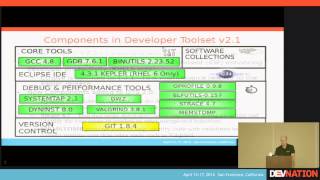
In this session, we'll cover when developers should use Red Hat Enterprise Linux system tools, when they should use the Red Hat Developer Toolset, and when they should use Red Hat Software Collections. We'll describe the developer tools for Red Hat Enterprise Linux and make recommendations in context, based on the type of application and the application life cycle. Well also explain the targeted audience for the native system tools and why they are not appropriate for all applications. Finally, we'll explain and provide examples of the target audience for the Red Hat Developer Toolset and Red Hat Software Collections tools.

Video Thumbnail
Video

DevNation 2015 - Matt Newsome - Red Hat Enterprise Linux C++ Toolchains

Red Hat Developer Program

As a C/C++ developer you want to be able to easily access and use supported versions of the latest and greatest tools, and you want to be able to get the most from those tools. In this session, we’ll look at the new features made available through the GCC compiler and friends in Red Hat Enterprise Linux 7 and Red Hat Developer Toolset (which puts the same tools in the hands of RHEL6 Developers). We'll look at new language standard support, optimizations, and other toolchain features in terms of both what they offer, and practical how-to guidance so that your development teams can get real world value from them. You’ll learn: - How Red Hat Developer Toolset offers newer releases of the GNU Compiler Collection (GCC) for development on RHEL6 or RHEL7, optionally using the Eclipse Integrated Development Environment. - About the base GCC toolchain provided as part of RHEL7, its language standard support, key optimizations and other major new features- Practical guidance on how to use these features in real world application development to get high value for your customers - How your applications can be run and their performance analyzed on multiple releases without modification, carrying special libraries or changing the operating system runtime. - Where you can find more information on all these topics This solution-focused session will appeal to all C and C++ software developers and their managers. Content will include both high-level overviews and some deeper dives into feature specifics, and will include hands-on demonstrations of features in real world use. There will also be opportunities to ask questions about your specific concerns, with experts both in the room and available after the event.

Technical How-to Books for Developers - Microservices, Design Patterns, .NET, Reactive, Databases Open configuration options
Article

Technical How-to Books for Developers - Microservices, Design Patterns, .NET, Reactive, Databases

Emily Parish

Within Red Hat knowledge sharing and collaboration are important. As a part of that many Red Hatters write books and we get the honor of sharing their knowledge with other developers. We have 7 more books in queue for the coming year and thought we would share the books you can currently download. Learn how to get started with a new technology. Learn why you would want to use new methodologies or technologies. Or just dive in a little deeper...

Measuring and comparing Open vSwitch performance
Article

Measuring and comparing Open vSwitch performance

Eelco Chaudron

Introduction There are infinite ways to test Virtual Switches, all tailored to expose (or hide) a specific characteristic. The goal of our test is to measure performance under stress and be able to compare versions, which may or may not have hardware offload. We will run the tests using the Physical to Virtual back to Physical topology. This configuration is also known as the PVP setup. The traffic will flow from a physical port to a virtual port on the...

Containers Image
Article

Why I started using containers

Konrad Kleine

A few years back (2013-2016) I was working as a C++ Software Development Engineer at Intel on a monolithic product with a backend written in C++ and a web frontend written in Java. The product was shipped complete with hardware and as a VMware image. Internally we kept ISO CD images on a shared server for every released or QA approved version of the product. Built into the product was a very clever issue reporting mechanism that allowed us, developers...

NodeJS
Article

Installing Node.js dependencies with Yarn via s2i builds and OpenShift

David Martin

Building a docker formatted container image for a Node.js application There are 2 main strategies for building an image for a Node.js Application. The most common strategy is simply using a Dockerfile with a base image of something like FROM node:4-onbuild. Then do a docker build. This will produce an image with your application in it, ready to be run. This strategy is known as the Docker strategy in an OpenShift BuildConfig. Another strategy is using the s2i tool for...