.NET

.NET Core
Article

Red Hat Releases .NET Core 2.0

Bob Davis

As a follow-up to yesterday’s press release , I am pleased to announce the immediate availability of and support for .NET Core 2.0, the latest version of the open source .NET Core project, on Red Hat’s portfolio of open technologies. A lightweight and modular platform for creating web applications and microservices, .NET Core 2.0 provides significant new developer capabilities while enabling developers to create .NET applications across platforms, and deploy on Red Hat Enterprise Linux, Red Hat OpenShift Container Platform...

Article Thumbnail
Article

.NET Core 2.0 - Frequently Asked Questions

mguerett

INTRODUCTION What has Red Hat announced? Red Hat has announced that .NET Core 2.0, an open source major release with significant improvements over the 1.0 and 1.1 releases, is now generally available for Red Hat Enterprise Linux, OpenShift Container Platform, and related platforms. This release brings .NET Core much closer to being aligned with the traditional .NET Framework, with massively expanded API support for .NET Standard 2.0 and far better support for NuGet packages. This release improves the experience of...

.NET Core
Article

Introduction to NuGet with .NET Core on RHEL

Dave Mulford

Introduction to NuGet with .NET Core NuGet is an open source package manager for the .NET Core ecosystem. For those familiar with Red Hat Enterprise Linux (RHEL), you can think of it as the “yum” for pulling libraries into your .NET Core project. Working with NuGet packages in .NET Core applications is accomplished primarily through your project’s .csproj file and the dotnet command-line interface. Repositories Just like RHEL, NuGet has its own repositories to get packages. By default, when the...

.NET Core
Article

Microsoft releases .NET Core 2.0

Mike Guerette

After a number of months with .NET Core 2.0 previews, Microsoft has released .NET Core 2.0. Very exciting for the open source world! If you've not seen Scott Hunter talk about today's announcement, see it here. Red Hat has been offering .NET Core 1.1 for a while now, and we expect many customers to be interested in 2.0. Stay tuned for more.

Advanced Microservices with .NET
Article

Advanced Microservices with .NET

Don Schenck

During Red Hat Summit, this past May I along with Scott Hunter from Microsoft took part in a session titled Microservices and OpenShift with .NET Core and .NET Standard 2.0. I went first and talked about building microservices. This was an overview demonstrating the evolution through running a program at a command line, a .NET Core program in RHEL. Once completed I then showed just how easy it was to take the image and put into OpenShift and scale it...

Video Thumbnail
Video

Install .NET Core on RHEL in under 5 minutes, by Don Schenck.

Don Schenck

A lightning talk from Red Hat Summit 2017. Here is the transcription:

[00:11] I have a VM here. Let me just run the .NET command to show you. It's not there, so we're going to install .NET on RHEL. The first thing I'm going to do is become Super User, otherwise I have to type pseudo for every command and that's just a hassle.

[00:33] I'm just going to copy and paste the commands here. The point isn't that I type out every command, the point is that you see it's only a couple of commands to get it installed. The first thing I'll do is get my subscription manager attached to the correct pool of RPMs, that's the packages I pulled down.

[00:49] When you install .NET on RHEL you're getting the package from Red Hat. You're not getting it from Microsoft. We get the source code from Microsoft and then we build it to run on RHEL. Red Hat packages are, I like to say vetted. That is, we test them and make sure they work really well so you're not just pulling down software and hoping it works.

[01:12] Now I'm going to enable the repo. I've attached to it and now I have to enable it. Notice at the end where it says, "RHEL 7 Server..." There's also a work station, and there's also one for an HP [high performance] special computing thing that I'm not really familiar with. The point is you're probably going to use a RHEL server to install .NET.

[01:26] One of the cool things about the new .NET core as opposed to the old one is the new .NET is much smaller. Whereas before, when you installed .NET, you would drop in a DVD, or a CD, and wait forever for it install, and you would get 4 gigabytes of .NET. Now it's just a couple hundred megabytes.

[01:49] I'm going to YUM install this scl utils. It doesn't matter what they do. They just enable installation. Let's just leave it at that. There's nothing to do because I've done that before, but that's OK. It's better to have nothing to do than to skip the step.

[02:08] Now here's the actual install itself. I want you to notice it's just a command line and it's a YUM installed .NET core 1.1, which is version 1.1. It's going to go up to the inner webs and pull down everything it needs to install it.

[02:17] Your limiting factor here is going to be your Internet speed. Other than that, that's it for installing .NET. It really is that small and that fast. After it's installed, you have to enable it to be available in Bash. Once that's done, we'll bring it up and we'll see .NET.

[02:36] One final step here. In just a few minutes we went from not having .NET...I don't know if I can copy and paste here, bear with me.

[02:47] It's enabled. Now we should have .NET command available. There it is. We'll do a .NET new which will create a new program. The first time you do a .NET new it's going to run this little expand. That might be considered the final step of installing .NET, that's it. That's all you have to do to install .NET, that's it.

Thank you.

DotNET Core process image
Article

.NET Core Magic: Develop on one OS, run on another

Don Schenck

I recently attempted to write a blog post about Angular and .NET Core 2.0 [Note: It will be posted as soon as the .NET Core 2.0 RPMs are released], using my Red Hat Enterprise Linux (RHEL) VM as the operating system. Even though the .NET Core 2.0 bits are not available yet from Red Hat, I gave it a shot by using a daily build. When I tried to run the code, however, I got an error related to the...

DotNET Core process image
Article

From Java to .NET Core, Part 2: Types

Yev Bronshteyn

In my previous post in the series, I discussed some fairly surface-level differences between C#/.NET and Java. These can be important for Java developers transitioning to .NET Core, to create code that looks and feels "native" to the new ecosystem. In this post, we dig beneath the surface, to understand .NET's type system. It is my belief that, with Java in the rear view mirror, the .NET type system is more effective and enjoyable to write on. But you be...

DotNET Core process image
Article

Writing a Linux daemon in C#

Takayoshi Tanaka

When you want to run .NET Core process as a daemon on Red Hat Enterprise Linux, you can create a custom systemd unit. Today I'll write about two examples of custom systemd unit for .NET Core. The one is a oneshot type for running a .NET Core console application and the other is a simple type for running an ASP.NET Core Web application. Oneshot type with a console application Building an app You can use dotnet run in systemd with...

Video Thumbnail
Video

Run .NET and SQL Server natively on Linux with OpenShift

Red Hat Developer Program

Hear from John Osborne, Sr. Solutions Architect, Red Hat, Harold Wong, Cloud Architect, Microsoft, and Jason Dudash, Specialist Solution Architect, Red Hat in this breakout session at Red Hat Summit 2017 For the past several years, Microsoft's approach has been to make Linux and open source technologies first class citizens in the public cloud. Microsoft engineers participate in key open source communities. In this joint session with Red Hat and Microsoft, we'll demonstrate technologies like .NET and SQL Server running on Red Hat Enterprise Linux-based containers in OpenShift on premise and in Azure. We'll also discuss the development and operational perspectives and things like security patching and scans. https://www.redhat.com/en/summit/2017/agenda/sessions

Video Thumbnail
Video

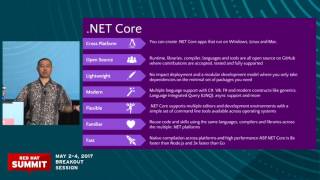
Microservices and OpenShift with .NET Core and .NET Standard 2.0

Red Hat Developer Program

Hear from Don Schenk, Director of Developer Experience, Red Hat and Scott Hunter, Microsoft in this breakout session at Red Hat Summit 2017. In this session, we’ll show the evolution from a .NET application running on a server to a microservices architecture with zero-downtime deployments—including advanced techniques for optimizing performance. Join this session if you’re ready to apply your .NET skills to microservices and Linux containers. https://www.redhat.com/en/summit/2017/agenda/session

Video Thumbnail
Video

.NET And Java And Containers: It’S A Brave New World (Don Schenck)

Red Hat Developer Program

Containers: they’re all the rage. But you need to stay grounded in trusted technology such as Java and .NET. Wouldn’t it be great if someone showed an example of bringing Java and .NET and containers together? Oh, and don’t be limited to just one technology stack. Well, this is that session. I’ll be using as many technologies as we can cram into 60 minutes to show how open source brings the old and new together to make both even better. You won’t want to miss this.

Video Thumbnail
Video

A Quick Guide To .NET Development On Red Hat Enterprise Linux (Rick Wagner)

Red Hat Developer Program

The partnership between Red Hat and Microsoft brings new possibilities for application development and deployment. .NET has long been the application platform for Microsoft developers, and for the first time it is now available to Red Hat Enterprise Linux users. In this session, we'll gently introduce .NET development, showing you the primary components and how they can be used to develop applications of your own. We'll also introduce Red Hat Enterprise Linux on Microsoft Azure, and discuss the application development process and usage of the tools essential for .NET applications. You'll leave with all you need to begin writing simple .NET applications using Red Hat Enterprise Linux for Microsoft Azure.

Video Thumbnail
Video

Getting started on .NET for Red Hat Developer Program (Jon Galloway & Scott Hunter)

Red Hat Developer Program

C# is a modern, advanced general-purpose programming language and is now fully open source and supported on Linux. In this session, you'll learn how to be productive with the new, modern C# on Linux. See what it's like building high performance web workloads in ASP.NET. Learn about the tooling support available to you, including how to configure your favorite editor. Check out the improved DevOps flows enabled by the full stack app, local deployment, and native compilation. And more.

Video Thumbnail
Video

OpenShift and Microsoft .NET in Action

Red Hat Developer Program

We are collaborating with Uhuru Software to bring Microsoft .NET and SQL Server capabilities to OpenShift, as an open source community-driven effort in OpenShift Origin. The demo will show the work done to date and how easy it is to deploy a .NET application with OpenShift.

Video Thumbnail
Video

Behind-the-scenes of .NET on Red Hat Enterprise Linux

Red Hat Developer Program

You may have heard Microsoft hearts Linux.  And soon you will be able to use .NET on Red Hat Enterprise Linux. While the pieces are still being finalized we are excited to share a behind-the-scenes sneak peek at how this will work for you. In this 2-hour webinar and demo, see: How .NET on Red Hat Enterprise Linux is coming together  What you can expect from the development experience  .NET on Red Hat Enterprise Linux in action

Technical How-to Books for Developers - Microservices, Design Patterns, .NET, Reactive, Databases Open configuration options
Article

Technical How-to Books for Developers - Microservices, Design Patterns, .NET, Reactive, Databases

Emily Parish

Within Red Hat knowledge sharing and collaboration are important. As a part of that many Red Hatters write books and we get the honor of sharing their knowledge with other developers. We have 7 more books in queue for the coming year and thought we would share the books you can currently download. Learn how to get started with a new technology. Learn why you would want to use new methodologies or technologies. Or just dive in a little deeper...

Java to .NET Core
Article

From Java to .NET Core. Part 1

Yev Bronshteyn

There was a time when the word ".NET" was virtually synonymous with bloat, vendor lock-in, and Windows. .NET Core is the exact opposite. It's blazingly fast. It's open source under a permissive license (Mostly MIT, some parts Apache-2.0). Unlike some other open-source platforms, .NET Core's Contributor License Agreement does not grant exclusive privileges to a single corporation. .NET Core is cross-platform, allowing you to target Windows, Mac, Docker, and many flavors of Linux. My favorite resource for getting started with...

Red Hat Summit logo
Article

O'Reilly Authors are Heading to Summit - microservices, raspberry pi hacks, .NET and more.

Emily Parish

Red Hat Summit is just around the corner in Boston and we are preparing just a few of the many Red Hat authors for their book signings. We've given them 6 steps to signing books: Step 1: Get books ordered. Step 2: Get to Boston. Step 3: Bring a marker. Step 4: Bring a spare marker. Step 5: Show up at the right time. Step 6: Enjoy sharing your work with attendees! Ok - so we may be teasing them...

DotNET Core process image
Article

Creating Your First .NET Program on Red Hat Enterprise Linux

Don Schenck

Sometimes things are really easy. This is one of those cases. There are only six steps to creating and running your first .NET program on Red Hat Enterprise Linux (RHEL). Install dotnet What's that? You don't have RHEL installed on your Windows PC in a Virtual Machine (VM). That's okay ... I'll wait while you install it. Just follow this video to download and install the Red Hat Development Suite. Okay, now that you have a VM, open PowerShell and...

Remote debug your ASP
Article

What's .NEW in .NET, Volume 1

Don Schenck

.NET Core continues to move forward at a rapid pace; this includes not only the framework but also the knowledge and tools related to it. Here are three recent highlights: LibYear, a "dotnet CLI tool for managing dependency freshness" Quicklink: https://stevedesmond.ca/blog/happy-libyear LibYear ( blog post here), written by Steve Desmond, uses your .csproj or project.json file as input and compares it to NuGet.org, producing a list of your dependencies and their freshness. That is, it checks to see if a...

Red Hat Enterprise Linux
Article

Sharing between Windows 10 and your VM

Don Schenck

If you're are anything like me, you find the easiest -- yet still best -- way to get things done. After all, life is too short to write programs using Edlin, so give me Visual Studio Code (VS Code). So, what's an easy way for a Windows .NET developer to write code for Linux? Enter the Red Hat Development Suite, a zero-cost bundle for running Linux on your Windows PC, including running .NET Core. After installing the Red Hat Development...

Versions in Versions in Versions, AKA The .NET Core Russian Doll
Article

Versions in Versions in Versions, AKA The .NET Core Russian Doll

Don Schenck

Version One Point What? Ever wonder what version of .NET Core you are running? Well, that’s simple enough to figure out; simply drop to the command line and type dotnet. You'll see something like this: Okay, I have version 1.1.0 installed easy enough. Another way to show this is to type, dotnet --version and see something like this: Wait … what? “Preview”? But I didn’t download a preview. A quick check at the download page on the web proves that...