
Article
Enterprise Kubernetes development with odo: The CLI tool for developers
This hands-on Node.js example demonstrates the benefits of Odo, a command-line tool built for developers working in a Kubernetes environment.
This hands-on Node.js example demonstrates the benefits of Odo, a command-line tool built for developers working in a Kubernetes environment.

Learn how to install CodeReady Workspaces in a restricted Red Hat OpenShift 4 environment by pulling images into a private registry.

Check out Cloud Native Compass—a GitHub repository of terms and definitions for cloud-native software development and microservices.

This blog explores concepts and techniques around automated API testing of business rules and processes deployed in a KIE Server.

Explore the improvements in JBoss Tools 4.15.0 and Red Hat CodeReady Studio 12.15 for Eclipse 4.15 (2020-03) to Quarkus and container-based development.

Explore the Red Hat Marketplace technical preview and see how Red Hat and IBM are making it easier to build Kubernetes applications on OpenShift.

CodeReady Workspaces 2.1 includes a new onboarding flow, Quarkus workspaces, improved VS Code support, plus .NET Core 3.1, Java 11, and Camel DSL support.

In this second of two articles, explore smaller improvements in JBoss Tools 4.14.0: updating Hibernate Tools and the JDTs for Java 13, and updating the UI.

In this first of two articles, find out what's new in JBoss Tools 4.14.0, including support for OpenShift Container Platform 4.3 and new Quarkus tooling.
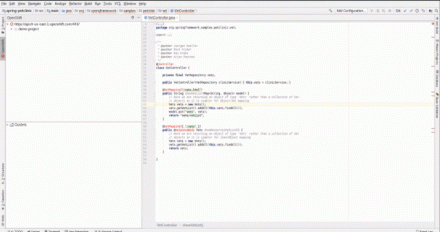
Discover how the OpenShift Connector 0.2.0 release lets you debug and share Java and Node.js Red Hat OpenShift components in JetBrains IntelliJ.

Improve program performance with the the Red Hat Rust and LLVM Toolsets, which can easily be used together for cross-language link-time optimization (LTO)

Explore the new self-fixing barriers feature added to Shenandoah GC in JDK 14, which reduce local latencies that are spent in barrier mid- and slow paths.

Enhance the developer experience by letting them debug their deployed Node.js and Java code directly from VS Code using OpenShift Connector.

Learn how to prevent accidental file check-ins in Git without the limitations of .gitignore, which only works well with files common to all collaborators.

Discover how Buildbot brings continuous integration to the GNU Project Debugger, where the project stands now, its challenges, and where it's headed.

Learn how OpenShift Actions let you deploy to your Red Hat OpenShift cluster directly from your GitHub repository, via GitHub Actions.

We explore the improvements to Quarkus Tools for Visual Studio Code version 1.3.0, which was released on the VS Code Marketplace to start off the new year.
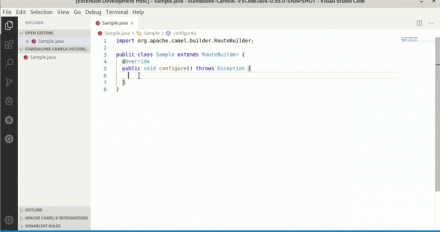
With Tooling for Apache Camel K version 0.11.0, Java language support now comes out of the box for standalone Camel K Java files.

Discover how the Didact VS Code extension makes it easy for non-developers to write tutorials and interact with the commands they want to invoke.

We discuss tools that help deploy your Maven applications to Kubernetes and Red Hat OpenShift, and then walk through an example.
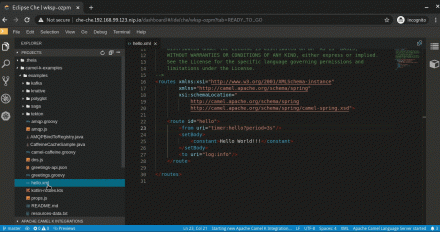
The Eclipse Che 7.6.0 release provides a new stack for Apache Camel K integration development. We look at how to test the new features on a local instance deployed on minikube.

We walk through the Red Hat CodeReady Workspaces 2.0 edit-debug-push (to GitHub) cycle.

We take a look at user flow improvements for deploying applications in Red Hat OpenShift 4.3's Developer perspective.

We explore the developer improvements added to OpenShift 4.3, which improves upon the features that were introduced in 4.2 and introduces new flows and features for the developer.

CodeReady Workspaces 2.0 frees the developer from the confines of a PC in favor of multiple specially configured workspaces; learn more.

Build here. Go anywhere.
We serve the builders. The problem solvers who create careers with code.
Join us if you’re a developer, software engineer, web designer, front-end designer, UX designer, computer scientist, architect, tester, product manager, project manager or team lead.
 Ask AI