
Video
Red Hat Enterprise Linux Atomic Host - Mike McGrath
Red Hat Enterprise Linux Atomic Host - Mike McGrath
Red Hat Enterprise Linux Atomic Host - Mike McGrath
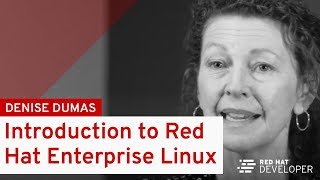
Denise Dumas, VP of Linux engineering, discusses application development and the importance of the platform.
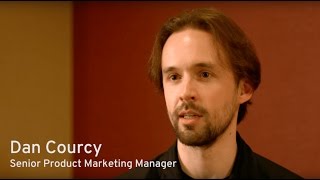
Red Hat Software Collections - Dan Courcy
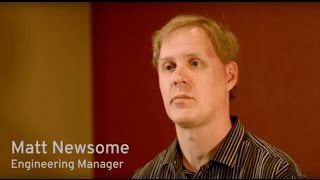
Red Hat Developer Toolset - Matt Newsome
In most subscriptions, Red Hat offers access to the Red Hat Software Collections (RHSCL) and Developer Toolset (DTS). RHSCL has 20+ content sets, providing recent-but-stable versions of languages, databases, web servers, etc.—like, ruby 2.2, postgresql 9.4, and nginx 1.6—that you use for development and production runtime. The DTS provides recent-but-stable content used mainly in development—for example, Eclipse, gcc, git. Come learn how and when to use this content in RPMs and Docker containers. We will show you how to launch Drupal in minutes and install Eclipse Mars. We will also demonstrate how to build containers using this content, which makes your Dockerfiles much simpler. Lastly, we will show you how OpenShift 3 can use the same content sets.
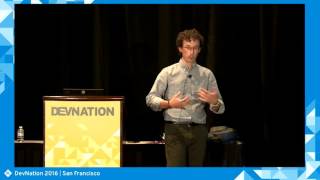
Despite the popularity and hype of containers, there is no need to regard containers as a block box. It is important to have an awareness of what's going on under the hood to help optimize your container requirements. In this session, we'll discuss: - Namespacing in the kernel - Copy-on-write storage choices - Portable container formats - Available container alternatives - Validation, trust, and content addressability with image verification See examples and options for your use-cases.
The partnership between Red Hat and Microsoft brings new possibilities for application development and deployment. .NET has long been the application platform for Microsoft developers, and for the first time it is now available to Red Hat Enterprise Linux users. In this session, we'll gently introduce .NET development, showing you the primary components and how they can be used to develop applications of your own. We'll also introduce Red Hat Enterprise Linux on Microsoft Azure, and discuss the application development process and usage of the tools essential for .NET applications. You'll leave with all you need to begin writing simple .NET applications using Red Hat Enterprise Linux for Microsoft Azure.
Scale changes everything. What once was quite adequate for enterprise messaging can't scale to support "Internet of Things". We need new protocols, patterns and architectures to support this new world. This session will start with basic introduction to the concept of Internet of Things. Next it will discuss general technical challenges involved with the concept and explain why it is becoming mainstream now. Now we’re ready to start talking about solutions. We will introduce some messaging patterns (like telemetry and command/control) and protocols (such as MQTT and AMQP) used in these scenarios. Finally we will see how Apache ActiveMQ is gearing up for this race. We will show tips for horizontal and vertical scaling of the broker, related projects that can help with deployments and what the future development road map looks like.

You may have heard Microsoft hearts Linux. And soon you will be able to use .NET on Red Hat Enterprise Linux. While the pieces are still being finalized we are excited to share a behind-the-scenes sneak peek at how this will work for you. In this 2-hour webinar and demo, see: How .NET on Red Hat Enterprise Linux is coming together What you can expect from the development experience .NET on Red Hat Enterprise Linux in action

Ruby has come a long way since JRuby first ran Rails in 2006. Frameworks like Rails have grown up with the modern web, now supporting web sockets, microservices, and integration with Javascript client libraries like Ember. Concurrency utilities modeled after the JDK are helping Ruby scale horizontally. Applications can be built with Rake - or with JRuby plugins for Gradle and Maven. Maven poms can be written in a beautiful Ruby DSL. Swing, JavaFX, and other graphics libraries become easy and fun with JRuby. Sass and Asciidoctor are already being used in Java apps thanks to JRuby. And you can bundle up the whole thing in an executable jar or war file; your devops will never know it's Ruby. Come see what JRuby 9000 can do for you in 2015.
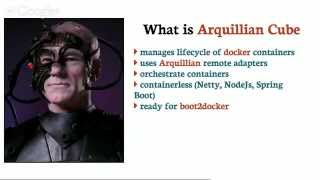
Alex Soto quickly walks us through Arquillian and talks about Docker and the new Arquillian Cube extension, which makes testing of applications in Docker containers a breeze.

I had the pleasure to talk to Henryk Konsek about Camel and Microservices and how it all comes together with Docker.
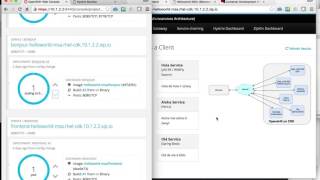
Our Microservices Playground: 6 different microservices, each using a unique Java framework: Dropwizard, Spring Boot, WildFly Swarm, JBoss Enterprise Application Platform, Node.js, Vert.x.
Leveraging Docker+Kubernetes+OpenShift running in a Red Hat Enterprise Linux (RHEL) VM. Microservices Slide Presentation http://bit.ly/helloworldmsa Demo Source Organization https://github.com/redhat-helloworld-msa Download the RHEL VM for Docker+Kubernetes+OpenShift (CDK) http://developers.redhat.com/products/cdk/docs-and-apis/
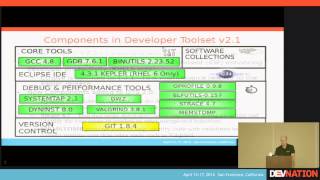
In this session, we'll cover when developers should use Red Hat Enterprise Linux system tools, when they should use the Red Hat Developer Toolset, and when they should use Red Hat Software Collections. We'll describe the developer tools for Red Hat Enterprise Linux and make recommendations in context, based on the type of application and the application life cycle. Well also explain the targeted audience for the native system tools and why they are not appropriate for all applications. Finally, we'll explain and provide examples of the target audience for the Red Hat Developer Toolset and Red Hat Software Collections tools.
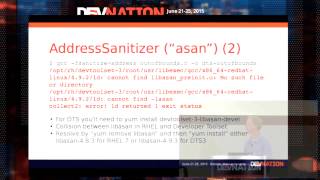
As a C/C++ developer you want to be able to easily access and use supported versions of the latest and greatest tools, and you want to be able to get the most from those tools. In this session, we’ll look at the new features made available through the GCC compiler and friends in Red Hat Enterprise Linux 7 and Red Hat Developer Toolset (which puts the same tools in the hands of RHEL6 Developers). We'll look at new language standard support, optimizations, and other toolchain features in terms of both what they offer, and practical how-to guidance so that your development teams can get real world value from them. You’ll learn: - How Red Hat Developer Toolset offers newer releases of the GNU Compiler Collection (GCC) for development on RHEL6 or RHEL7, optionally using the Eclipse Integrated Development Environment. - About the base GCC toolchain provided as part of RHEL7, its language standard support, key optimizations and other major new features- Practical guidance on how to use these features in real world application development to get high value for your customers - How your applications can be run and their performance analyzed on multiple releases without modification, carrying special libraries or changing the operating system runtime. - Where you can find more information on all these topics This solution-focused session will appeal to all C and C++ software developers and their managers. Content will include both high-level overviews and some deeper dives into feature specifics, and will include hands-on demonstrations of features in real world use. There will also be opportunities to ask questions about your specific concerns, with experts both in the room and available after the event.
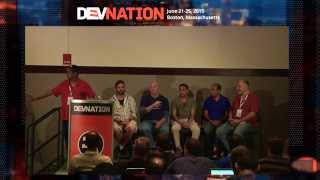
DevOps is changing at a fast pace as containers are rapidly going mainstream. In this panel, leading startup companies and Red Hat's platform group will discuss their insights and predictions for the how DevOps will change going forward. Our industry experts will discuss: DevOps Docker technology Source-to-image STI CI/CD Immutable infrastructure Panel members Krish Subramanian (moderator), OpenShift director of strategy, Red Hat Avi Cavale, CEO Shippable.com Steven Sheinfield, Sr. business development manager, NewRelic Andrew Phillips, VP of product management, XebiaLabs Langdon White, Developer evangelist, Red Hat Ryan King (introduction), Red Hat Innovate

ThreadSafe is a static analysis product for finding concurrency bugs in multi-threaded Java programs. Such bugs can be difficult to find using conventional testing methods. They may occur randomly due to non-deterministic scheduling behaviour, and can be hard to replicate. ThreadSafe analyses can be from within the Eclipse IDE, and/or in conjunction with the Sonar quality dashboard. ThreadSafe is developed by Contemplate, a spin-out company from the University of Edinburgh. Following its commercial release, it has been installed by an investment bank that participated in Contemplate's Early Adopter Program, and is under evaluation in others. The design intent is not only to identify the subtle issues which can arise in multi-threaded software development, but also to provide an easy to use user experience which allows the developer to quickly understand the analysis and to take remedial action, where required, with confidence and understanding. Contemplate will talk about its focus on concurrency, and demonstrate ThreadSafe's analysis of some Open Source examples.



Build here. Go anywhere.
We serve the builders. The problem solvers who create careers with code.
Join us if you’re a developer, software engineer, web designer, front-end designer, UX designer, computer scientist, architect, tester, product manager, project manager or team lead.