microservices

Ducklings image
Article

The rise of Agile Integration, Integration is not DEAD nor LAME!

Christina Lin

I wanted to blog about this for a very long time, but because of work and being too lazy to turn on my laptop on the weekends, I now finally have a couple of hours to sit down and start blogging. "Integration is DEAD." "No, no, let's talk about microservice!" "What is that again? Integration, you mean SOA? It's lame...". During my recent conversations with many people about Integration, these comments came up a lot. In fact, if you happen...

Video Thumbnail
Video

From legacy to microservices: Lessons learned on the road to success by Miles & More

Red Hat Developer Program

Watch Matthias Krohnen, Manager IT, Lead Innovation Lab, Miles & More GmbH, Torben Jaegar, Middleware Specialist Solution Architect, Red Hat, and Pagop, Middleware Sales Specialist, Red Hat speak in this breakout session at Red Hat Summit 2017. With over 29 million participants, Miles & More is the largest frequent flyer program in Europe. Expanding this travel rewards program into other markets required a fundamental change to the company's IT infrastructure, as the previous legacy environment was hard to maintain and not scalable. Miles & More chose to move to a microservices-based architecture built on Red Hat OpenShift. With this new environment, the company can support innovation and deploy new microservices into production within 5 days with zero downtime. Learn more about how Miles & More modernized their application development environment and process. Learn more: https://www.redhat.com/en/summit/2017/agenda/sessions

Video Thumbnail
Video

Reproducible development to live applications with Java and Red Hat CDK

Red Hat Developer Program

Andrew Lee Rubinger, Principle Software Engineer, Red Hat, Lalatendu Mohanty, Sr. Software Engineer, Red Hat share inights in the breakout session from Red Hat Summit 2017. Red Hat Container Development Kit (CDK) provides a ready-to-use development environment for developing microservices on Red Hat OpenShift Container Platform. In this session, we will design a small microservices application using Angular2 served through Eclipse Vert.x for front-end environments and REST over HTTP and Java API for RESTful Web Services (JAX-RS) via WildFly Swarm for back-end environments. We’ll also bootstrap the environment using CDK. This live-coding experience will walk you through setting up a new containerized environment from scratch and using it to develop a functional application in 50 minutes. Learn more: https://www.redhat.com/en/summit/2017/agenda/sessions

Video Thumbnail
Video

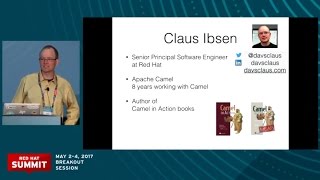
Developing cloud-ready Camel microservice

Red Hat Developer Program

Hear from Claus Isben, Sr. Principal Software Engineer, Red Hat in this breakout session from Red Hat Summit 2017. For Java developers, it may be daunting to get started developing container applications that run on OpenShift clusters. Minishift can help you run OpenShift locally by launching a local, single-node OpenShift cluster within a virtual machine. With fabric8 tools, it’s even easier to install and run OpenShift using familiar tools like Apache Maven. In this session, we’ll build a set of Apache Camel- and Jav-based microservices that use Spring Boot and WildFly Swarm. We’ll show how fabric8 Maven tools can be used to build, deploy, and run your Java projects on local or remote OpenShift clusters, as well as to easily perform live debugging. Additionally, we’ll discuss best practices for building distributed and fault-tolerant microservices using technologies such as Kubernetes Services, Netflix Hystrix, and Apache Camel Enterprise Integration Patterns (EIPs) for fault tolerance. Learn more: https://www.redhat.com/en/summit/2017/agenda/sessions

Video Thumbnail
Video

JBoss Enterprise Middleware overview

Red Hat Developer Program

In this video from the Red Hat Stories Technologies series, Craig Muzilla, vice president of the Middleware Business, discusses the growth and development of the JBoss Enterprise Middleware suites and technologies. He explains how Red Hat solutions extend from the middleware layer and further allow hardware flexibility and great application choice, with excellent long-term value. "You can configure JBoss technology to the needs that you have in an organization. You're not constrained and restricted." - Craig Muzilla See more of the Red Hat Stories: http://www.redhat.com/stories/

Video Thumbnail
Video

Brian Stevens keynote (2011 Red Hat Summit & JBoss World)

Red Hat Developer Program

Red Hat Chief Technical Officer and Vice President Brian Stevens gives a keynote at the 2011 Red Hat Summit and JBossWorld. Stevens discusses his ten-year tenure at Red Hat and the inspiration he finds in today's work--as much or more than he did when he joined the company. He begins with a look at the proprietary architectures of the past--expensive hardware that was difficult and expensive to manage and maintain, and hard to move away from when technologies improved. Today's technology outlook is very different. Flexible, open stacks that allow for vendor choice are replacing sunset old hardware and giving enterprise users the ability to take advantage of the newest developments. Stevens discusses the implementation of cloud technology and the open source infrastructure that runs many of the major deployments in business use today. He talks about the benefits of foundational change that are creeping in to even the most proprietary companies, and reviews some of the technical tools we use today, including Linux Torvalds' git and new Red Hat offerings like OpenShift. Video presentations allow him to share the experiences of expert Red Hat developers and product line managers, as well as partners and customers who have built their business on Red Hat. See more videos from the 2011 Red Hat Summit and JBossWorld: http://www.youtube.com/user/RedHatVideos#g/c/995CD1141C3330D5 Find out more about OpenShift: http://www.openshift.com

Video Thumbnail
Video

Simplifying JBoss administration

Red Hat Developer Program

JBoss ON experts Chris Morgan (senior product marketing manager) and Greg Hinkel (engineering team lead) discuss the value of management tools and features from Red Hat and JBoss. Screenshots further demonstrate the options and impact of technologies like Jopr and other open source applications, projects, and toolkits. "At the end of the day, you still have Red Hat behind the name, and you have a fully supported platform that can integrate all these different parts... in a way that gives you overall added value that's greater than the sum of its parts." -- Greg Hinkel See more Red Hat videos: http://www.redhat.com/videos/

Video Thumbnail
Video

Intro to Microservices (Burr Sutter)

Burr Sutter +1

Burr shows a private cloud for your laptop and walks through the critical capabilities of microservices architectures - Spring Boot, Wildfly Swarm and Eclipse Vert.x.

Video Thumbnail
Video

JavaOne 2015 - Aslak Knutsen - Taming Microservices Testing with Arquillian

Red Hat Developer Program

The Borg is docking your system; testing is futile! Or is it? With microservices, polyglot, and DevOps on the rise, where are we at with testing? Do these technologies bring more complexity and make our testing effort harder, or maybe the contrary? Do they actually help us write better tests more easily? This session explores not only how we can do our testing in this new world but also how the new world can help us test better. It takes a close look at various topics, from NodeJS-, DynJS-, VertX-, Ceylon-, or Ruby-orchestrated microservices through system-scale testing with various configurations to database migration and regression testing. All are within reach.

Video Thumbnail
Video

JavaOne 2015 - Ken Finnigan - Java EE 7 Applications as a Microservice with WildFly Swarm

Red Hat Developer Program

This session demonstrates how you don’t have to throw the Java EE baby out with the bath water just because you’re thinking about microservices. WildFly Swarm comes to the rescue, allowing flexibility in how a Java EE application is packaged. If your company has experience with Java EE and you’ve been thinking about getting into microservices, or even just single-purpose deployments, that doesn’t have to mean ditching Java EE. The presentation shows how WildFly Swarm can construct a single JAR containing a Java EE application, along with whatever WildFly components it would require, that can be deployed easily and quickly to any environment with a JVM.

Video Thumbnail
Video

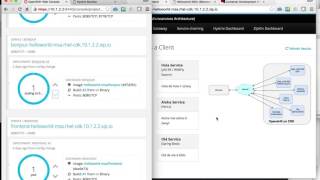
Helloworld Microservices Introduction

Burr Sutter

Our Microservices Playground: 6 different microservices, each using a unique Java framework: Dropwizard, Spring Boot, WildFly Swarm, JBoss Enterprise Application Platform, Node.js, Vert.x.

Leveraging Docker+Kubernetes+OpenShift running in a Red Hat Enterprise Linux (RHEL) VM. Microservices Slide Presentation http://bit.ly/helloworldmsa Demo Source Organization https://github.com/redhat-helloworld-msa Download the RHEL VM for Docker+Kubernetes+OpenShift (CDK) http://developers.redhat.com/products/cdk/docs-and-apis/

Video Thumbnail
Video

DevNation 2015 - Knutsen, Majsak - Taming microservices testing with Docker & Arquillian Cube

Red Hat Developer Program

With microservices, polyglot, and DevOps on the rise, what's happening with testing? Do they increase complexity and make our testing efforts harder? Or do they actually make it easier to write better tests? In this session, we will explore how we can do our testing in this new world, and how the new world can help us test better. Other topics we'll discuss include: NodeJS, DynJS, VertX, Ceylon, or Ruby-orchestrated microservices. System scale testing with different configurations. Database migration and regression testing.

Video Thumbnail
Video

Microservices & you: Practical Introduction

Steve Pousty +1

This session introduces the basic ideas behind microservices, covers the pros and cons of them, and gets started on building your first one.

FULL ABSTRACT: Curious about microservices? Want to hear what happens when you actually use them in your environments? This session introduces the basic ideas behind microservices and goes on to discuss some pros and cons of using them. We’ll discuss the process I went through in constructing http://wwww.flatfluffy.com, a multi-device application for gamified recording of roadkill. We’ll review the code and tools used to run the whole application, with a focus on how a microservices architecture was used to produce the mapping experience in FlatFluffy. Join this informal, interactive session where you’ll have the opportunity to ask your implementation questions. Come in curious, and leave with a solid understanding of how to get started on your first microservice-architected application.

Video Thumbnail
Video

DevNation 2015 - Sarah Novotny - Making the case for microservices

Red Hat Developer Program

The Internet has evolved from a monolithic application stack to a loosely coupled collection of microservices delivering specialized features. The benefits? Faster development and faster repair. In this session, we’ll share strategies to help you move from a monolithic architecture to one that allows you to innovate, respond faster, and give your users the best possible experience. We'll discuss ways to give your users a better experience when failure does happen.

Video Thumbnail
Video

The cold hard truth about microservices and how open source can help

Red Hat Developer Program

Microservice architectures have become popular, but we have to balance hype with reality. Microservices make it harder to manage deployments and create complex inter-service communications patterns. Learn how Open Source software built by open communities like Apache Camel, Docker, Kubernetes, OpenShift and Fabric8 can help achieve organizational goals to integrate services and establish effective continuous integration and continuous delivery pipelines. With Christian Posta -  Principal Middleware Specialist

Video Thumbnail
Video

Java EE Microservices with WildFly Swarm

Red Hat Developer Program

For this session we have Bob McWhirter talking about WildFly Swarm, which is a project he founded to bring microservices to the Java EE world. == Abstract == WildFly Swarm makes it possible to wade into the great ocean of microservices without abandoning your JavaEE knowledge and experience. In this talk, we’ll introduce you to what makes WildFly Swarm similar to and distinct from proper WildFly. We will explore how WildFly Swarm can enable a microservices architecture. We’ll also demonstrate how to weave together multiple services to have a non-trivial application composed of multiple, independently-deployable services.

Technical How-to Books for Developers - Microservices, Design Patterns, .NET, Reactive, Databases Open configuration options
Article

Technical How-to Books for Developers - Microservices, Design Patterns, .NET, Reactive, Databases

Emily Parish

Within Red Hat knowledge sharing and collaboration are important. As a part of that many Red Hatters write books and we get the honor of sharing their knowledge with other developers. We have 7 more books in queue for the coming year and thought we would share the books you can currently download. Learn how to get started with a new technology. Learn why you would want to use new methodologies or technologies. Or just dive in a little deeper...

Red Hat JBoss Developer Studio Logo
Article

JBoss Tools and Red Hat Developer Studio Maintenance Release for Eclipse Neon.3

Jeff Maury

JBoss Tools 4.4.4 and Red Hat JBoss Developer Studio 10.4 for Eclipse Neon.3 are here waiting for you. Check it out! Installation JBoss Developer Studio comes with everything pre-bundled in its installer. Simply download it from our Red Hat Developers and run it like this: java -jar devstudio-.jar JBoss Tools or Bring-Your-Own-Eclipse (BYOE) JBoss Developer Studio require a bit more: This release requires at least Eclipse 4.6.3 (Neon.3) but we recommend using the latest Eclipse 4.6.3 Neon JEE Bundle since...

Kubernetes logo
Article

Fighting Service Latency in Microservices with Kubernetes

Bilgin Ibryam

CPU and network speed have increased significantly in the last decade, as well as memory and disk sizes. But still one of the possible side effects of moving from a monolithic architecture to Microservices is the increase in the service latency. Here are few quick ideas on how to fight it using Kubernetes. It is not the network In the recent years, networks transitioned to using protocols that are more efficient and moved from 1GBit to 10GBit and even to...

Red Hat Logo
Article

Riviera Dev/JUDCon: Riviera 2017 Recap

Lance Ball

I returned late Sunday night from a trip to the south of France, where I was privileged to speak about Microservices, OpenShift, and how to do it all on Node.js. The conference was RivieraDev/JUDCon: Riviera 2017 and took place in Sophia Antipolis, near Nice, Cannes, St. Tropez and other fabulous Mediterranean cities on the southeastern coast of France. This was a two-day conference, sponsored in part by Red Hat. It was great to see so many Red Hatters there and...

Microservice architecture
Article

The Truth about Microservices

Brian Atkisson

John Frizelle, a Mobile Platform Architect at Red Hat, gave a talk on microservices wherein he provided some great advice about microservices. Most importantly, he provided guidance on when, where, and why (or why not) you should deploy them. What are Microservices Microservices are a method of breaking down an application into a suite of small, lightweight services, and are processes that typically communicate over HTTP. Building a single microservice is easy, building a microservice architecture is extremely hard. It...

Blueprint for Modern Application Architecture
Article

Blueprint for Modern Application Architecture

Brian Atkisson

... with APIs, OpenID, and Microservices, Daria Mayorova and Mark Cheshire from Red Hat 3Scale shared their presentation on how to construct microservice-based applications with the benefits of API management. Some general characteristics of microservices include: componentization via service organized around business capabilities smart endpoints design for failure decoupling of components Typically, microservices are divided into to two general architectural buckets: Inner Architecture Any service communication with other microservices within a larger service boundary (think intra-application communication). Outer Architecture Border...