Docker

Video Thumbnail
Video

2015 JBoss Red Hat Keynote Demo

Red Hat Developer Program

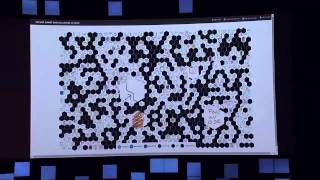
For the 2015 demonstration, we really wished to stretch ourselves by creating multiple applications that the audience was to touch. To illustrate IoT (Internet of Things), we specifically fielded several hundred bluetooth beacons and several Raspberry Pi-based sensors/scanners to demonstrate how to track movement inside of a physical space (where GPS is not appropriate). We combined this technology with a mobile application (based on the announced Red Hat Mobile Application Platform) so the moving objects (people) could see their current status, their arrivals/departures from a particular room. Also, via this same mobile application, we invited the audience to submit a finger drawn sketch to claim one of 1000+ containers we launched live on stage via Openshift (based on Docker & Kubernetes)

Video Thumbnail
Video

DevNation 2015 - Knutsen, Majsak - Taming microservices testing with Docker & Arquillian Cube

Red Hat Developer Program

With microservices, polyglot, and DevOps on the rise, what's happening with testing? Do they increase complexity and make our testing efforts harder? Or do they actually make it easier to write better tests? In this session, we will explore how we can do our testing in this new world, and how the new world can help us test better. Other topics we'll discuss include: NodeJS, DynJS, VertX, Ceylon, or Ruby-orchestrated microservices. System scale testing with different configurations. Database migration and regression testing.

Video Thumbnail
Video

DevNation 2015 - Ryan King - Devops in a container world: panel discussion

Red Hat Developer Program

DevOps is changing at a fast pace as containers are rapidly going mainstream. In this panel, leading startup companies and Red Hat's platform group will discuss their insights and predictions for the how DevOps will change going forward. Our industry experts will discuss: DevOps Docker technology Source-to-image STI CI/CD Immutable infrastructure Panel members Krish Subramanian (moderator), OpenShift director of strategy, Red Hat Avi Cavale, CEO Shippable.com Steven Sheinfield, Sr. business development manager, NewRelic Andrew Phillips, VP of product management, XebiaLabs Langdon White, Developer evangelist, Red Hat Ryan King (introduction), Red Hat Innovate

Video Thumbnail
Video

DevNation 2015 - Christian Posta & Charles Moulliard - Continuous delivery with Fuse on Openshift

Red Hat Developer Program

Come see how a practical, out-of-box-reusable deployment of a continuous delivery tool delivers complex integration deployments using tools like Docker, Jenkins, OpenShift Enterprise by Red Hat, and Red Hat JBoss Fuse. As we’ve worked with clients to complete complex integrations with JBoss Fuse, we’ve learned best practices doing continuous delivery. We’ve taken what we’ve learned and created a working, modular example hosted on github. In this session, we'll use this example to discuss continuous delivery, DevOps, and how Red Hat’s technology brings a practical approach to making the theory a reality.

Video Thumbnail
Video

DevNation 2015 - Paul Bakker - Kubernetes: Beyond the basics

Red Hat Developer Program

Kubernetes has answers to many questions related to clustering and the required low-level networking. When using Kubernetes for real live deployments we need more than those lower-level solutions however. We need things like automated deployments, load balancing for web applications, blue/green deployments and monitoring. This is all possible with Kubernetes when we start to look at Kubernetes as an API. In this talk you will learn to embrace the Kuberentes API and some of the patterns, tools and mechanisms we developed and use around Kubernetes to prepare for production grade deployments.

Video Thumbnail
Video

DevNation 2015- Michael Hrivnak - Docker for developers

Red Hat Developer Program

Docker is not just for deployment. As a developer, there are many ways Docker can make you more productive, regardless of how your app gets deployed. In this session, you'll learn practical strategies for using Docker, including how to: Run unit tests locally in multiple environments with almost no overhead. Make your integration tests easy for anyone to run by distributing them in a Docker image. Simulate advanced network topologies, especially for a service-oriented architecture. Make a Docker image in 5 minutes or less that produces builds from a consistent environment. Isolate database state changes in your test suite by using a pool of disposable containers.

Red Hat JBOSS Data Grid
Article

Enabling LDAP Security for DataGrid Cache

Kamesh Sampath

Expanding on Tristan's blog, where he spoke of enabling security for JBoss Data Grid caches, in this post we will cover how to add LDAP based security to the JDG caches. The principles and techniques remain defined by Tristan, but there are some minor changes that I will be highlighting in this blog for a successful working configuration of JDG enabled with LDAP security. Before we jump on to configuring the JDG for security, I would like to brush up...

Red Hat CDK
Article

Adding Persistent Storage to Minishift / CDK 3 in Minutes

Alessandro Arrichiello

Hi there! It's been a while since I last wrote an article. Today, I want to show you how to easily setup some persistent storage for your projects in minishift / CDK 3 (Red Hat's Containers Development Kit 3). Prerequisites First, let's start planning what you'll need: A working minishift or CDK 3. That's all, I swear! I won't go deep into how to set up a minishift or CDK 3, there are many articles on the Internet to cover...

Red Hat CDK
Article

Node, S2I and Docker

Lucas Holmquist

(Edit: November 22, 2019) The Node images used in this post, both community centos7 and product, are no longer being updated and maintained. For community images, please use the Universal Base Image (UBI)-based node images located here: registry.access.redhat.com/ubi8/nodejs-10 For a fully supported Product version of Node.js, please check out the Red Hat Software Collections Node.js image, RH SCL Node.js. Intro I like Node.js and I like Docker. While I am not an expert on either, I do pretend to be...

Red Hat Enterprise Linux
Article

How to start with Containers and OpenShift for newcomers in Red Hat Enterprise Linux 7

Petr Hracek

The document covers the initial steps that describe how to play with containers and OpenShift. The article was written together with Jiri Hornicek. Prerequisites For more information about installing containers i n RHEL, see Installation Guide - Red Hat Customer Portal Download OpenShift binaries from Releases - openshift/origin - GitHub . Extract the binaries to your / home / directory and copy them to the /usr/bin / directory : $ tar -xzvf # like openshift-origin-server-v1.3.1-dad658de7465ba8a234a4fb40b5b446a45a4cee1-linux-64bit.tar.gz $ cd $...

Software Collections logo
Article

Using Perl 5.24 Red Hat Software Collection

Jitka Plesnikova

Red Hat Software Collection (RHSCL) 2.3 brings new rh-perl524 collection. It includes Perl 5.24.0, which provides a number of bug fixes and enhancements over the previously released rh-perl520 Software Collection. The details about the changes can be found in 5.22.0 perldelta and 5.24.0 perldelta. The new collection adds package rh-perl524-perl-App-cpanminus, which contains the cpanm utility for getting, extracting, building, and installing modules from the Comprehensive Perl Archive Network (CPAN) repository. RHSCL is distributed as a collection of RPM packages that...

Using API keys securely in your OpenShift microservices and applications
Article

Using Pipelines in OpenShift 3.3+ for CI/CD

Alessandro Arrichiello

It's been a while since Red Hat released version 3.3 of OpenShift Container Platform, this version is full of features. One of my favorites is the support for Pipelines (Tech Preview for now) that lets you easily integrate Jenkins builds on your OpenShift (Origin) Platform. OpenShift Pipelines OpenShift Pipelines are based on the Jenkins Pipeline plugin. ( https://jenkins.io/solutions/pipeline/) Integrating Jenkins Pipelines into OpenShift unlocks all the features for the CI/CD world enabling its users to easily manage repeatable tasks in...

Article Thumbnail
Article

Cockpit: Your entrypoint to the Containers Management World

Alessandro Arrichiello

Containers are one of the top trend today. Starting working or playing with them could be really hard also if you've well understood the theory at their base. With this article I'll try to show you some useful tips and tricks to start into containers world, thanks also to the great web interface provided by the Cockpit project. Cockpit overview Cockpit is an interactive server admin interface. You'll find below some a of its great features: Cockpit comes “out of...

Article Thumbnail
Article

Container Orchestration Specification for better DevOps

Pradeepto Bhattacharya

The world is moving to microservices, where applications are composed of a complex topology of components, orchestrated into a coordinated topology. Microservices have become increasingly popular as they increase business agility and reduce the time for changes to be made. On top of this, containers make it easier for organizations to adopt microservices. Increasingly, containers are the runtimes used for composition, and many excellent solutions have been developed to handle container orchestration such as: Kubernetes/OpenShift; Mesos and its many frameworks...

Article Thumbnail
Article

Docker project: Can you have overlay2 speed and density with devicemapper? Yep.

Jeremy Eder

It's been a while since our last deep-dive into the Docker project graph driver performance. Over two years, in fact! In that time, Red Hat engineers have made major strides in improving container storage: Introduced the docker-storage-setup package to help make configuring devicemapper-based storage a snap. Introduced full support for overlay FS in RHEL7.2+ when used with containers Introduced overlay2 as Tech Preview mode Gotten SELinux support to both overlay and overlay2 merged into upstream kernel 4.9 Added a warning...

Red Hat and Eclipse IDE, looking back at Neon and forward at Oxygen
Article

Red Hat and Eclipse IDE, looking back at Neon and forward at Oxygen

Mickael Istria

Last June, Eclipse IDE had a great release, named Neon. It features, among many other less visible but still quite useful improvements, many new functionalities for everyone. If you did not migrate yet and are still using an older Eclipse version, just move to Neon right now, it’s worth it! For this Neon release, Red Hat managed to increase its contributions to the Eclipse IDE. The 2 main teams doing Eclipse IDE development (to package Eclipse IDE as .rpm for...

Article Thumbnail
Article

Connecting to a Remote database from a JWS/Tomcat application on OpenShift

Guna Vijayaratnam

One of the common requirements for Java based applications on OpenShift is to have these workloads connect back out to an enterprise database that resides outside of the OpenShift infrastructure. While OpenShift natively supports a variety of relational databases (including Postgres and MySQL) as Docker based deployments within the platform, connecting to an existing enterprise database infrastructure is preferred in many large organizations for a variety of reasons including: Inherent confidence in traditional databases due to in house experience around...

Article Thumbnail
Article

Create Resilient Camel applications with Hystrix

Bilgin Ibryam

Apache Camel is a mature integration library (over 9 years old now) that implements all the patterns from Enterprise Integration Patterns book, but Camel is not only an EIP implementation library, it is a modern framework that constantly evolves, adds new patterns and adapts to the changes in the industry. Apart from tens of connectors added in each release, Camel goes hand-in-hand with the new features provided by the new versions of Java language itself and other Java frameworks. With...

Article Thumbnail
Article

How to Set Up A Kubernetes Developer Box

Hemant Jain

Kubernetes is a great tool for container orchestration on a server cluster. It makes it easy to deploy lots of containers in a resource-efficient way using a simple interface. But one thing that is not easy to do with Kubernetes is to deploy it locally. Kubernetes is designed to run on an actual cluster, which means using it only on a single computer is tough. I know. You're probably wondering why you'd want to use Kubernetes locally in the first...

Article Thumbnail
Article

Maven mirrors on OpenShift with and without Source to Image (S2I)

James Falkner

I'm guessing if you've done enough repeated builds on OpenShift, using Maven, that you are probably aware of the " download the internet" phenomenon that plagues build times. You start a build, expecting all those Maven dependencies you downloaded for your last build to be re-used, but quickly see your network traffic ramp up while the same 100MB of jars are downloaded again and again. Even builds of a few minutes tend to grind on me, frustrate me as a...

Jolokia JVM Monitoring in OpenShift
Article

Jolokia JVM Monitoring in OpenShift

Andrew Block

Cloud based technology offers the ability to build, deploy and scale applications with ease; however, deploying to the cloud is only half of the battle. How cloud applications are monitored becomes a paramount concern with operations teams. When issues arise, teams and their monitoring systems must be able to detect, react, and rectify the situation. CPU, system memory, and disk space are three common indicators used to monitor applications, and are typically reported by the operating system. However, for Java...

A Practical Introduction to Docker Container Terminology
Article

A Practical Introduction to Docker Container Terminology

Scott McCarty (fatherlinux) +1

When discussing an architecture for containerization, it’s important to have a solid grasp on the related vocabulary. One of the challenges people have is that many of the terms are used interchangeably... often causing quite a bit of confusion for newcomers.

Review of the year Top 10 Highlights
Article

2015 Year in Review - oh what a year.

Emily Parish

2015 is coming to a close and it’s always fun to reflect on all that has changed, grown, and news that almost make you wonder if pigs can now fly. Our team has greatly expanded, the community is growing, we are now accepting content contributors from around the world...so much to pick from. As you can tell it’s been a busy year and here are just some of top highlights. Here we go and in no particular order: 1) A...

A Practical Introduction to Docker Container Terminology
Article

Containerize your Ruby on Rails/PostgreSQL application with RHSCL Docker images

Josef Stříbný

New RHSCL-based Docker images that are now in beta let you easily build your own application containers even without writing any Dockerfiles. Here is an example of a Ruby on Rails application built with the Ruby 2.2 image using the PostgreSQL 9.4 image as a database backend. For building the application image we will use a tool called source-to-image (s2i, formally sti) which is a program that can build your application image on top of s2i images. For example the...

A Practical Introduction to Docker Container Terminology
Article

Database Docker images - now beta via Software Collections

Marek Skalický

“As a part of the Red Hat Software Collections offering, Red Hat provides a number of container images, which are based on the corresponding Software Collections. These include application, daemon, and database images. The provided images, currently available in the Beta version” (for more information see https://access.redhat.com/articles/1752723) Red Hat Software Collections allows you to run newer versions of software on a stable Red Hat Enterprise Linux. These new images combine this feature with the benefits of containers. In this post...