Red Hat OpenShift

Video Thumbnail
Video

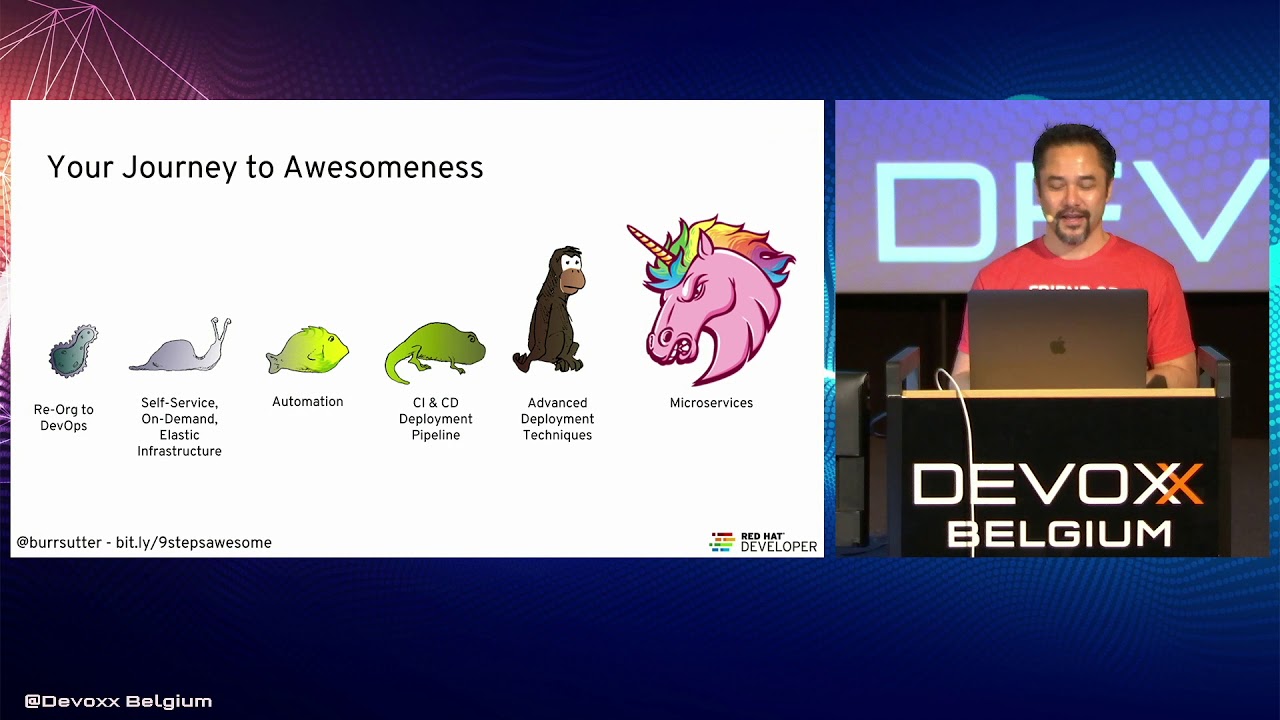
Sidecars and a microservices mesh | DevNation Tech Talk

Burr Sutter +2

In this session, we will give you a taste of Envoy and Istio, two open source projects that will change the way you write distributed, cloud native, Java applications on Kubernetes.

Configuring mKahaDB persistence storage for ActiveMQ
Article

Flexible Images or Using S2I for Image Configuration

Eliska Slobodova

Container images usually come with pre-defined tools or services with minimal or limited possibilities of further configuration. This brought us into a way of thinking of how to provide images that contain reasonable default settings but are, at the same time, easy to extend. And to make it more fun, this would be possible to achieve both on a single Linux host and in an orchestrated OpenShift environment. Source-to-image (S2I) has been introduced three years ago to allow developers to...

Using API keys securely in your OpenShift microservices and applications
Article

Accelerating the development of Node.js using OpenShift

Cesar Valdez

In this blog entry, I want to introduce a "different" way to work with OpenShift. In the typical way to deploy a Pod to OpenShift, we have available a set of very useful objects we have build/image configurations. This takes the pain from us by hiding the details about image construction but, sometimes we just want to see some code running in the cloud. Or we want to see if our service/application is able to interact with nearby services or...

Devoxx logo
Article

Red Hat Sessions at Devoxx 2017

Gunnar Morling

The 2017 edition of the legendary Devoxx conference is over, and as always, it has been a fantastic week. Hosted in Antwerp, Belgium, and sold out months in advance, it's one of the top events of the Java community. Five days fully packed with workshops, regular conference sessions, BOFs, ignite sessions and even quickie talks during the lunch breaks - there was something for everyone. The super-comfortable cinema seats at the Devoxx venue are legendary, but also if you couldn't...

Running Microsoft SQL Server pod on OpenShift
Article

Wiping the Slate Clean with the OpenShift Container Platform

Benjamin Holmes

With traditional virtualized infrastructure or Infrastructure-as-a-Service, it is common practice to regularly refresh instances back to a known good state. This provides confidence that the application workloads have the correct runtime configuration, no deltas are being introduced, and they can be relied upon to provide value for the business. In these cases, you might use tools such as Ansible or Jenkins, but when we move our application workloads to containers running on OpenShift Container Platform, we can use native tools...

Red Hat JBoss Developer Studio Logo
Article

Announcing Red Hat Developer Studio 11.1.0.GA and JBoss Tools 4.5.1.Final for Eclipse Oxygen.1A

Jeff Maury

JBoss Tools 4.5.1 and Red Hat JBoss Developer Studio 11.1 for Eclipse Oxygen.1A are here waiting for you. Check it out! Installation JBoss Developer Studio comes with everything pre-bundled in its installer. Simply download it from our JBoss Products page and run it like this: java -jar jboss-devstudio-.jar JBoss Tools or Bring-Your-Own-Eclipse (BYOE) JBoss Developer Studio requires a bit more: This release requires at least Eclipse 4.7 (Oxygen) but we recommend using the latest Eclipse 4.7.1A Oxygen JEE Bundle since...

GNU C library
Article

Fall 2017 GNU Toolchain Update Part 4

Nick Clifton

(Part 4)The GNU Toolchain is a collection of programming tools produced by the GNU Project. The tools are often packaged together due to their common use for developing software applications, operating systems, and low-level software for embedded systems. This blog is part of a regular series covering the latest changes and improvements in the components that make up this Toolchain. Apart from the announcement of new releases, however, the features described here are at the bleeding edge of software development...

Software Defined Data Center
Article

Build your Software Defined Data Center with Red Hat CloudForms and Openstack - part 2

Michele Naldini

Welcome back, here we will continue with the second part of my post, where we will work with Red Hat Cloudforms. If you remember, in our first post we spoke about Red Hat OpenStack Platform 11 (RHOSP). In addition to the blog article, at the end of this article is also a demo video I created to show to our customers/partners how they can build a fully automated software data center. Hands-on - Part 2 Well, now we need something...

Video Thumbnail
Video

Ep. 1: Input Validation (2 of 2)

Red Hat Developer Program

(Part 2)Learn about recommended practices for producing secure code with input validation in part one of this four-part video series.

Video Thumbnail
Video

Ep. 4: Security Mentality (2 of 2)

Red Hat Developer Program

Learn how to start adopting a security-like mentality, also known as the "security mindset" in part four of this four-part video series.

Video Thumbnail
Video

Ep. 3: Authorization

Red Hat Developer Program

Learn about authorization such as user privileges, levels of access, and how they're different in part three of this four-part video series.

Video Thumbnail
Video

Ep. 2: Numeric Errors

Red Hat Developer Program

Learn about numeric errors and the dangers of using incorrect data types in part two of this four-part video series.

Video Thumbnail
Video

Ep. 1: Input Validation (1 of 2)

Red Hat Developer Program

(Part 1)Learn about recommended practices for producing secure code with input validation in part one of this four-part video series.

Dynamic Storage
Article

How to configure persistent storage with OpenShift or Kubernetes for development environment

Chandra Shekhar Pandey

We know that containers in Openshift or Kubernetes don't persist data. Every time we start an application, it is started in a new container with an immutable Docker image. Hence, any persisted data in the file systems is lost when the container stops. Hence if an application or container is rebuilt or restarted than we can't view previous logs or if we are using containers with mysql or any other database then schema, tables, and all data will be lost...

Video Thumbnail
Video

Minishift

Red Hat Developer Program

Minishift

Video Thumbnail
Video

Openshift Introduction - Diogenes Rettori

Red Hat Developer Program

In this session, Diógenes gives an introduction of the basic concepts that make OpenShift, giving special attention to its relationship with Linux containers and Kubernetes.

Red Hat Logo
Article

vSphere Cloud provider and VMDK dynamic provisioning

davis phillips

The release of OpenShift Container Platform 3.6 brings support for vsphere cloud provider. This provides vsphere VMDK dynamic provisioning for persistent volumes for container workloads. The storage presented to vsphere virtual machines as a VMDK has ReadWriteOnce access mode. In the OCP 3.6 on vSphere reference architecture, much of this process is automated and can be implemented easily. Virtual Machine Disks or VMDKs exists in virtual machines. Configuring the OCP cluster for vsphere cloud provider support requires: Master Node Configuration...

Data Streaming with WildFly Swarm and Apache Kafka
Article

Data Streaming with WildFly Swarm and Apache Kafka

Ken Finnigan

At the beginning of October, I attended JavaOne in San Francisco to present on WildFly Swarm and Apache Kafka. For those of you that weren't able to attend the session, or for those that did and saw first hand the issues with the demo, I will be covering all the details of how the demo should work! The presentation material that was presented at JavaOne can be found here, and all the code for the demos is in GitHub. MiniShift...

First steps in integration of Windows and Linux Containers in Red Hat OpenShift
Article

First steps in integration of Windows and Linux Containers in OpenShift

Glenn West

I've started an interesting exploration on the integration of Microsoft Windows Containers and Linux Containers in an OCP Environment. This allows a true bi-modal IT technical implementation by combining the strength of both platforms into one cluster. So, I start this off, with the deployment of an OpenShift Cluster on Azure, using the 3.6 reference architecture. After this is run, I used the Azure Portal to add a Windows Server 2016 Node to the cluster. So if you look closely...

Remote debug your ASP
Article

Remote debug your ASP.NET Core container on OpenShift with Visual Studio Code

Takayoshi Tanaka

Visual Studio provides a graphical remote debugging ASP.NET Core app with Docker Tools for Windows. Since Visual Studio supports SSH protocol, you can remote debug ASP.NET Core process running on the Linux host. It used to be if you install and setup SSH server on docker container, you can remote debug with Visual Studio. However, it's strongly not recommended due to security reasons. Now I'll explain to you how to remote debug your ASP.NET Core on OpenShift with Visual Studio...