
Article
Keeping Kubernetes secrets secret
Watch this DevNation Tech Talk to learn how to manage your secrets with Vault in Kubernetes, and why Kubernetes secrets themselves might be not enough.
Watch this DevNation Tech Talk to learn how to manage your secrets with Vault in Kubernetes, and why Kubernetes secrets themselves might be not enough.

Learn how Migration Toolkit for Applications 5.0 analyzes your VM-based Java applications and helps you migrate them to containers.

Add Java language support to Apache Camel K within Eclipse Che with this brief how-to and video demonstration, and discover what's coming next.

Learn how to use a Spring Cloud function to build and deploy a simple Red Hat OpenShift Serverless Google Translate wrapper.

Explore container-native virtualization, a Red Hat OpenShift Container Platform feature for running and managing VM workloads alongside container workloads.
Hacking the Mesh: Extending Istio with WebAssembly Modules | DevNation Tech Talk

Red Hat CodeReady Workspaces 2.3 brings two ways to inject secrets, cluster-wide proxy support, devfile and IDE plugin updates, and more.

Create, test, and export a simple, custom namespace-scoped "Hello, World" Kubernetes Operator in Golang with the Kubernetes Operator SDK.
ArgoCD and Tekton: Match made in Kubernetes heaven | DevNation Tech Talk

Discover Open Liberty 20.0.0.8's new JSON logging features that take advantage of the accessLogging logFormat attribute, and get started using them.

Explore the range of Kubernetes 1.18-based technology updates that improve the operational and development experience when using OpenShift 4.5.

Learn the fundamental concepts and benefits of Tekton and then practice using this framework in this KubeCon 2020 CI/CD and Tekton tutorial.

Compare Kubernetes development to OpenShift's CLI and native extension API resources, including build configs, deployment configs, and image streams.
10 awesome Kubernetes tools every user should know | DevNation Tech Talk

Discover the updates in Open Data Hub 0.7, including support for Kubeflow 1.0 and increased component testing for OpenShift continuous integration.

In this DevNation Tech Talk, we use Skupper to set up cloud-native Java microservices distributed across three different public clouds.

In this DevNation Tech Talk, we introduce the Mutiny reactive programming library and show how Quarkus and Mutiny simplify reactive application development.
Serverless Workflow: New approach to Kubernetes service orchestration | DevNation Tech Talk

A decentralized team of open source container tool superheroes comes to the rescue when an asteroid storm threatens the planet. Learn about each tool—Podman, CRI-O, Buildah, Skopeo, and OpenShift—as they redesign the planet's protective shields' container deployment to protect Earth.

Learn how to experiment with your data models with Kale (a Kubeflow extension using JupyterLab's UI) to convert your notebooks to Kubeflow pipelines.

Learn how to make a monolithic Java web application cloud-native and deploy it into a Kubernetes or OpenShift cluster using Eclipse JKube Maven plugins.

Explore three options for customizing Open Data Hub or Kubeflow deployments: Edit manifests in a fork, create repositories with overrides, and add overlays.

Discover what's new in JBoss Tools 4.16.0 and Red Hat CodeReady Studio 12.16 for Eclipse 4.16 (2020-06), from UI updates to updated JDT extensions.
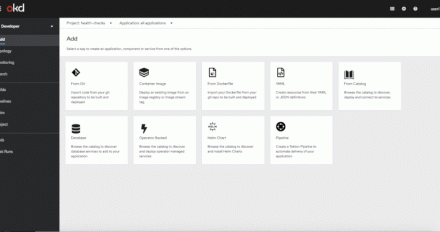
Learn how to improve application reliability and uptime in Red Hat OpenShift 4.5 with health checks using readiness, liveness, and startup probes.

Learn how to migrate Spring Boot tests to Quarkus, and how to deal with the Spring Boot test functionalities that don't map to Quarkus.

Build here. Go anywhere.
We serve the builders. The problem solvers who create careers with code.
Join us if you’re a developer, software engineer, web designer, front-end designer, UX designer, computer scientist, architect, tester, product manager, project manager or team lead.
 Ask AI