Redhat Developers  Logo
  • AI

    Get started with AI

    • Red Hat AI
      Accelerate the development and deployment of enterprise AI solutions.
    • AI learning hub
      Explore learning materials and tools, organized by task.
    • AI interactive demos
      Click through scenarios with Red Hat AI, including training LLMs and more.
    • AI/ML learning paths
      Expand your OpenShift AI knowledge using these learning resources.
    • AI quickstarts
      Focused AI use cases designed for fast deployment on Red Hat AI platforms.
    • No-cost AI training
      Foundational Red Hat AI training

    Featured resources

    • Open Source AI for developers
    • AI product application development
    • Open source-powered AI/ML for hybrid cloud
    • AI and Node.js cheat sheet

    Red Hat AI Factory with NVIDIA

    • Red Hat AI Factory with NVIDIA is a co-engineered, enterprise-grade AI solution for building, deploying, and managing AI at scale across hybrid cloud environments.
    • Explore the solution
  • Learn

    Self-guided

    • Documentation
      Find answers, get step-by-step guidance, and learn how to use Red Hat products.
    • Learning paths
      Explore curated walkthroughs for common development tasks.

    Hands-on

    • Developer Sandbox
      Spin up Red Hat's products and technologies without setup or configuration.
    • Interactive labs
      Learn by doing in these hands-on, browser-based experiences.
    • Interactive demos
      Click through product features in these guided tours.

    Browse by topic

    • AI/ML
    • Automation
    • Java
    • Kubernetes
    • Linux
    • See all topics

    Training & certifications

    • Courses and exams
    • Certifications
    • Skills assessments
    • Red Hat Academy
    • Learning subscription
    • Explore training
  • Build

    Get started

    • Red Hat build of Podman Desktop
      A downloadable, local development hub to experiment with our products and builds.
    • Developer Sandbox
      Spin up Red Hat's products and technologies without setup or configuration.

    Download products

    • Access product downloads to start building and testing right away.
    • Red Hat Enterprise Linux
    • Red Hat AI
    • Red Hat OpenShift
    • Red Hat Ansible Automation Platform
    • See all products

    Featured

    • Red Hat build of OpenJDK
    • Red Hat JBoss Enterprise Application Platform
    • Red Hat OpenShift Dev Spaces
    • Red Hat Developer Toolset

    References

    • E-books
    • Documentation
    • Cheat sheets
    • Architecture center
  • Community

    Get involved

    • Events
    • Live AI events
    • Red Hat Summit
    • Red Hat Accelerators
    • Community discussions

    Follow along

    • Articles & blogs
    • Developer newsletter
    • Videos
    • Github

    Get help

    • Customer service
    • Customer support
    • Regional contacts
    • Find a partner

    Join the Red Hat Developer program

    • Download Red Hat products and project builds, access support documentation, learning content, and more.
    • Explore the benefits

Istio Smart Canary Launch: Easing Into Production

April 24, 2018
Don Schenck
Related topics:
KubernetesJavaContainersMicroservicesNode.jsService mesh
Related products:
Red Hat OpenShift Container Platform

    First to fall over when the atmosphere is less than perfect

    Your sensibilities are shaken by the slightest defect

    You live your life like a canary in a coalmine...

    When Sting and The Police sang those lyrics, I doubt they had microservices, Istio, Kubernetes, and OpenShift in mind. Yet here we are, years later, using the Canary Deployment pattern to ease code into production.

    [This is part eight of my ten-week Introduction to Istio Service Mesh series.  My previous article was Part 7: Istio Dark Launch: Secret Services.]

    Proceed with Caution

    If you're not familiar with the Canary Deployment pattern, it's quite simple: You start up your next version of your software--a microservice, in our case--and then grant limited access to a small group of users. If that is a success, you slowly grow the group of users until the software either fails--the canary in the coal mine died--or you successfully reach 100 percent of users. By purposefully and carefully easing your software into production, and by intelligently deciding which users will request the new version, you can limit the risk and maximize the feedback.

    Of course, Istio makes this easy while giving you several good options for intelligent routing. And--you may have heard this before--you can do it all without changing your source code.

    Searching for Safari

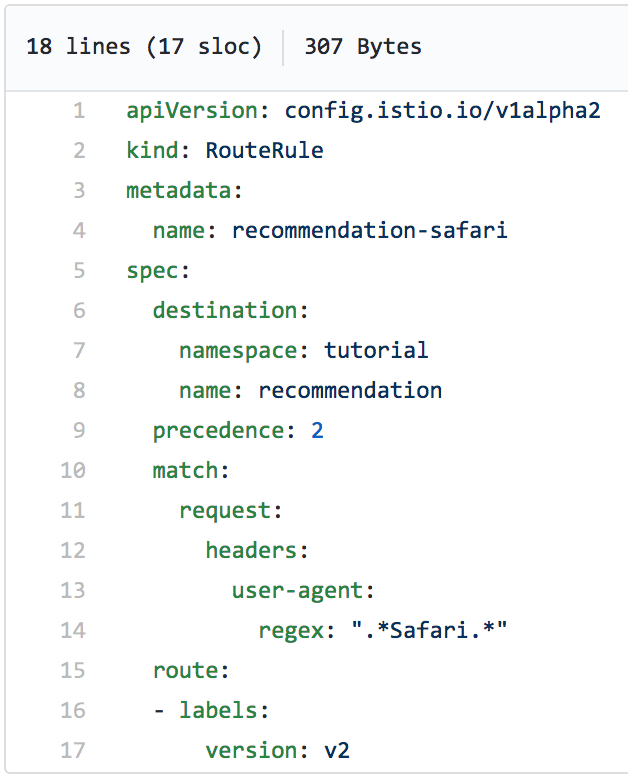
    One easy routing criteria is to allow only certain browers to have access to your site. For example, let's say you want to limit access to Safari users so that they use version 2 of your microservice. The following Istio route rule will do just that:
    After applying this route rule, we can launch a loop of curl requests from the command line to the microservice to mimic real-life activity. The result is that only version 1 of our microservice is responding to the requests:
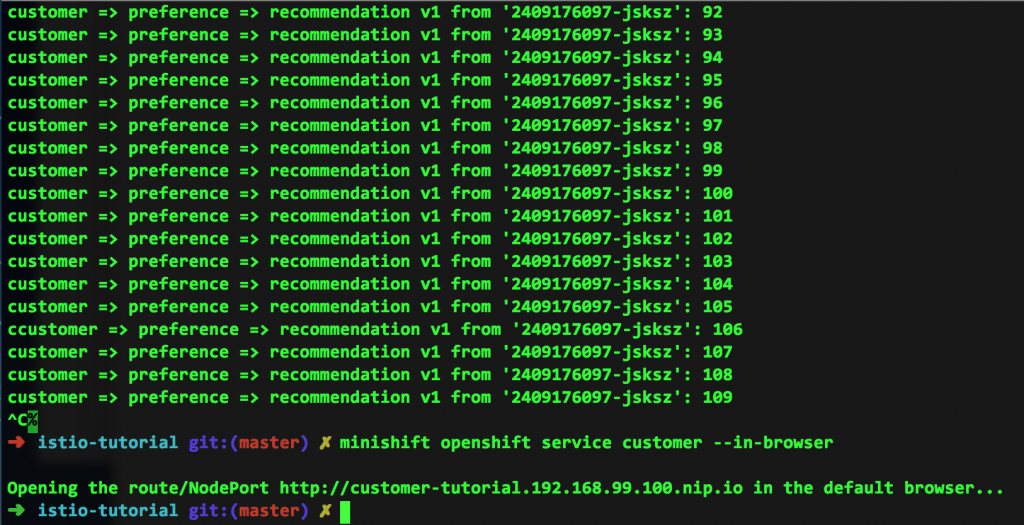
    Where is the version 2 traffic? Well, in my particular case, since I'm running curl from the command line, all of the traffic is being routed to version 1. Notice that at the end of the above screen capture, I run the request from my browser (Safari), which results in this:

     

    Unlimited Power

    As you probably noticed, using a regular expression to route requests is very powerful. Consider this following example; I'm sure you can easily figure out what it does:
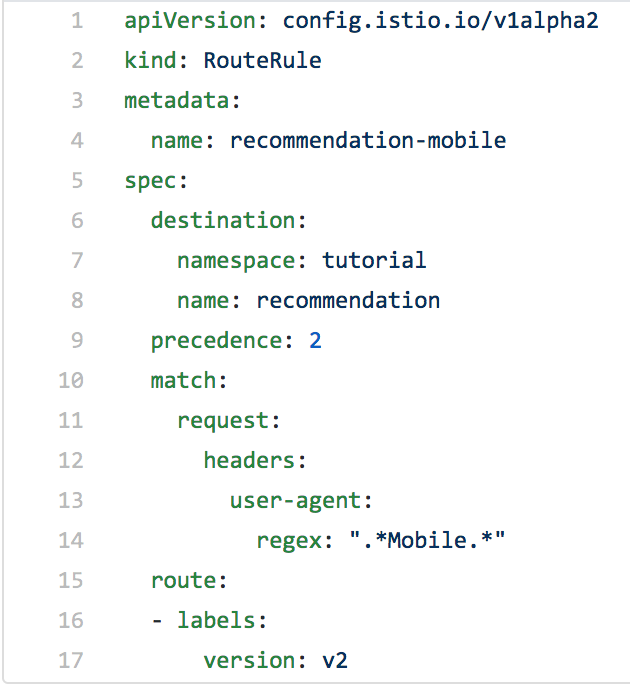
    Given these examples, you are probably already imagining what you can do.

    Being Smart About It

    Smart routing, particularly the ability to use regular expressions against request headers, means you can direct traffic however you want as you ease new code into production. It's easy, requires no changes to your source code, and can be quickly undone if necessary.

    I Want More

    Want more? Want to start experimenting with Istio, Kubernetes, and OpenShift on your own PC? Perhaps follow a tutorial? You're in luck: We (the Red Hat Developer team) have put together this awesome tutorial. We also have made available all the bits you need. Simply surf over to the tutorial and knock yourself out.

    I guess you could say it will really make your deployments sing.


    All articles in the "Introduction to Istio" series:

    • Part 1: Introduction to Istio Service Mesh
    • Part 2: Istio Route Rules: Telling Service Requests Where to Go
    • Part 3: Istio Circuit Breaker: How to Handle (Pool) Ejection
    • Part 4: Istio Circuit Breaker: When Failure Is an Option
    • Part 5: Istio Tracing & Monitoring: Where Are You and How Fast Are You Going?
    • Part 6: Istio Chaos Engineering: I Meant to Do That
    • Part 7: Istio Dark Launch: Secret Services
    • Part 8: Istio Smart Canary Launch: Easing into Production
    • Part 9: Istio Egress: Exit Through the Gift Shop
    • Part 10: Istio Service Mesh Blog Series Recap

    Last updated: September 3, 2019

    Recent Posts

    • Red Hat UBI 8 builders have been promoted to the Paketo Buildpacks organization

    • Using eBPF in Red Hat products

    • How we made one data layer serve the UI, the mocks, and the E2E tests

    • Build trusted Python containers with Project Hummingbird and Calunga

    • Simplify distributed tracing: ObservabilityInstaller installation

    Red Hat Developers logo LinkedIn YouTube Twitter Facebook

    Platforms

    • Red Hat AI
    • Red Hat Enterprise Linux
    • Red Hat OpenShift
    • Red Hat Ansible Automation Platform
    • See all products

    Build

    • Developer Sandbox
    • Developer tools
    • Interactive tutorials
    • API catalog

    Quicklinks

    • Learning resources
    • E-books
    • Cheat sheets
    • Blog
    • Events
    • Newsletter

    Communicate

    • About us
    • Contact sales
    • Find a partner
    • Report a website issue
    • Site status dashboard
    • Report a security problem

    RED HAT DEVELOPER

    Build here. Go anywhere.

    We serve the builders. The problem solvers who create careers with code.

    Join us if you’re a developer, software engineer, web designer, front-end designer, UX designer, computer scientist, architect, tester, product manager, project manager or team lead.

    Sign me up

    Red Hat legal and privacy links

    • About Red Hat
    • Jobs
    • Events
    • Locations
    • Contact Red Hat
    • Red Hat Blog
    • Inclusion at Red Hat
    • Cool Stuff Store
    • Red Hat Summit
    © 2026 Red Hat

    Red Hat legal and privacy links

    • Privacy statement
    • Terms of use
    • All policies and guidelines
    • Digital accessibility