Overview: Accelerate 5G core standalone rollout: An end-to-end testing pipeline with Red Hat OpenShift

There are many challenges to interoperability in multi-vendor 5G core environments, including managing different software versions of 5G core network functions and the need for extensive testing automation to guarantee streamlined operations across the service provider’s network. The 5G core continuous testing framework developed by Red Hat and Rebaca Technologies streamlines vendor onboarding, improves interoperability, and ultimately lays the groundwork for long-term success. To learn more, check out our blog post about the 5G core continuous testing framework.
While this framework is exciting, how we implement it is important. This learning path is your practical guide to bringing that framework to fruition. We’ll walk you through the implementation of our 5G core testing pipeline, showing you exactly how we use Red Hat OpenShift Pipelines to create a continuous quality check for a 5G core network. You'll see how we integrate tools like Red Hat Ansible Automation Platform for automation and ABot, a cloud-native testing tool from Rebaca, to ensure integration and performance across different vendors. For a look at the testing framework from start to finish, see Figure 1.
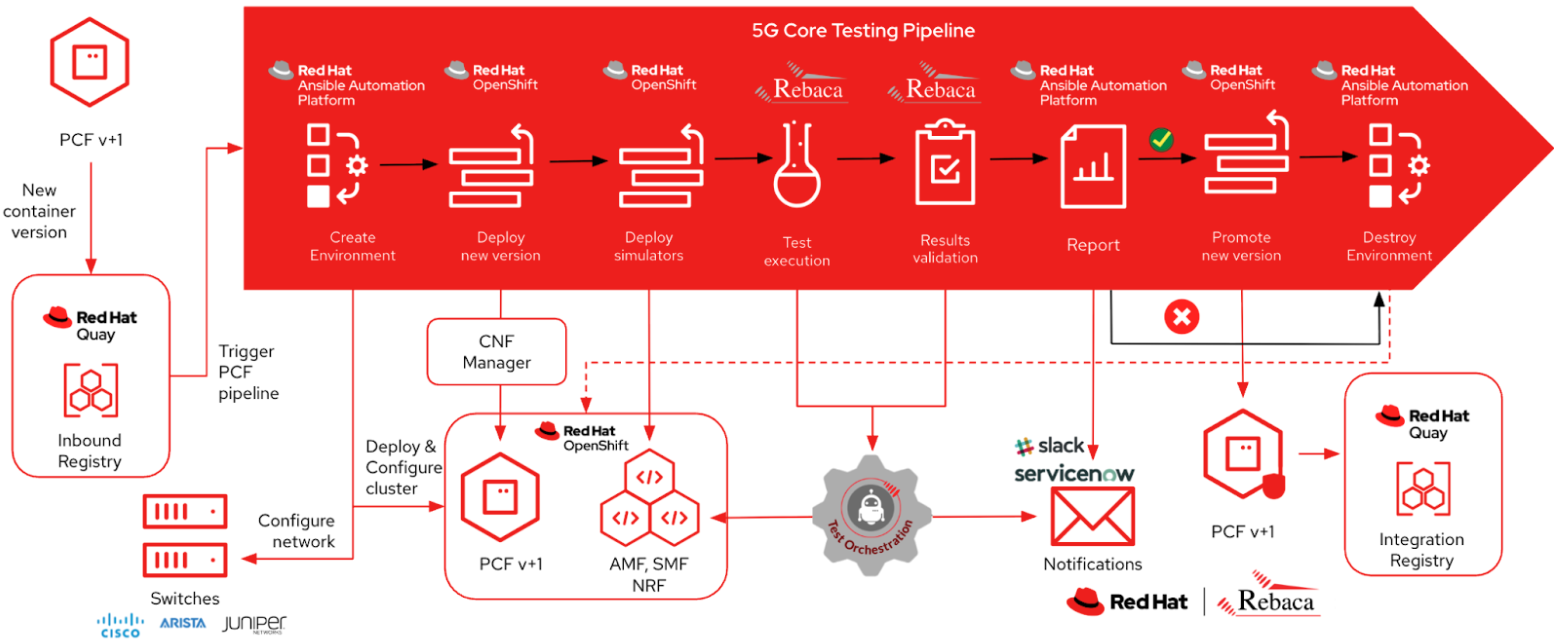
You can also watch a video demo of the process to get a sense of what we will cover.
Ready to build your own robust, automated 5G core testing environment? Let's dive in.
Prerequisites:
- Download Red Hat OpenShift version 4.18 or higher.
- Deploy a 5G core solution with deployment artifacts accessible to the CI/CD pipeline from a central repository.
- Have access to a code repository platform like GitHub for storing playbooks.
- Install an artifact registry platform like Red Hat Quay for storing container images.
- Install the Red Hat OpenShift Pipelines operator for CI/CD.
- Install a test orchestration tool like Rebaca ABot (via OperatorHub or Helm), but any comparable solution works.
- Install
oc CLIinstalled on your local machine.
In this learning path, you will:
- Create a persistent volume claim (PVC) and Ansible Automation Platform credentials in a new pipelines project.
- Add the
cluster-adminrole to the pipeline service account. - Configure inbound and outbound Quay repositories.
- Configure ABot with the correct properties files.
- Integrate Slack notifications into the testing pipeline.
- Create a new pipeline with defined tasks on your OpenShift cluster.
- Run the pipeline by pushing the test image to the inbound repository and see whether it passes or fails.

