So we've covered what edge computing is, what platforms are available, and how to choose between them. But there's one question that comes up in nearly every conversation I have with customers: "That's great, but how do I manage all of this?" And frankly, it's the right question to ask. When you're deploying to tens, hundreds, or thousands of edge locations, consistent management is what determines whether your deployment succeeds at scale.
Red Hat addresses this with a layered management approach to edge computing architecture. Think of it as 3 compartments, as shown in Figure 1. At the bottom, you have management tools that work universally—regardless of whether you're running Red Hat Enterprise Linux (RHEL) with Podman, MicroShift, or full-blown Red Hat OpenShift at your edge sites. These include Red Hat Ansible Automation Platform, Red Hat Quay, Red Hat Lightspeed (formerly Red Hat Insights), and Red Hat Trusted Software Supply Chain.
On the left, we have solutions that focus on operating system (OS)-level fleet management for RHEL-based deployments: Red Hat Edge Manager and Red Hat Satellite. And on the right, for Kubernetes-based deployments, Red Hat Advanced Cluster Management for Kubernetes and Red Hat Advanced Cluster Security for Kubernetes provide the cluster lifecycle and security management that comes with running an enterprise platform.
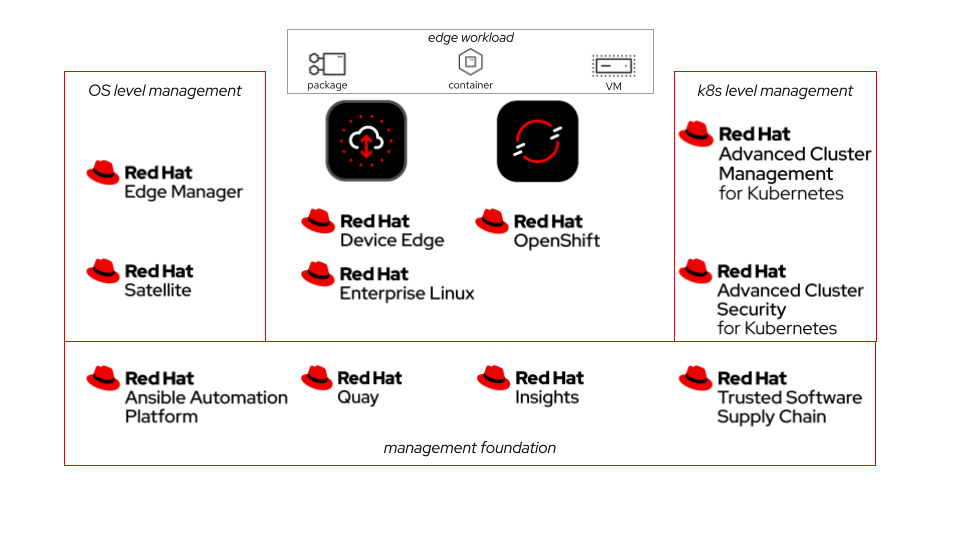
Let's walk through each of them. For every management solution, I'll give you a short description, tell you when to use it, highlight its strengths, and candidly point out the trade-offs so you can assemble the management stack that fits your scenario.
Management foundation
These tools form the base layer of any edge management strategy. They're not tied to a specific deployment type—you'll benefit from them whether you run RHEL, MicroShift, or OpenShift at the edge.
Red Hat Ansible Automation Platform
Ansible Automation Platform is Red Hat's enterprise automation engine. At the edge, it shines at automating the repetitive tasks that come with managing distributed infrastructure: configuring network devices, deploying applications, applying security policies, and orchestrating complex workflows across hundreds of locations. Its agentless architecture is a real advantage here because no additional software needs to run on the managed edge devices.
But what makes Ansible especially valuable at the edge goes beyond managing Linux hosts or Kubernetes clusters. You can automate pretty much anything with an API—switches, routers, firewalls, and storage appliances—through Ansible playbooks. Ansible connects your Linux hosts, network hardware, and storage systems into a single, repeatable workflow. Event-Driven Ansible takes this a step further: it can automatically respond to events from the edge, for instance, remediating a misconfigured device the moment Red Hat Lightspeed detects drift.
For edge teams automating unfamiliar devices, the automation coding assistant (formerly Red Hat Ansible Lightspeed)—powered by IBM watsonx—accelerates playbook creation by generating automation code directly from natural language prompts.
Strengths:
- Agentless, human-readable automation across the full technology stack, including Linux, network gear, cloud services, and APIs
- Massive ecosystem of pre-built content through Ansible Galaxy and certified collections
- Event-Driven Ansible enables automated response to edge events
- Optional pull-based device connectivity when paired with Red Hat Edge Manager
When to use:
- Whenever you need to automate operational tasks consistently across your edge footprint, as Ansible complements every other tool on this list
Trade-offs:
- For large-scale container orchestration, use alongside purpose-built tools like Red Hat Advanced Cluster Management. Ansible automates tasks but doesn't continuously reconcile desired state like a Kubernetes operator.
- Requires SSH access from the management layer (core) to the edge: either the port must be open, the edge device has a VPN client to securely connect to the management layer, or you use the Red Hat Edge Manager capability (see above)
Red Hat Quay container image registry
Quay is Red Hat's enterprise container image registry. Having a reliable, secure place to store and distribute container images is foundational at the edge, whether your workloads run on Podman, MicroShift, or OpenShift. Quay gives you vulnerability scanning, role-based access control, geo-replication, and continuous integration and continuous delivery (CI/CD) integration. That means you can catch known vulnerabilities before images ever reach your edge locations.
For connected sites, Quay is available as a hosted service (quay.io). For isolated environments, it can be deployed self-managed on-premise.
For disconnected or bandwidth-constrained edge sites, set up local Quay mirrors near your edge sites so remote nodes don't have to pull heavy container images over constrained WAN links. Combined with image mode for Red Hat Enterprise Linux (bootc), where the entire OS is packaged as a container image, Quay becomes the single distribution hub for your complete edge software stack: operating system, middleware, and application workloads.
Strengths:
- Built-in vulnerability scanning catches known vulnerabilities before images reach edge locations
- Geo-replication and mirror registries for bandwidth-efficient edge distribution
- Works in both connected and disconnected environments
When to use:
- Whenever you deploy container-based workloads to the edge, as even RHEL-based deployments benefit from Quay when using image mode for Red Hat Enterprise Linux (bootc)
Trade-offs:
- Quay distributes images but doesn't orchestrate deployments; pair it with Ansible, Red Hat Edge Manager, or Red Hat Advanced Cluster Management to roll out updates.
Red Hat Lightspeed
Red Hat Lightspeed (formerly known as Red Hat Insights) is a software-as-a-service (SaaS) or on-premise analytics service included with every Red Hat subscription. Red Hat Lightspeed continuously analyzes fleet telemetry against Red Hat's knowledge base, flagging misconfigurations and CVEs before they cause outages.
For edge deployments, where physical access to systems is limited and sending someone to troubleshoot is expensive, this proactive approach is invaluable. Red Hat Lightspeed detects configuration drift, flags vulnerable systems, and recommends remediation steps, often with pre-built Ansible playbooks you can apply automatically. The compliance service helps you prove your edge fleet meets regulatory requirements like Payment Card Industry Data Security Standard (PCI DSS), Health Insurance Portability and Accountability Act (HIPAA), or Center for Internet Security (CIS) benchmarks across all locations, which your auditors will thank you for.
Strengths:
- Proactive risk identification with automated Ansible remediation
- Compliance service for PCI-DSS, HIPAA, and CIS benchmarks across all edge locations
- Included with existing Red Hat subscriptions at no additional cost
When to use:
- Any edge deployment where you want visibility into fleet health, security, and compliance without manually checking each system
Trade-offs:
- Requires connectivity to the Red Hat SaaS platform. For fully air-gapped environments, use Satellite's local compliance capabilities instead.
Trusted Software Supply Chain
Red Hat Trusted Software Supply Chain brings end-to-end supply chain security to your edge deployments. Edge security requires verifying that software running at remote locations comes from trusted sources, remains untampered, and meets security standards. Red Hat Trusted Software Supply Chain addresses this across the full software lifecycle (code, build, deploy, and monitor), so you catch problems early rather than discovering them in production at a remote edge site.
At its core, the solution bundles 3 capabilities as the Red Hat Advanced Developer Suite. Red Hat Developer Hub provides a Backstage-based internal developer portal with security-focused solution templates and integrated checks—giving developers pre-approved assets so they can write compliant code without friction. Red Hat Trusted Profile Analyzer lets you curate trusted open source content, with provenance verification and proactive vulnerability analysis that helps you understand the impact radius of security threats before they reach your edge fleet. And Red Hat Trusted Artifact Signer, built on the open source Sigstore project, provides cryptographic signing, attestation, and verification for your container images and build artifacts using an immutable transparency log.
By automating image signing and SBOM generation during build time, your CI/CD pipeline enforces SLSA Level 3 compliance before code ever reaches remote hardware. At deployment time, whether through Red Hat Advanced Cluster Management, Red Hat Edge Manager, or Ansible, enterprise contract policies enforce that only signed, verified images built from trusted content are allowed to run. This gives you an unbroken chain of trust from development to production at the edge. For regulated industries where audit trails and provenance documentation are mandatory, this is what keeps you compliant.
Strengths:
- End-to-end supply chain security across the full software lifecycle, from coding to runtime
- Curated, provenance-verified open source content reduces risk from inherited dependencies
- Tamper-evident, auditable software provenance through cryptographic signing and transparency logs
- Automated SBOM generation and SLSA Level 3 build attestations for regulatory compliance
- Built on open standards (Sigstore, in-toto, SLSA) for broad ecosystem compatibility
When to use:
- Whenever security or compliance demands provenance verification for edge-deployed software, which is increasingly a must-have for regulated industries
- When your development teams consume open source dependencies and need visibility into what's in their supply chain
Trade-offs:
- Requires integration into your CI/CD pipeline and developer workflows. The setup investment pays off at scale, but plan for it upfront.
- The full value comes from adopting the complete lifecycle approach; using signing without trusted content curation and developer portal captures only part of the benefit
OS-level management
Now we move to solutions designed specifically for managing RHEL-based edge deployments: the operating system, its configuration, content, and lifecycle.
Red Hat Edge Manager
Red Hat Edge Manager is a central management plane built specifically to operate large fleets of devices running RHEL and MicroShift. It allows you to organize your edge fleet into groups, roll out OS and application updates, monitor device status, and enforce configuration through a declarative, GitOps-inspired approach.
What I find compelling about Edge Manager is its device-centric model. Devices enroll with the service, organize into fleets using labels, and operate through desired-state specifications. Update a fleet spec, and Edge Manager handles the rollout across all matching devices: staged rollouts, health checks, automatic rollbacks, the works. For MicroShift deployments, it manages the complete stack through a single plane: OS image, MicroShift configuration, and Kubernetes workloads.
Strengths:
- Purpose-built for edge device management at scale with a modern declarative approach
- Manages both RHEL (bootc and RPM-based) and MicroShift through a unified management plane
- Designed for intermittent connectivity scenarios common at edge sites
When to use:
- As the preferred management solution for RHEL and Red Hat Device Edge or MicroShift deployments, especially at scale
- If you are starting a new RHEL or MicroShift deployment and require declarative, GitOps-based fleet management, consider Edge Manager as your primary management plane
Trade-offs:
- Feature set is still growing. For complex content lifecycle management (custom RPM repositories and content management), Satellite remains more mature.
- Does not manage OpenShift clusters; pair with Red Hat Advanced Cluster Management for that.
Red Hat Satellite
Red Hat Satellite is the established content and lifecycle management platform for RHEL. If your datacenter already relies on Red Hat Satellite, you can extend those same content promotion pipelines out to your edge hosts. Satellite provides comprehensive content management (RPM packages, errata, container images), provisioning, configuration management, and compliance reporting. Originally designed for datacenters and the cloud, it also supports edge deployments.
Satellite Capsule servers solve edge bandwidth challenges by acting as local content proxies, caching updates nearby so remote nodes patch efficiently. This matters when you have limited bandwidth or patchy connectivity. Satellite's content lifecycle management, with its structured promotion from dev through test to production, provides the change management rigor regulated industries need.
Strengths:
- Mature, feature-rich lifecycle management with deep RHEL integration
- Structured content promotion workflows (dev → test → prod)
- Capsule servers for local content distribution at edge sites
- Comprehensive compliance and audit reporting
When to use:
- When you need sophisticated content lifecycle management with promotion workflows (dev → test → prod)
- When you already have Satellite infrastructure in place
- For traditional RPM-based edge deployments needing granular package management
Trade-offs:
- Requires many times more infrastructure investment than Edge Manager, needing dedicated servers for Satellite and Capsule instances with large resources
- For new image-based edge deployments using bootc, Edge Manager's declarative model might be a more natural fit, though the two are complementary.
- Requires a high-bandwidth network link between the system being managed and Satellite/Capsule
Kubernetes-level management
For edge deployments running OpenShift (whether single-node OpenShift, 2-node, or compact clusters), these are the tools that give you platform lifecycle management and security at scale.
Red Hat Advanced Cluster Management for Kubernetes
Red Hat Advanced Cluster Management for Kubernetes is the central hub for your OpenShift fleet. From a single pane of glass, you provision new edge clusters, manage their lifecycle, deploy applications consistently, and enforce governance policies. If you're running OpenShift at the edge, Red Hat Advanced Cluster Management is what scales your operations from a handful of clusters to hundreds or thousands.
Red Hat Advanced Cluster Management's edge story is built on 3 pillars. First, cluster lifecycle: Red Hat Advanced Cluster Management supports Zero-Touch Provisioning (ZTP), meaning a bare-metal server at an edge site boots up, gets automatically provisioned as an OpenShift cluster, and joins your managed fleet without anyone on-site needing to do anything beyond plugging it in. This is how large telco Open Radio Access Network (O-RAN) deployments stand up thousands of cell sites.
Second, application management: you define desired application state in Git, and Red Hat Advanced Cluster Management helps apply it consistently across all target clusters, enabling GitOps at fleet scale.
Third, governance: policies let you enforce security standards, resource quotas, and compliance requirements across every cluster. If there's a policy violation at a remote edge site, Red Hat Advanced Cluster Management catches it and can remediate automatically.
Strengths:
- Single point of control for the entire OpenShift edge fleet
- Zero-Touch Provisioning (ZTP) for hands-free edge cluster deployment
- GitOps-based application management for consistency at scale
- Policy-based governance for automated compliance enforcement
- Pairs with Red Hat Edge Manager to provide a unified control panel for OpenShift, MicroShift, and RHEL devices
When to use:
- Whenever you run OpenShift at the edge, whether managing a few clusters or thousands
- The more clusters you manage, the more value Red Hat Advanced Cluster Management provides
Trade-offs:
- Requires an OpenShift hub cluster, which adds to the infrastructure footprint
- Not the right tool for RHEL-only edge deployments; use Edge Manager or Satellite instead
Red Hat Advanced Cluster Security for Kubernetes
Red Hat Advanced Cluster Security for Kubernetes delivers security across the full container lifecycle: build, deploy, and runtime. Because remote edge sites lack physical security controls, software-level encryption and access policies are mandatory.
Red Hat Advanced Cluster Security scans images for vulnerabilities, enforces deployment policies (blocking images with critical CVEs, for example), monitors runtime behavior for anomalies, and maps network traffic. The tight integration with Red Hat Advanced Cluster Management means security policies cascade across your entire edge fleet through the same governance framework. Define a policy prohibiting any container with a known critical vulnerability from running at any edge location, and Red Hat Advanced Cluster Security enforces it everywhere Red Hat Advanced Cluster Management manages. That combination of centralized policy and distributed enforcement is exactly what edge security requires.
Strengths:
- Full lifecycle container security, including vulnerability management, deployment policies, runtime detection, and network visibility
- Fleet-wide security enforcement through tight Red Hat Advanced Cluster Management integration
- Centralized security dashboard across all edge clusters
When to use:
- Whenever you run OpenShift or MicroShift at the edge and need consistent security across distributed locations
- Especially valuable in regulated industries or where physical edge security is limited
Trade-offs:
- Sensor and collector components add resource overhead on each managed cluster; factor the additional CPU and memory into hardware sizing for resource-constrained edge nodes.
Conclusion
Managing edge infrastructure isn't about finding a single silver bullet—it's about layering automation, image delivery, and cluster governance to fit your footprint. The management tools aren't an afterthought; they're what turns a collection of edge sites into a managed, secure, and maintainable fleet.
The key takeaway: these tools are complementary, not competing. A typical RHEL or MicroShift edge deployment might combine Edge Manager for fleet management, Ansible for infrastructure automation, Quay for image distribution, Lightspeed for proactive monitoring, and Trusted Software Supply Chain for provenance, all working together. Running OpenShift at the edge? Swap in Red Hat Advanced Cluster Management for cluster lifecycle and add Red Hat Advanced Cluster Security for security. The building blocks are there; you choose how to stack them based on what your edge locations need.
Thanks for staying with me through all 3 parts. Ready to test these management patterns? Spin up a test environment in the no-cost Developer Sandbox or explore Red Hat edge solutions.
And if you missed the earlier parts: Part 1 covers RHEL and Device Edge platform selection, and part 2 dives into OpenShift topologies. Start wherever fits your current decision.

