Redhat Developers  Logo
  • AI

    Get started with AI

    • Red Hat AI
      Accelerate the development and deployment of enterprise AI solutions.
    • AI learning hub
      Explore learning materials and tools, organized by task.
    • AI interactive demos
      Click through scenarios with Red Hat AI, including training LLMs and more.
    • AI/ML learning paths
      Expand your OpenShift AI knowledge using these learning resources.
    • AI quickstarts
      Focused AI use cases designed for fast deployment on Red Hat AI platforms.
    • No-cost AI training
      Foundational Red Hat AI training.

    Featured resources

    • OpenShift AI learning
    • Open source AI for developers
    • AI product application development
    • Open source-powered AI/ML for hybrid cloud
    • AI and Node.js cheat sheet

    Red Hat AI Factory with NVIDIA

    • Red Hat AI Factory with NVIDIA is a co-engineered, enterprise-grade AI solution for building, deploying, and managing AI at scale across hybrid cloud environments.
    • Explore the solution
  • Learn

    Self-guided

    • Documentation
      Find answers, get step-by-step guidance, and learn how to use Red Hat products.
    • Learning paths
      Explore curated walkthroughs for common development tasks.
    • Guided learning
      Receive custom learning paths powered by our AI assistant.
    • See all learning

    Hands-on

    • Developer Sandbox
      Spin up Red Hat's products and technologies without setup or configuration.
    • Interactive labs
      Learn by doing in these hands-on, browser-based experiences.
    • Interactive demos
      Click through product features in these guided tours.

    Browse by topic

    • AI/ML
    • Automation
    • Java
    • Kubernetes
    • Linux
    • See all topics

    Training & certifications

    • Courses and exams
    • Certifications
    • Skills assessments
    • Red Hat Academy
    • Learning subscription
    • Explore training
  • Build

    Get started

    • Red Hat build of Podman Desktop
      A downloadable, local development hub to experiment with our products and builds.
    • Developer Sandbox
      Spin up Red Hat's products and technologies without setup or configuration.

    Download products

    • Access product downloads to start building and testing right away.
    • Red Hat Enterprise Linux
    • Red Hat AI
    • Red Hat OpenShift
    • Red Hat Ansible Automation Platform
    • See all products

    Featured

    • Red Hat build of OpenJDK
    • Red Hat JBoss Enterprise Application Platform
    • Red Hat OpenShift Dev Spaces
    • Red Hat Developer Toolset

    References

    • E-books
    • Documentation
    • Cheat sheets
    • Architecture center
  • Community

    Get involved

    • Events
    • Live AI events
    • Red Hat Summit
    • Red Hat Accelerators
    • Community discussions

    Follow along

    • Articles & blogs
    • Developer newsletter
    • Videos
    • Github

    Get help

    • Customer service
    • Customer support
    • Regional contacts
    • Find a partner

    Join the Red Hat Developer program

    • Download Red Hat products and project builds, access support documentation, learning content, and more.
    • Explore the benefits

How Trilio secures OpenShift virtual machines and containers

June 12, 2025
Ricardo Garcia Cavero
Related topics:
SecurityVirtualization
Related products:
Red Hat OpenShift Container PlatformRed Hat OpenShift Virtualization

    Modern IT environments demand platforms capable of running any type of application, from traditional virtualized to cutting-edge, cloud-native and AI/ML workloads. 

    Red Hat OpenShift has positioned itself as a trusted enterprise Kubernetes platform that enables organizations to deliver all their applications in new ways, supporting deployments across edge, datacenter, hybrid, and multi-cloud environments. Within the Red Hat OpenShift platform, organizations can manage containers and virtual machines (VMs). VMs isolate the hardware, typically running applications on top of OS dependencies, a kernel, hypervisor, and hardware.

    Conversely, containers isolate the process, running applications on OS dependencies layered on a container host (kernel), hypervisor, and hardware. While containers offer significant flexibility, container environments present unique challenges such as:

    • Container security: image scanning, patching, and compliance.

    • Day 2 management: installations, upgrades, maintenance, and integration.

    • Application delivery: monitoring, metering, management, and integration.

    This article discusses comprehensive data protection for OpenShift and protecting containers and virtual machines with Trilio.

    Data protection for cloud-native apps

    As organizations leverage Red Hat OpenShift Virtualization to integrate traditional virtualized workloads alongside cloud-native applications, the need for a robust, unified data protection strategy becomes critical. Reliable backup and restore capabilities are essential for ensuring business continuity and disaster recovery. 

    The responsibility for protecting these workloads often falls on specific roles. VM administrators are frequently tasked with the day-to-day management, backup, and restoring of virtual guests and their applications. Virtual infrastructure administrators manage the underlying physical infrastructure, storage, and networking necessary for successfully running VM resources. 

    This highlights the need for a solution that can address the data protection requirements of both virtual machines and containers in a converged environment like this and makes the transition easy for traditional VM administrators familiar with legacy virtualization technologies but not necessarily with OpenShift Virtualization. 

    Trilio is recognized as a leader in cloud-native data protection for Kubernetes, KubeVirt, and OpenStack environments. Customers across industries (including telecom, defense, automotive, and financial services) trust Trilio’s technology for critical operations, such as disaster recovery or migrating workloads to new infrastructure. It seamlessly integrates with OpenShift by an operator that, once installed, creates a menu in the OpenShift console (Figure 1). The operator framework makes it easy to integrate partner products with OpenShift and manage their lifecycle.
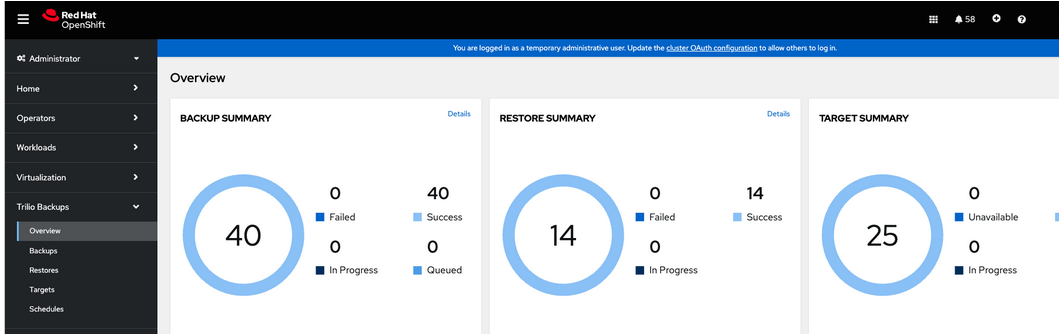
    Trilio Backups menu in Red Hat OpenShift Console.
    Figure 1: Trilio backups menu in the Red Hat OpenShift Console.

    Trilio's advanced solutions

    Trilio provides the same advanced backup and recovery capabilities for containers and VMs running on OpenShift. The most important features that makes it an outstanding solution include:

    • High granularity: With Trilio, customers can decide what needs to be backed up and restored, whether it is a complete namespace, an operator (to prevent unexpected issues after upgrading it), a container image, or some files in a VM or any other element, instead of having to take large comprehensive backups all the time.
    • No vendor lock-in: Trilio uses non-proprietary backup formats—QCOW2 for data and JSON for metadata.
    • Effective protection against ransomware with immutable backups and LUKS-256 bit encryption.
    • Recover anywhere, be it bare metal, any cloud, or a mix of them.
    • Any storage: Backups and restores can be performed to/from any S3, NFS, or Blob storage.
    • Recovery with transforms that allows customers to modify the resources of the restored components, e.g. change the CPU, memory or even chipset of a VM.
    • Faster disaster recovery: Trilio offers fast recovery time objective (RTO) in case of disaster thanks to Trilio Continuous Restore, which automatically creates a snapshot in the disaster recovery cluster every time a backup is taken on the main one (Figure 2).
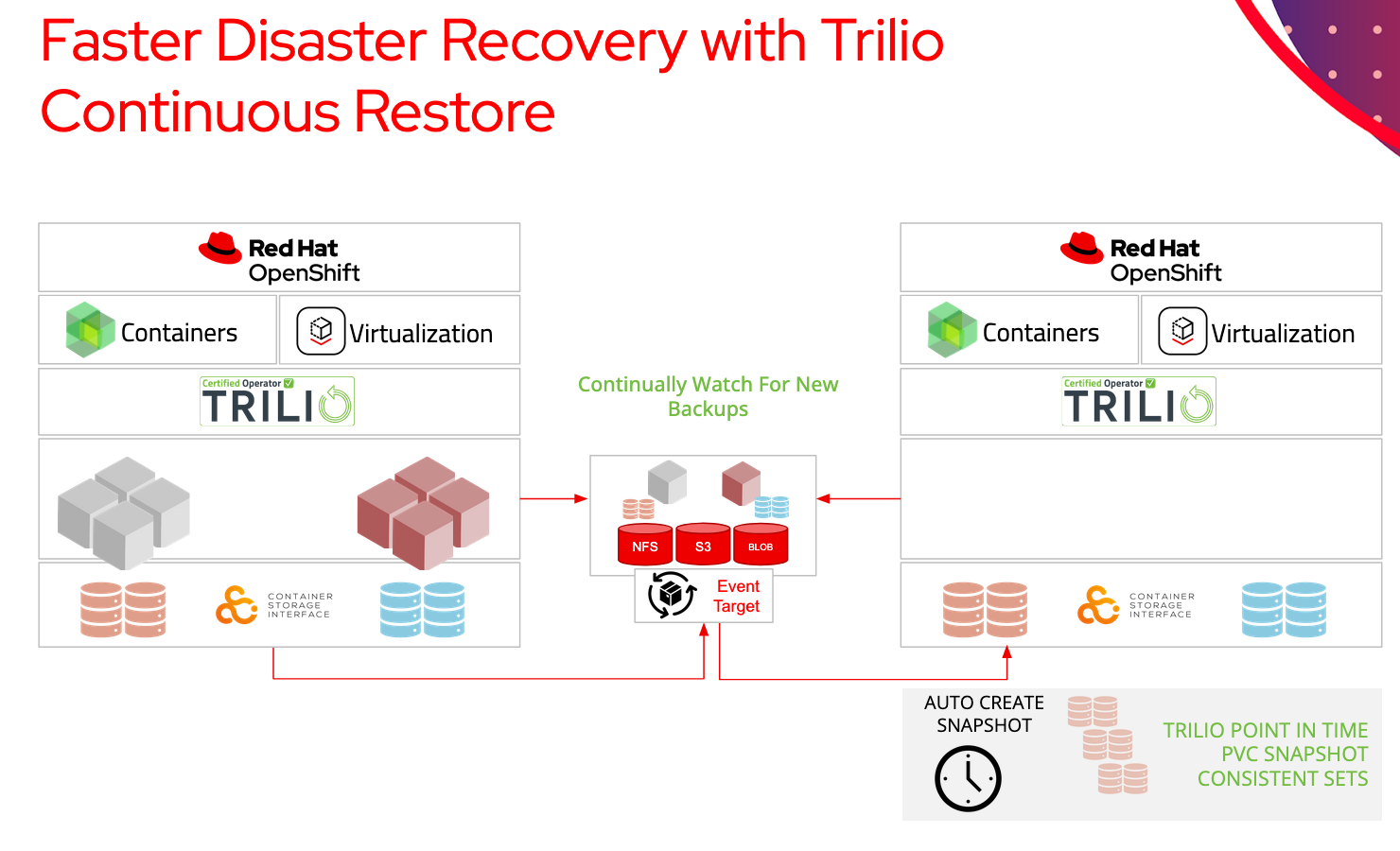
    Disaster recovery with Trilio Continuous Restore.
    Figure 2: Disaster recovery with Trilio Continuous Restore.

    The synergy between Trilio and Red Hat technologies goes beyond OpenShift. It also integrates with Red Hat Advanced Cluster Management for Kubernetes. For example it manages the lifecycle of the Trilio operator in all Red Hat OpenShift clusters, and Red Hat Ansible Automation Platform has a dedicated collection on Automation Hub, allowing you to cover complex scenarios like unattended recoveries triggered by Event-Driven Ansible. The administrator’s tasks are highly simplified when they don't have to do them manually.

    Wrap up

    Protecting your vital virtual machines and containers running on Red Hat OpenShift is essential for ensuring resilience and business continuity. Trilio provides robust and innovative capabilities to back up, restore, and protect these crucial workloads effectively across any type of infrastructure.

    Curious to see this data protection solution in action? Contact a Red Hat or Trilio sales representative to learn how to perform essential management activities like operator installation, creating backup targets, defining backup plans, and executing restores for your critical OpenShift workloads. 

    Related Posts

    • Building virtual machines with Red Hat Developer Hub: The what, why, and how

    • A self-service approach to building virtual machines at scale

    • How to back up and restore virtual machines with OpenShift

    • How to build virtual machines using Ansible Collections

    Recent Posts

    • Every layer counts: Defense in depth for AI agents with Red Hat AI

    • Fun in the RUN instruction: Why container builds with distroless images can surprise you

    • Trusted software factory: Building trust in the agentic AI era

    • Build a zero trust AI pipeline with OpenShift and RHEL CVMs

    • Red Hat Hardened Images: Top 5 benefits for software developers

    What’s up next?

    This learning path provides a detailed step-by-step guide for migrating applications distributed in VMware vSphere-compliant OVA files into Red Hat OpenShift Virtualization.

    Start the activity
    Red Hat Developers logo LinkedIn YouTube Twitter Facebook

    Platforms

    • Red Hat AI
    • Red Hat Enterprise Linux
    • Red Hat OpenShift
    • Red Hat Ansible Automation Platform
    • See all products

    Build

    • Developer Sandbox
    • Developer tools
    • Interactive tutorials
    • API catalog

    Quicklinks

    • Learning resources
    • E-books
    • Cheat sheets
    • Blog
    • Events
    • Newsletter

    Communicate

    • About us
    • Contact sales
    • Find a partner
    • Report a website issue
    • Site status dashboard
    • Report a security problem

    RED HAT DEVELOPER

    Build here. Go anywhere.

    We serve the builders. The problem solvers who create careers with code.

    Join us if you’re a developer, software engineer, web designer, front-end designer, UX designer, computer scientist, architect, tester, product manager, project manager or team lead.

    Sign me up

    Red Hat legal and privacy links

    • About Red Hat
    • Jobs
    • Events
    • Locations
    • Contact Red Hat
    • Red Hat Blog
    • Inclusion at Red Hat
    • Cool Stuff Store
    • Red Hat Summit
    © 2026 Red Hat

    Red Hat legal and privacy links

    • Privacy statement
    • Terms of use
    • All policies and guidelines
    • Digital accessibility

    Chat Support

    Please log in with your Red Hat account to access chat support.