Redhat Developers  Logo
  • AI

    Get started with AI

    • Red Hat AI
      Accelerate the development and deployment of enterprise AI solutions.
    • AI learning hub
      Explore learning materials and tools, organized by task.
    • AI interactive demos
      Click through scenarios with Red Hat AI, including training LLMs and more.
    • AI/ML learning paths
      Expand your OpenShift AI knowledge using these learning resources.
    • AI quickstarts
      Focused AI use cases designed for fast deployment on Red Hat AI platforms.
    • No-cost AI training
      Foundational Red Hat AI training.

    Featured resources

    • OpenShift AI learning
    • Open source AI for developers
    • AI product application development
    • Open source-powered AI/ML for hybrid cloud
    • AI and Node.js cheat sheet

    Red Hat AI Factory with NVIDIA

    • Red Hat AI Factory with NVIDIA is a co-engineered, enterprise-grade AI solution for building, deploying, and managing AI at scale across hybrid cloud environments.
    • Explore the solution
  • Learn

    Self-guided

    • Documentation
      Find answers, get step-by-step guidance, and learn how to use Red Hat products.
    • Learning paths
      Explore curated walkthroughs for common development tasks.
    • Guided learning
      Receive custom learning paths powered by our AI assistant.
    • See all learning

    Hands-on

    • Developer Sandbox
      Spin up Red Hat's products and technologies without setup or configuration.
    • Interactive labs
      Learn by doing in these hands-on, browser-based experiences.
    • Interactive demos
      Click through product features in these guided tours.

    Browse by topic

    • AI/ML
    • Automation
    • Java
    • Kubernetes
    • Linux
    • See all topics

    Training & certifications

    • Courses and exams
    • Certifications
    • Skills assessments
    • Red Hat Academy
    • Learning subscription
    • Explore training
  • Build

    Get started

    • Red Hat build of Podman Desktop
      A downloadable, local development hub to experiment with our products and builds.
    • Developer Sandbox
      Spin up Red Hat's products and technologies without setup or configuration.

    Download products

    • Access product downloads to start building and testing right away.
    • Red Hat Enterprise Linux
    • Red Hat AI
    • Red Hat OpenShift
    • Red Hat Ansible Automation Platform
    • See all products

    Featured

    • Red Hat build of OpenJDK
    • Red Hat JBoss Enterprise Application Platform
    • Red Hat OpenShift Dev Spaces
    • Red Hat Developer Toolset

    References

    • E-books
    • Documentation
    • Cheat sheets
    • Architecture center
  • Community

    Get involved

    • Events
    • Live AI events
    • Red Hat Summit
    • Red Hat Accelerators
    • Community discussions

    Follow along

    • Articles & blogs
    • Developer newsletter
    • Videos
    • Github

    Get help

    • Customer service
    • Customer support
    • Regional contacts
    • Find a partner

    Join the Red Hat Developer program

    • Download Red Hat products and project builds, access support documentation, learning content, and more.
    • Explore the benefits

New developer onboarding features in Red Hat OpenShift 4.6

November 20, 2020
Serena Chechile Nichols
Related topics:
CI/CDDevOpsKubernetesServerless
Related products:
Red Hat OpenShift

    We've added new features in the Red Hat OpenShift 4.6 release to help developers get started faster with the OpenShift web console:

    • The default developer perspective is set based on your permissions.
    • The developer perspective includes a guided tour.
    • Quick starts guide you through common user flows.
    • Samples make it easy to deploy new applications on OpenShift.

    Keep reading to learn about these new features to improve developer onboarding with the OpenShift web console in OpenShift 4.6.

    Get started with the developer perspective

    Developers asked for a more intuitive path to the developer perspective, so we've created one. Starting with OpenShift 4.6, non-privileged users logging into the OpenShift console for the first time will land on the developer perspective by default.

    Once in the developer perspective, first-time users are offered a guided tour of the user interface (UI). Developers who opt-in to the tour are guided through UI areas, starting with the topology view. The demonstration in Figure 1 shows how to launch the guided tour.
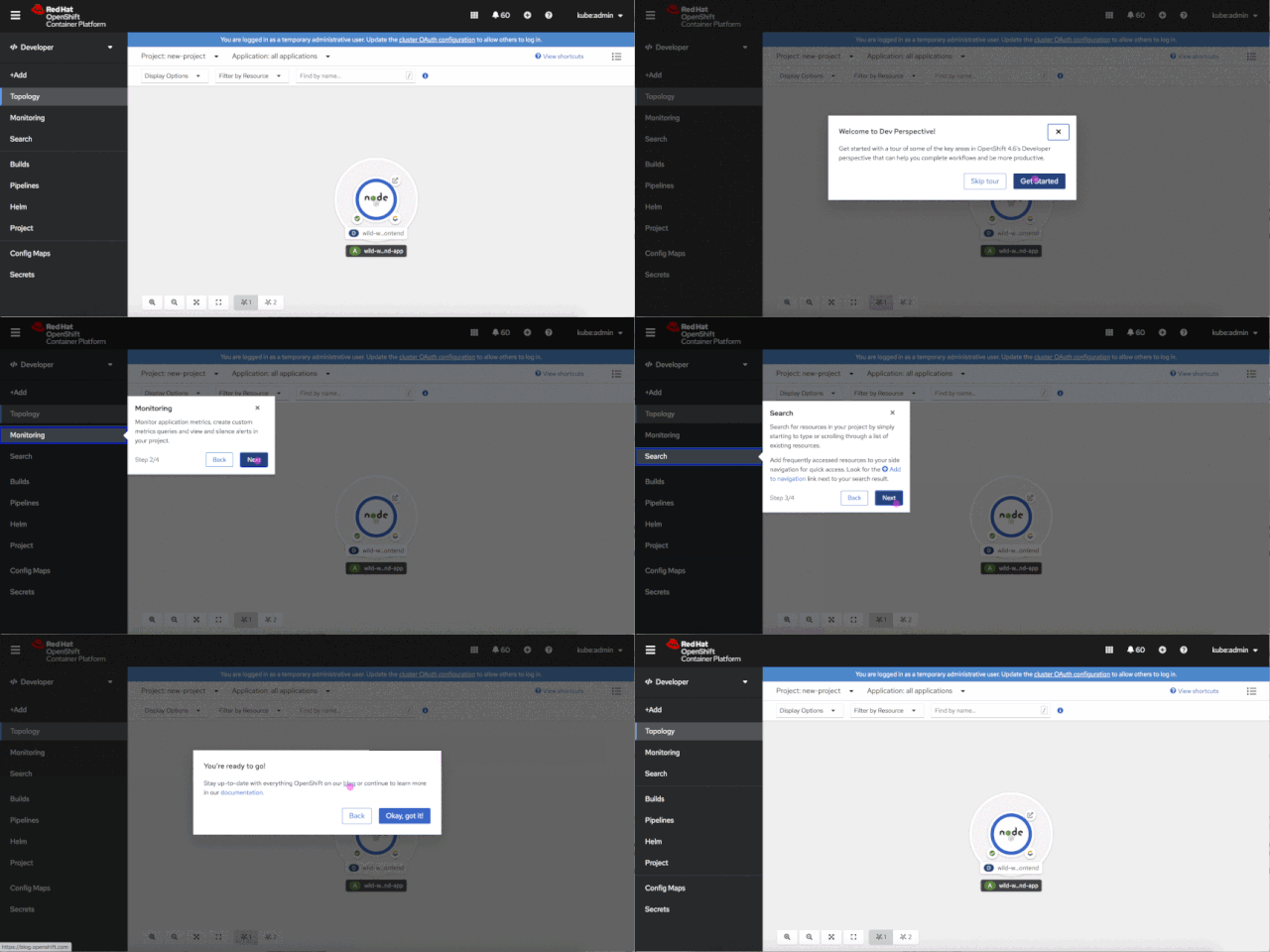
    The demo shows the guided tour launching in the OpenShift console.
    Figure 1: Launch the guided tour from the OpenShift console.
    Figure 1: Launch the guided tour from the OpenShift console.

    If you are uninterested in the tour, you can skip it by hitting Skip tour. The tour won’t show up again unless you log into another cluster. If you want to access the guided tour later, you can find it in the Help menu, shown in Figure 2.

    The Help menu is shown as a drop-down list. The list includes the guided tour as an option.
    Figure 1 - Guided tour
    Figure 2: Use the Help menu to access the guided tour anytime.

    Quick starts in OpenShift 4.6

    With this release, we've provided quick starts to get you started with the most common user flows in the OpenShift web console.

    You can use the OpenShift console's Add page to navigate to quick starts. Open the Add page and locate the quick starts card, then click the See all Quick Starts link to get to the quick starts catalog. Figure 3 shows the quick starts card on the Add page.

    The quick starts card on the OpenShift Add page.
    Figure 3 - Accessing quick starts from the +Add page
    Figure 3: Click See all Quick Starts to go to the quick starts catalog.

    You can also access quick starts from the Help menu. As shown in Figure 4, clicking Quick Starts in the Help menu brings you to the Quick Starts catalog.
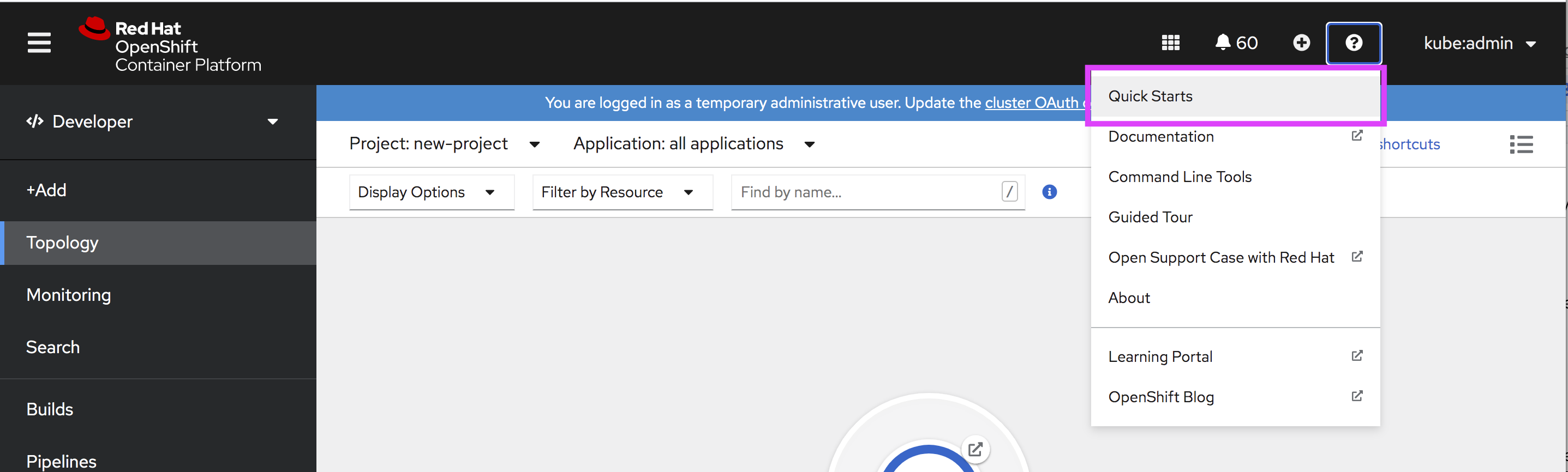
    The Help menu's drop-down list includes quick starts as an option.
    Figure 4 - Accessing quick starts from the Help menu
    Figure 4: Accessing quick starts from the Help menu.

    When you enter the quick starts catalog, you will see all of the quick starts available for the OpenShift console, as shown in Figure 5.
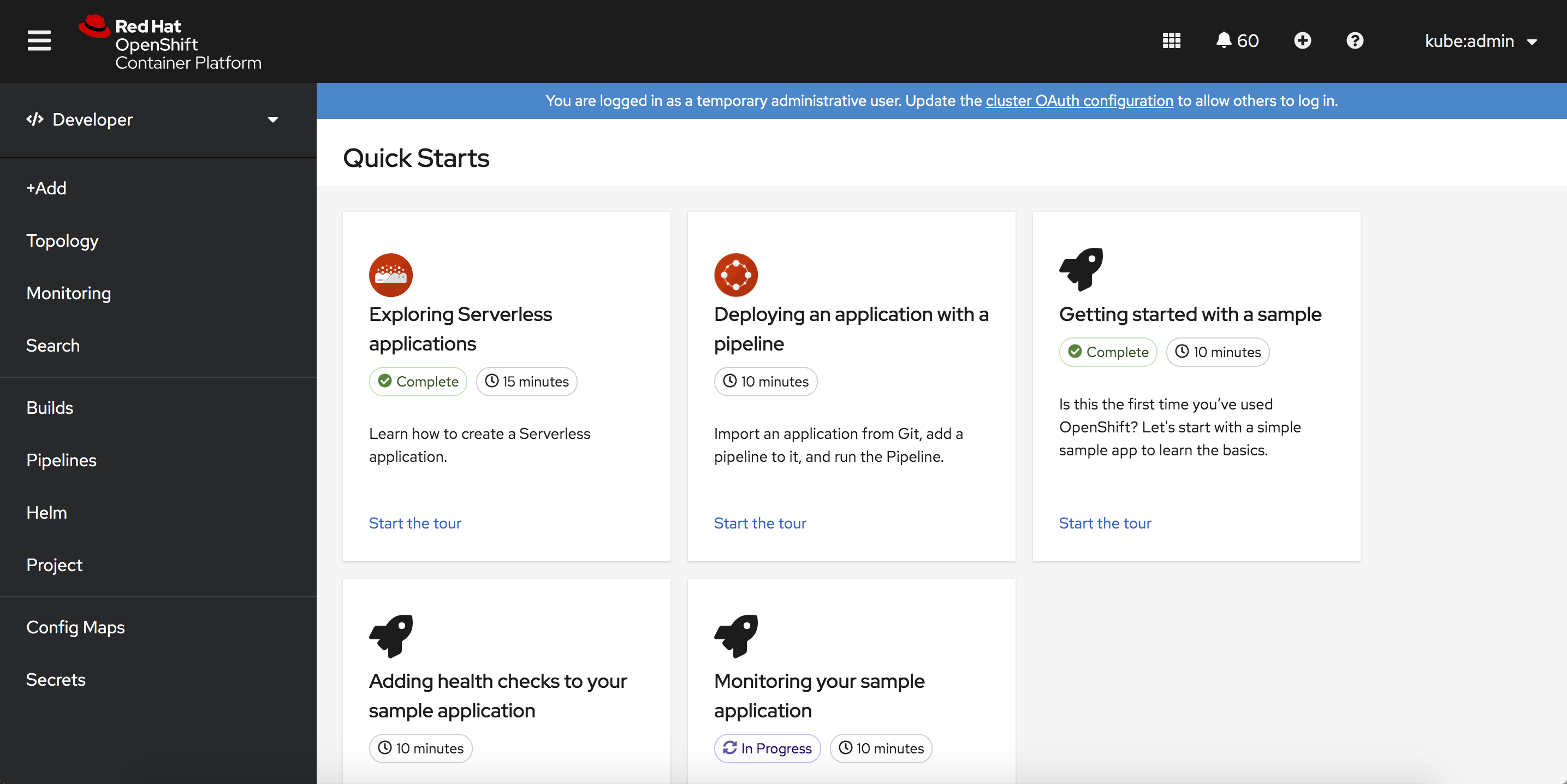
    Five quick starts are shown as cards in the catalog.
    Figure 5 - Quick start catalog
    Figure 5: Open the quick starts catalog to view all of the quick start options.

    Developer quick starts

    The OpenShift console in the 4.6 release ships with seven quick starts. Two of these are specifically for administrators, focused on installing the OpenShift Pipeline and OpenShift Serverless Operators. The other five quick starts are for developers:

    • Exploring serverless applications is available when the OpenShift Serverless Operator has been installed. This quick start introduces how to deploy a serverless application and demonstrates how it works in context.
    • Deploying an application with a pipeline is available when the OpenShift Pipelines Operator has been installed. It shows you how to import an application from Git, add a pipeline to it, and run that pipeline.
    • Getting started with a sample shows you how to deploy a sample application in OpenShift.
    • Adding health checks to your sample application guides you through viewing the details of your OpenShift application and adding health checks to it.
    • Monitoring your sample application guides you through the available flows to monitoring an application, including viewing monitoring details, the monitoring dashboard, and custom metrics.

    Accessing a quick start

    When you select a quick start, the quick start panel opens. Once you begin the quick start, instructions guide you through the user flow for that example.

    Create a sample application in the OpenShift console

    Starting with OpenShift 4.6, you can create a sample application to try out an application running on OpenShift. The demonstration in Figure 6 shows you how to access a sample application from the Add page in the developer perspective.
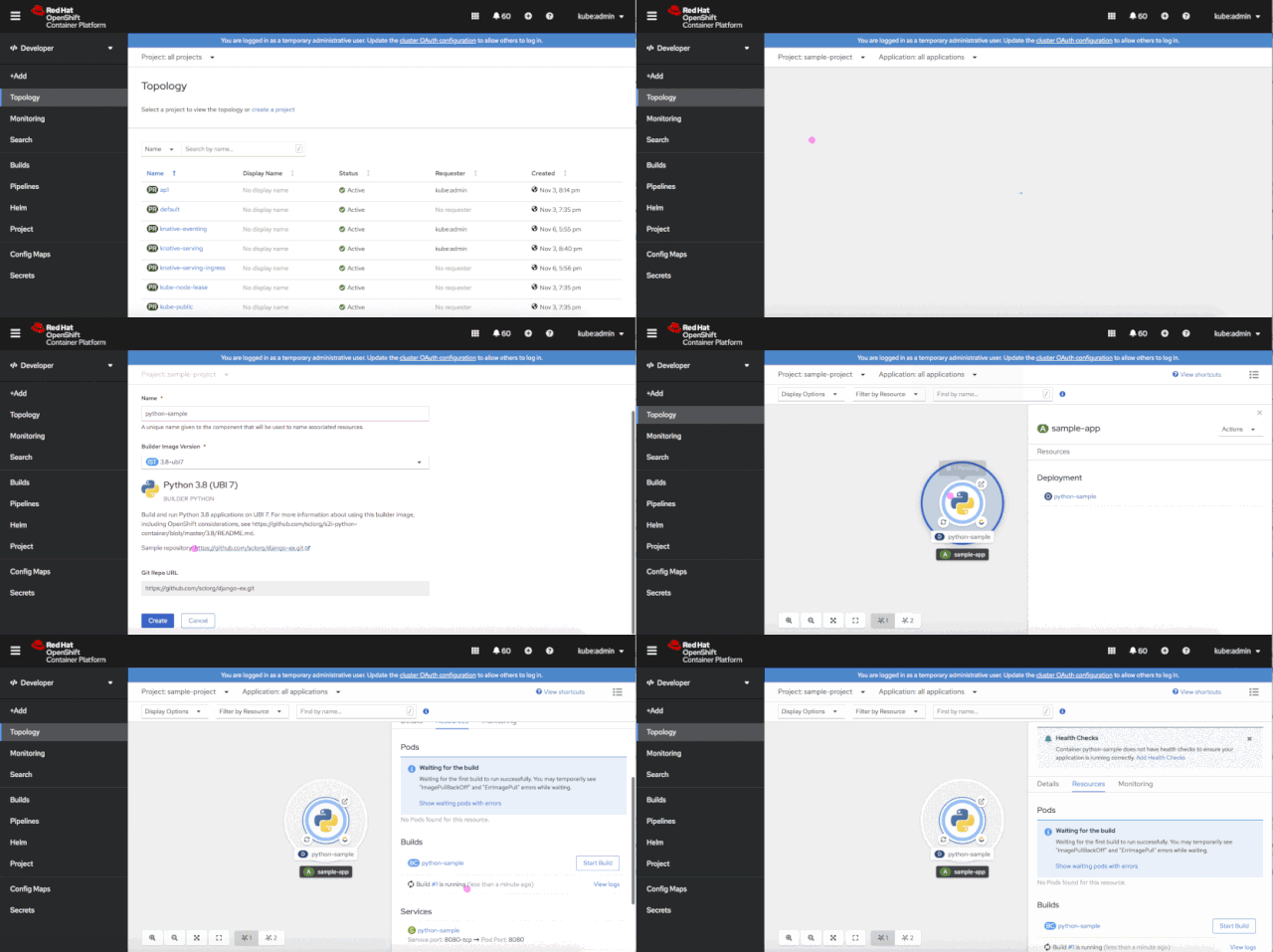
    A demonstration in the OpenShift console.
    Figure 6: How to create a sample application.
    Figure 6: How to create a sample application.

    What's next for OpenShift?

    Keep your eyes open for new features coming in OpenShift 4.7. We are working on new improvements, and we're excited about sharing them with our OpenShift developer community.

    In the meantime, please let us know what you think of the new web console features in OpenShift 4.6! Hearing directly from developers helps us continually improve your experience on OpenShift. You can share your feedback by attending office hours on the OpenShift Twitch channel. Or, if you prefer, you can use this form to let us know your thoughts. We also invite you to join the OpenShift Developer Experience Google Group, where you can share your web console tips, get support from other developers, and provide feedback that will help us shape the future of OpenShift. Are you ready to get started? Try OpenShift today.

    Last updated: March 21, 2023

    Recent Posts

    • Protect data offloaded to GPU-accelerated environments with OpenShift sandboxed containers

    • Case study: Measuring energy efficiency on the x64 platform

    • How to prevent AI inference stack silent failures

    • Preventing GPU waste: A guide to JIT checkpointing with Kubeflow Trainer on OpenShift AI

    • How to manage TLS certificates used by OpenShift GitOps operator

    Red Hat Developers logo LinkedIn YouTube Twitter Facebook

    Platforms

    • Red Hat AI
    • Red Hat Enterprise Linux
    • Red Hat OpenShift
    • Red Hat Ansible Automation Platform
    • See all products

    Build

    • Developer Sandbox
    • Developer tools
    • Interactive tutorials
    • API catalog

    Quicklinks

    • Learning resources
    • E-books
    • Cheat sheets
    • Blog
    • Events
    • Newsletter

    Communicate

    • About us
    • Contact sales
    • Find a partner
    • Report a website issue
    • Site status dashboard
    • Report a security problem

    RED HAT DEVELOPER

    Build here. Go anywhere.

    We serve the builders. The problem solvers who create careers with code.

    Join us if you’re a developer, software engineer, web designer, front-end designer, UX designer, computer scientist, architect, tester, product manager, project manager or team lead.

    Sign me up

    Red Hat legal and privacy links

    • About Red Hat
    • Jobs
    • Events
    • Locations
    • Contact Red Hat
    • Red Hat Blog
    • Inclusion at Red Hat
    • Cool Stuff Store
    • Red Hat Summit
    © 2026 Red Hat

    Red Hat legal and privacy links

    • Privacy statement
    • Terms of use
    • All policies and guidelines
    • Digital accessibility

    Chat Support

    Please log in with your Red Hat account to access chat support.