Redhat Developers  Logo
  • AI

    Get started with AI

    • Red Hat AI
      Accelerate the development and deployment of enterprise AI solutions.
    • AI learning hub
      Explore learning materials and tools, organized by task.
    • AI interactive demos
      Click through scenarios with Red Hat AI, including training LLMs and more.
    • AI/ML learning paths
      Expand your OpenShift AI knowledge using these learning resources.
    • AI quickstarts
      Focused AI use cases designed for fast deployment on Red Hat AI platforms.
    • No-cost AI training
      Foundational Red Hat AI training.

    Featured resources

    • OpenShift AI learning
    • Open source AI for developers
    • AI product application development
    • Open source-powered AI/ML for hybrid cloud
    • AI and Node.js cheat sheet

    Red Hat AI Factory with NVIDIA

    • Red Hat AI Factory with NVIDIA is a co-engineered, enterprise-grade AI solution for building, deploying, and managing AI at scale across hybrid cloud environments.
    • Explore the solution
  • Learn

    Self-guided

    • Documentation
      Find answers, get step-by-step guidance, and learn how to use Red Hat products.
    • Learning paths
      Explore curated walkthroughs for common development tasks.
    • Guided learning
      Receive custom learning paths powered by our AI assistant.
    • See all learning

    Hands-on

    • Developer Sandbox
      Spin up Red Hat's products and technologies without setup or configuration.
    • Interactive labs
      Learn by doing in these hands-on, browser-based experiences.
    • Interactive demos
      Click through product features in these guided tours.

    Browse by topic

    • AI/ML
    • Automation
    • Java
    • Kubernetes
    • Linux
    • See all topics

    Training & certifications

    • Courses and exams
    • Certifications
    • Skills assessments
    • Red Hat Academy
    • Learning subscription
    • Explore training
  • Build

    Get started

    • Red Hat build of Podman Desktop
      A downloadable, local development hub to experiment with our products and builds.
    • Developer Sandbox
      Spin up Red Hat's products and technologies without setup or configuration.

    Download products

    • Access product downloads to start building and testing right away.
    • Red Hat Enterprise Linux
    • Red Hat AI
    • Red Hat OpenShift
    • Red Hat Ansible Automation Platform
    • See all products

    Featured

    • Red Hat build of OpenJDK
    • Red Hat JBoss Enterprise Application Platform
    • Red Hat OpenShift Dev Spaces
    • Red Hat Developer Toolset

    References

    • E-books
    • Documentation
    • Cheat sheets
    • Architecture center
  • Community

    Get involved

    • Events
    • Live AI events
    • Red Hat Summit
    • Red Hat Accelerators
    • Community discussions

    Follow along

    • Articles & blogs
    • Developer newsletter
    • Videos
    • Github

    Get help

    • Customer service
    • Customer support
    • Regional contacts
    • Find a partner

    Join the Red Hat Developer program

    • Download Red Hat products and project builds, access support documentation, learning content, and more.
    • Explore the benefits

Manage your APIs deployed with Istio service mesh

<p>&nbsp;</p> <quillbot-extension-portal></quillbot-extension-portal>

April 30, 2019
Nicolas Massé
Related topics:
MicroservicesService mesh
Related products:
Red Hat OpenShift Service Mesh

    With the rise of microservices architectures, companies are looking for a way to connect, secure, control, and observe their microservices. Currently, a service mesh such as Istio is the best option to reach this goal.

    • Connect: Istio can intelligently control the flow of traffic between services, conduct a range of tests and upgrade gradually with blue/green deployments.
    • Secure: Automatically secure your services through managed authentication, authorization, and encryption of communication between services.
    • Control: Apply policies and ensure that they are enforced and that resources are fairly distributed among consumers.
    • Observe: See what’s happening with rich automatic tracing, monitoring, logging of all your services.

    And, as explained in "Distributed microservices architecture: Istio, managed API gateways and, enterprise integration", a service mesh does not relieve the need for an API management solution. A service mesh manages services and the connections between them, whereas an API management solution manages APIs and their consumers. In this article, I'll describe how to manage APIs using the Red Hat Integration adapter for Istio.

    Red Hat Integration offers an API management capability that let companies build an ecosystem of consumers around their APIs and then drive new revenue from them.

    • Visibility: Get insights on your APIs usage (most used methods of your API, top consuming applications, API Health, etc.).
    • Control: Manage the client applications and their consumption (quotas, SLAs, pricing, etc.).
    • Monetization: Drive new revenue with per-usage pricing.
    • Hybrid API management: Connect APIs wherever they are (on-premises, SaaS, or in various cloud providers), manage them from a single location.
    • API lifecycle: Scale from an idea to the realization, from the inception of an API program up to management at scale throughout your whole company (see “Full API lifecycle management: A primer” for more information).

    When APIs meet the service mesh

    The latest release of Red Hat Integration adds an Istio adapter that connects the Istio service mesh to it so that you can upgrade any service in your service mesh to a full-featured API.

    This adapter brings to the Istio service mesh the API management capabilities of Red Hat Integration:

    • Developer self-service and on-boarding
    • API documentation
    • Monetization
    • Usage analytics

    In Istio, an adapter is a pluggable component that handles various aspects of the service mesh. An adapter can handle aspects such as Authorization and Telemetry, for example. The Red Hat Integration adapter plugs in the Mixer component to validate an API Key (Authorization) and report usage (Telemetry).
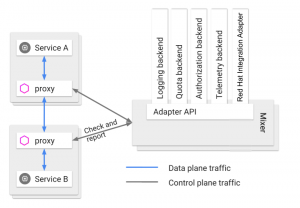
    Tutorial

    In the rest of this article, I'll describe the first steps for using the Red Hat Integration adapter. These steps assume Istio is already installed on your Minishift instance or on your Red Hat OpenShift cluster, as well as Red Hat Integration.

    Before managing APIs in the service mesh, we need to deploy a few sample components in it: start by deploying the bookstore application as explained here:

    oc new-project bookstore
    oc adm policy add-scc-to-user privileged -z default -n bookstore
    oc adm policy add-scc-to-user anyuid -z default -n bookstore
    oc apply -n bookstore -f https://raw.githubusercontent.com/Maistra/bookinfo/master/bookinfo.yaml
    oc apply -n bookstore -f https://raw.githubusercontent.com/Maistra/bookinfo/master/bookinfo-gateway.yaml
    

    Confirm the bookstore application is working with:

    $ export GATEWAY_URL=$(oc get route -n istio-system istio-ingressgateway -o jsonpath='{.spec.host}')
    $ curl -s http://$GATEWAY_URL/api/v1/products |jq
    [
      {
        "descriptionHtml": "<a href=\"https://en.wikipedia.org/wiki/The_Comedy_of_Errors\">Wikipedia Summary</a>: The Comedy of Errors is one of <b>William Shakespeare's</b> early plays. It is his shortest and one of his most farcical comedies, with a major part of the humour coming from slapstick and mistaken identity, in addition to puns and word play.",
        "id": 0,
        "title": "The Comedy of Errors"
      }
    ]
    

    As you can see, the bookstore application exposes an API which is not yet managed (anyone can query it freely).

    Discover how to manage this API using the Red Hat Integration adapter for Istio in the following video.

    Last updated: January 12, 2024

    Recent Posts

    • Protect data offloaded to GPU-accelerated environments with OpenShift sandboxed containers

    • Case study: Measuring energy efficiency on the x64 platform

    • How to prevent AI inference stack silent failures

    • Preventing GPU waste: A guide to JIT checkpointing with Kubeflow Trainer on OpenShift AI

    • How to manage TLS certificates used by OpenShift GitOps operator

    Red Hat Developers logo LinkedIn YouTube Twitter Facebook

    Platforms

    • Red Hat AI
    • Red Hat Enterprise Linux
    • Red Hat OpenShift
    • Red Hat Ansible Automation Platform
    • See all products

    Build

    • Developer Sandbox
    • Developer tools
    • Interactive tutorials
    • API catalog

    Quicklinks

    • Learning resources
    • E-books
    • Cheat sheets
    • Blog
    • Events
    • Newsletter

    Communicate

    • About us
    • Contact sales
    • Find a partner
    • Report a website issue
    • Site status dashboard
    • Report a security problem

    RED HAT DEVELOPER

    Build here. Go anywhere.

    We serve the builders. The problem solvers who create careers with code.

    Join us if you’re a developer, software engineer, web designer, front-end designer, UX designer, computer scientist, architect, tester, product manager, project manager or team lead.

    Sign me up

    Red Hat legal and privacy links

    • About Red Hat
    • Jobs
    • Events
    • Locations
    • Contact Red Hat
    • Red Hat Blog
    • Inclusion at Red Hat
    • Cool Stuff Store
    • Red Hat Summit
    © 2026 Red Hat

    Red Hat legal and privacy links

    • Privacy statement
    • Terms of use
    • All policies and guidelines
    • Digital accessibility

    Chat Support

    Please log in with your Red Hat account to access chat support.