Welcome to the Q2'26 edition of Red Hat’s quarterly newsletter, all about Apache Camel! This series aims to share all the noteworthy Camel goodness from the last quarter, so you don’t miss a thing. Be sure to read the previous edition to catch up on all the exciting updates and insights in Q1 of 2026.
Red Hat build of Apache Camel 4.18
Red Hat build of Apache Camel 4.18 helps integration teams bridge enterprise architectures with AI-driven semantic processing while improving day-to-day developer productivity. The release adds important updates to components such as camel-openai, camel-docling, camel-qdrant, and camel-milvus, expands the Simple language with many new functions and operators, and strengthens security, observability, and REST support across the stack.
Tooling also takes a significant step forward. The self-contained Camel CLI Launcher removes the need for a separate JBang installation, while Kaoto 2.11 introduces stronger API-first design flows, major DataMapper improvements, and visual Citrus test design. On the operations side, HawtIO operator v2 can now be installed cluster-wide on OpenShift to manage console instances across requested namespaces. Altogether, Camel 4.18 provides a stable foundation for production environments and marks the last Red Hat Camel 4 release on Spring Boot 3 before the planned transition to Spring Boot 4 later this year.
For more details, visit the What’s new in Red Hat build of Apache Camel 4.18 article.
Red Hat Application Foundations AI Quickstart
Our first Red Hat Application Foundations AI Quickstart, the Smart Telemetry Pipeline (Figure 1), is now live. It combines OpenTelemetry, Kafka, Camel, Artemis, Infinispan, and OpenShift AI to demonstrate an end-to-end AI-assisted telemetry pipeline that you can try entirely for free on the Red Hat Developer Sandbox.
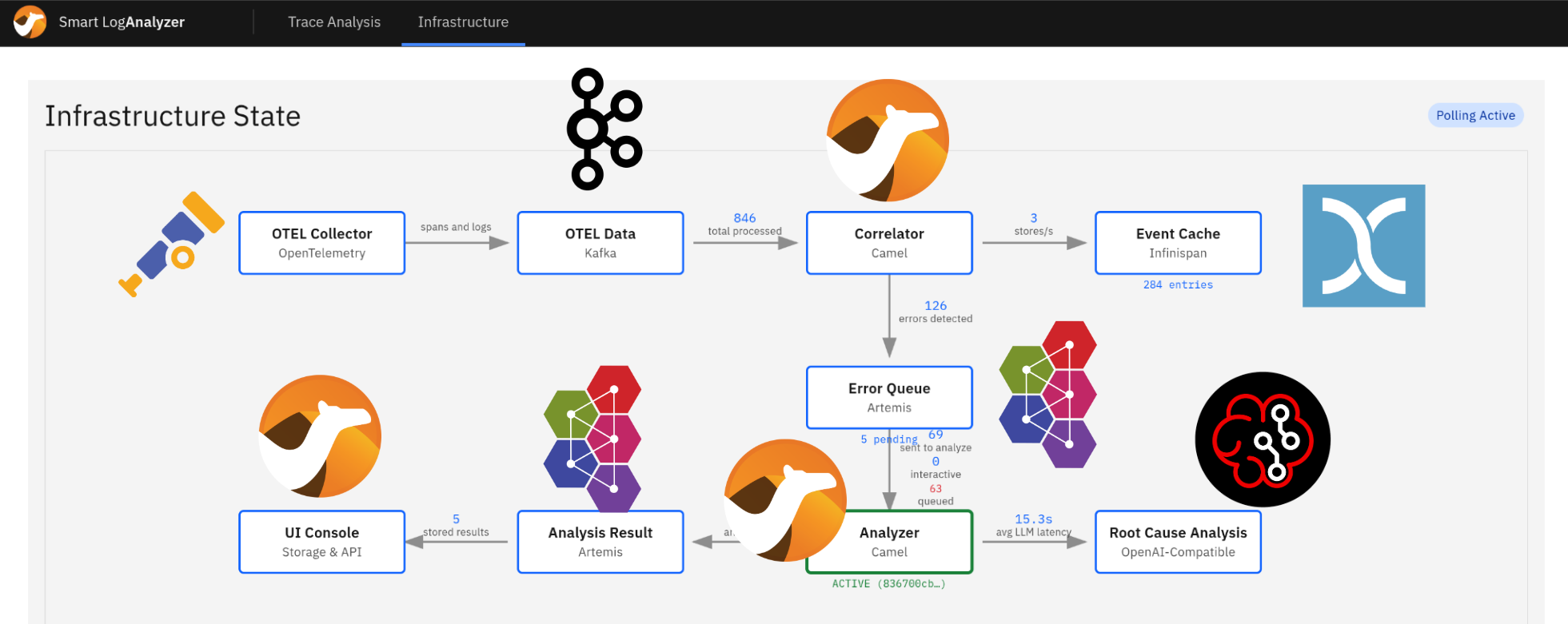
The solution routes telemetry through an event-driven pipeline where AI analyzes correlated logs and traces, turning raw signals into actionable root cause analysis. “Power Autonomous Root Cause Analysis for Distributed Systems” and try it here: https://docs.redhat.com/en/learn/ai-quickstarts/rh-smart-telemetry-pipeline
Camel Workshop in Ireland
Following the Application Services partner and customer days in March, we organized a hands-on Camel workshop in Ireland for participants who wanted deeper practical experience with Apache Camel and a clearer view of whether it fits modernization journeys such as migrations from BizTalk.
The workshop walks attendees through building a multi-system messaging hub, including Discord integration, using Apache Camel and the Kaoto graphical interface. Participants implement a plug-in architecture with Apache Kafka and OpenShift Data Foundation inside Red Hat Dev Spaces, giving them a low-code but realistic introduction to modern integration development. Try it yourself or ask your account manager to organize a workshop: https://catalog.demo.redhat.com/catalog?item=babylon-catalog-prod/openshift-cnv.dil-camel3-cnv.prod
Articles
Dive into the latest developments within Apache Camel through our curated selection of articles.
Apache Camel is preparing for Post-Quantum Cryptography
This deep dive explores the work underway to prepare Camel’s SSL/TLS infrastructure for the post-quantum era. It introduces new camel.ssl.* options for named groups and signature schemes, automatic PQC-friendly defaults on newer JDKs, and proof-of-concept examples showing real TLS 1.3 handshakes with hybrid PQC key exchange across JDK 21, 24, and 27.
How Apache Camel elevates Citrus Integration Testing to next levels
Christoph Deppisch shows how Camel and Citrus complement each other for realistic integration testing. The article demonstrates how Citrus tests can reuse Camel’s huge component catalog, data formats, processors, and direct: endpoints to validate multi-protocol routes with less boilerplate and stronger test fidelity.
Camel Monitor Operator
Pasquale Congiusti introduces Camel Monitor Operator, a new project dedicated to monitoring Camel workloads on Kubernetes. It discovers labeled deployments, creates CamelMonitor resources, surfaces health and pressure indicators through CLI and dashboard views, and can automatically integrate with Prometheus and Grafana for deeper observability.
Hello World with Apache Camel: From YAML to a Native Binary
This tutorial is a practical introduction to Camel for newcomers. Starting from a simple Timer -> Bean -> Log route in YAML DSL, it walks through running the integration with Camel CLI, exporting it to Quarkus, compiling it to a native binary with GraalVM/Mandrel, and packaging it into a lightweight container image for cloud-native deployment.
Kaoto v2.11 release
Kaoto 2.11 delivers one of its biggest tooling updates yet. Highlights include full Citrus testing support in the visual designer, new runtime management options, a redesigned DataMapper rendering engine for large schemas, stronger XML Schema handling, and multiple quality-of-life improvements across the canvas and REST DSL editors.
Wanaku MCP Router: Getting Started on Your Laptop
Markus Eisele provides a hands-on walkthrough for running Wanaku locally and using it as a unified MCP endpoint. The guide shows how to import an HTTP toolset, forward an upstream MCP server over SSE, and expose both local and remote tools through one router, while also documenting some of the current rough edges in local-mode workflows.
Wanaku 0.1.1: Bringing Apache Camel Integration Capabilities to AI Agents via MCP
Wanaku 0.1.1 highlights how Camel routes can become AI-callable tools through the Model Context Protocol. The release introduces Service Catalogs and Service Templates, making it easier to package Camel YAML routes, dependencies, and MCP metadata into reusable units that can be deployed locally or on Kubernetes.
Hawtio AI: Utilizing AI in the Operational Phase of Camel Integrations
This early look at the Hawtio AI plugin shows how AI can support the operational side of Camel applications, not just route development. The MVP focuses on diagnosis by sending selected JMX/Jolokia data to a model on demand, helping operators inspect Camel contexts and route statistics while keeping user control over what data is shared.
See How Your Routes Connect: Route Topology Diagrams in Apache Camel
This article introduces the new route topology diagrams added in Camel 4.21. Unlike a route diagram that shows the internals of a single route, the topology view reveals how routes connect to each other and to external systems, and it is available in the developer console, the Camel TUI, and even build-generated documentation artifacts.
Apache Camel 4.20 What's New
Apache Camel 4.20 is an expedited security fix release built on top of 4.19. It adds first-class JDK 25 compatibility and makes local HTTPS development easier in Camel CLI with self-signed certificate support, while also continuing the groundwork for smoother upgrades through the Camel Upgrade Recipes tooling.
Apache Camel 4.21 What's New
Apache Camel 4.21 is a feature-packed release that advances observability, AI integration, and developer tooling. It introduces route topology services, richer error registry support, major Camel TUI improvements, embedded MCP runtime tooling, stronger security hardening, canonical YAML normalization, and new AI capabilities such as the preview camel-a2a component and expanded camel-openai support.
Apache Camel by the Numbers: 19 Years of Open Source Integration
Claus Ibsen reflects on 19 years of development on the Apache Camel project and provides various interesting statistics. For example, did you know that of the 56,000+ Java files in the repository, 22,000 are test files - 39% of the entire codebase! Yes, we take quality and stability very seriously.
Demos and Presentations
The modern integration blueprint: Building AI-ready pipelines
As organizations move from AI experimentation to production, the bottleneck is shifting from models to data architecture. Building truly "AI-infused" applications requires solving challenges around real-time data movement, hybrid cloud silos, and the growing computational demands of AI inference.
In this webinar, Bruno Meseguer and Mark Cheshire show how to build a high-performance connectivity backbone using Apache Kafka, Apache Camel, Red Hat Service Interconnect, and Red Hat Connectivity Link.
Community Showcase: How to Rewrite 20+ Critical Banking ETL Applications
Rewriting critical banking ETL applications is risky because these systems handle business data that must stay accurate, stable, and traceable. In his JEurope 2025 talk, Dzmitry Paddubnik explains how his team rebuilt more than 20 banking ETL applications in Java and using Camel.
Upcoming
Here’s a look at our key planned milestones and where you can connect with us at upcoming conferences:
July
- 14 July - Red Hat Tech day in London
November
- Red Hat build of Apache Camel 4.22 GA

