Redhat Developers  Logo
  • AI

    Get started with AI

    • Red Hat AI
      Accelerate the development and deployment of enterprise AI solutions.
    • AI learning hub
      Explore learning materials and tools, organized by task.
    • AI interactive demos
      Click through scenarios with Red Hat AI, including training LLMs and more.
    • AI/ML learning paths
      Expand your OpenShift AI knowledge using these learning resources.
    • AI quickstarts
      Focused AI use cases designed for fast deployment on Red Hat AI platforms.
    • No-cost AI training
      Foundational Red Hat AI training

    Featured resources

    • Open Source AI for developers
    • AI product application development
    • Open source-powered AI/ML for hybrid cloud
    • AI and Node.js cheat sheet

    Red Hat AI Factory with NVIDIA

    • Red Hat AI Factory with NVIDIA is a co-engineered, enterprise-grade AI solution for building, deploying, and managing AI at scale across hybrid cloud environments.
    • Explore the solution
  • Learn

    Self-guided

    • Documentation
      Find answers, get step-by-step guidance, and learn how to use Red Hat products.
    • Learning paths
      Explore curated walkthroughs for common development tasks.

    Hands-on

    • Developer Sandbox
      Spin up Red Hat's products and technologies without setup or configuration.
    • Interactive labs
      Learn by doing in these hands-on, browser-based experiences.
    • Interactive demos
      Click through product features in these guided tours.

    Browse by topic

    • AI/ML
    • Automation
    • Java
    • Kubernetes
    • Linux
    • See all topics

    Training & certifications

    • Courses and exams
    • Certifications
    • Skills assessments
    • Red Hat Academy
    • Learning subscription
    • Explore training
  • Build

    Get started

    • Red Hat build of Podman Desktop
      A downloadable, local development hub to experiment with our products and builds.
    • Developer Sandbox
      Spin up Red Hat's products and technologies without setup or configuration.

    Download products

    • Access product downloads to start building and testing right away.
    • Red Hat Enterprise Linux
    • Red Hat AI
    • Red Hat OpenShift
    • Red Hat Ansible Automation Platform
    • See all products

    Featured

    • Red Hat build of OpenJDK
    • Red Hat JBoss Enterprise Application Platform
    • Red Hat OpenShift Dev Spaces
    • Red Hat Developer Toolset

    References

    • E-books
    • Documentation
    • Cheat sheets
    • Architecture center
  • Community

    Get involved

    • Events
    • Live AI events
    • Red Hat Summit
    • Red Hat Accelerators
    • Community discussions

    Follow along

    • Articles & blogs
    • Developer newsletter
    • Videos
    • Github

    Get help

    • Customer service
    • Customer support
    • Regional contacts
    • Find a partner

    Join the Red Hat Developer program

    • Download Red Hat products and project builds, access support documentation, learning content, and more.
    • Explore the benefits

Istio Egress: Exit Through the Gift Shop

May 1, 2018
Don Schenck
Related topics:
JavaService meshKubernetes

    Using Istio with Red Hat OpenShift and Kubernetes makes life with microservices easier. Tucked away inside of Kubernetes pods, using the Istio service mesh, your code can run (mostly) in isolation. Performance, ease-of-changes, tracing, and so on are made available by simply using the Istio sidecar container model. But what if you want your microservice to talk to another service that is outside of your OpenShift/Kubernetes/pods environment?

    Enter Istio Egress.

    [This is part nine of my ten-part Introduction to Istio Service Mesh series. My previous article was Part 8: Istio Smart Canary Launch: Easing into Production.]

    Bin There, Done That

    Istio Egress, put simply, allows you to access resources (read: services) outside of your Kubernetes pods. In an out-of-the-box Istio-enabled environment, traffic is routed within and between the clusters of pods based on internal IP tables. This walled-off approach is fine...until you need to access a service elsewhere.

    Egress gives you the power to bypass those IP tables, either based on Egress rules or for a range of IP addresses.

    As an example, we'll use a Java program that makes a GET request to httpbin.org/headers.

    (If you're not familiar with httpbin.org, it's a great resource for testing outgoing service requests.)

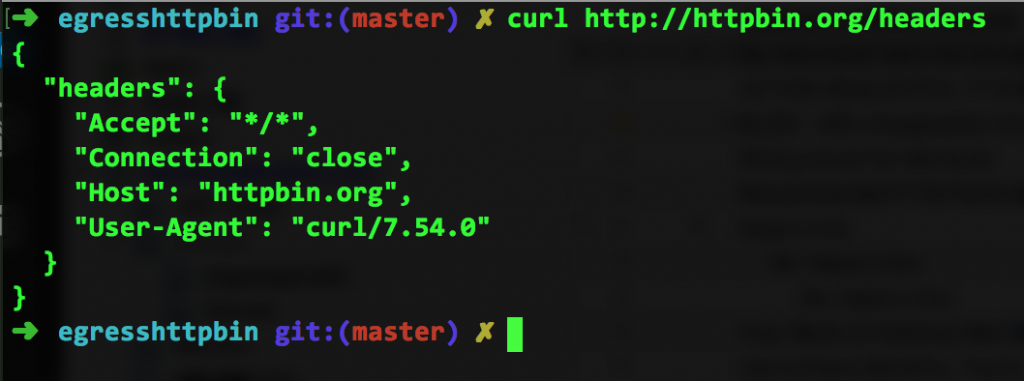
    If I simply run curl http://httpbin.org/headers from the command line, I'll see the following:
    If I point my browser to the URL, I see this:

    Clearly, the test is doing its job and returning the headers passed into it.

    Thinking Inside the Box

    Next, I'll take some Java code that uses this URL and run that code inside of Istio. (You can do this yourself by visiting our Istio tutorial.) After building the image and running it in OpenShift, I can invoke it using curl egresshttpbin-istioegress.$(minishift ip).nip.io, which gives me this:

    Wait. What just happened? It was working a few minutes ago. What do you mean "Not Found"?? It's right there! I just curl-ed it.

    Bring the Web to the (IP) Tables

    Blame (or thank) Istio. Remember: Istio is a sidecar container that is handling your discovery and routing (and a bunch of other stuff, as the past eight weeks' blog posts have pointed out). Because of this, the IP tables are limited to your internal services. Since httpbin.org is outside of our cluster, it's not available. That's where Istio Egress comes to the rescue.

    Again.

    Without changing your source code.

    Again.

    By implementing the following Egress rule, we can direct Istio to look out (across the vast world wide web, if you will) to find a service—in this case, httpbin.org. As you can see from this file (egress_httpbin.yml), the functionality is rather obvious:
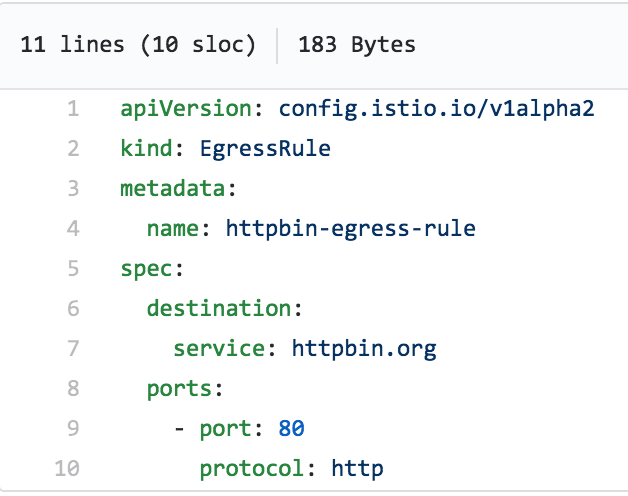
    Implementing this rule is as simple as a one-liner:

    istioctl create -f egress_httpbin.yml -n istioegress

    I can then see the Egress rule by using the command istioctl get egressrules:

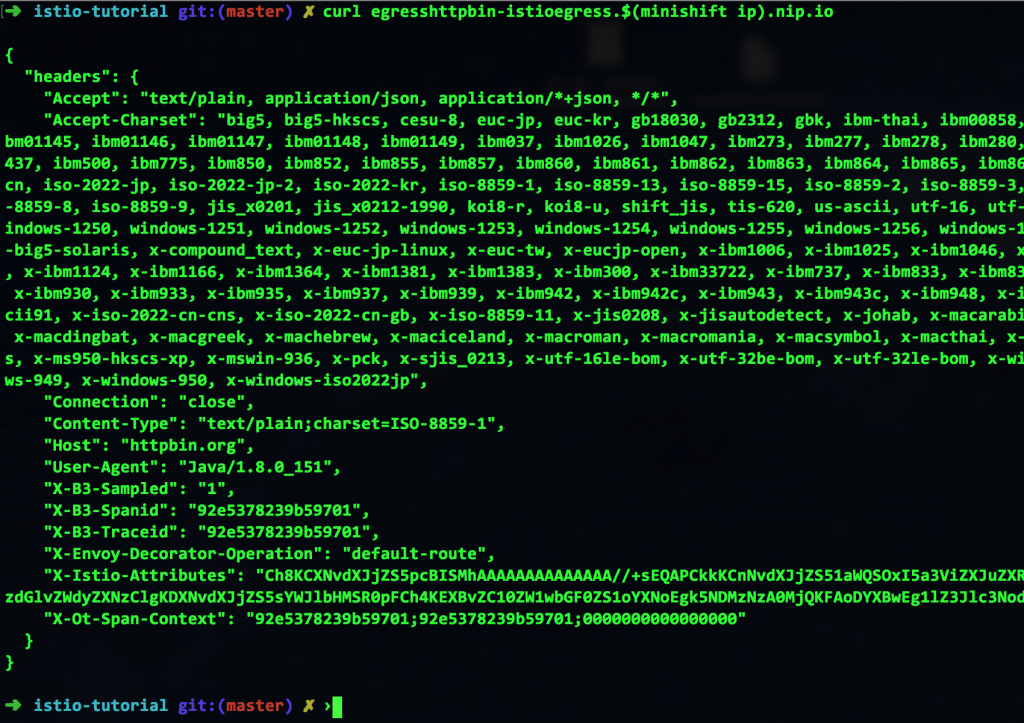
    Finally, I can run the curl command again and see the correct results:
    Thinking Outside the Box

    As you can see, Istio works well with others. While you can create OpenShift services, managed by Kubernetes, and keep everything in pods and scale up and down as necessary, you still have the ability to reach outside of your environment to use services—without changing your source code...have I ever mentioned that?


    All articles in the “Introduction to Istio” series:

    • Part 1: Introduction to Istio Service Mesh
    • Part 2: Istio Route Rules: Telling Service Requests Where to Go
    • Part 3: Istio Circuit Breaker: How to Handle (Pool) Ejection
    • Part 4: Istio Circuit Breaker: When Failure Is an Option
    • Part 5: Istio Tracing & Monitoring: Where Are You and How Fast Are You Going?
    • Part 6: Istio Chaos Engineering: I Meant to Do That
    • Part 7: Istio Dark Launch: Secret Services
    • Part 8: Istio Smart Canary Launch: Easing into Production
    • Part 9: Istio Egress: Exit Through the Gift Shop
    • Part 10: Istio Service Mesh Blog Series Recap

    Last updated: September 3, 2019

    Recent Posts

    • Red Hat UBI 8 builders have been promoted to the Paketo Buildpacks organization

    • Using eBPF in Red Hat products

    • How we made one data layer serve the UI, the mocks, and the E2E tests

    • Build trusted Python containers with Project Hummingbird and Calunga

    • Simplify distributed tracing: ObservabilityInstaller installation

    Red Hat Developers logo LinkedIn YouTube Twitter Facebook

    Platforms

    • Red Hat AI
    • Red Hat Enterprise Linux
    • Red Hat OpenShift
    • Red Hat Ansible Automation Platform
    • See all products

    Build

    • Developer Sandbox
    • Developer tools
    • Interactive tutorials
    • API catalog

    Quicklinks

    • Learning resources
    • E-books
    • Cheat sheets
    • Blog
    • Events
    • Newsletter

    Communicate

    • About us
    • Contact sales
    • Find a partner
    • Report a website issue
    • Site status dashboard
    • Report a security problem

    RED HAT DEVELOPER

    Build here. Go anywhere.

    We serve the builders. The problem solvers who create careers with code.

    Join us if you’re a developer, software engineer, web designer, front-end designer, UX designer, computer scientist, architect, tester, product manager, project manager or team lead.

    Sign me up

    Red Hat legal and privacy links

    • About Red Hat
    • Jobs
    • Events
    • Locations
    • Contact Red Hat
    • Red Hat Blog
    • Inclusion at Red Hat
    • Cool Stuff Store
    • Red Hat Summit
    © 2026 Red Hat

    Red Hat legal and privacy links

    • Privacy statement
    • Terms of use
    • All policies and guidelines
    • Digital accessibility