Redhat Developers  Logo
  • AI

    Get started with AI

    • Red Hat AI
      Accelerate the development and deployment of enterprise AI solutions.
    • AI learning hub
      Explore learning materials and tools, organized by task.
    • AI interactive demos
      Click through scenarios with Red Hat AI, including training LLMs and more.
    • AI/ML learning paths
      Expand your OpenShift AI knowledge using these learning resources.
    • AI quickstarts
      Focused AI use cases designed for fast deployment on Red Hat AI platforms.
    • No-cost AI training
      Foundational Red Hat AI training.

    Featured resources

    • OpenShift AI learning
    • Open source AI for developers
    • AI product application development
    • Open source-powered AI/ML for hybrid cloud
    • AI and Node.js cheat sheet

    Red Hat AI Factory with NVIDIA

    • Red Hat AI Factory with NVIDIA is a co-engineered, enterprise-grade AI solution for building, deploying, and managing AI at scale across hybrid cloud environments.
    • Explore the solution
  • Learn

    Self-guided

    • Documentation
      Find answers, get step-by-step guidance, and learn how to use Red Hat products.
    • Learning paths
      Explore curated walkthroughs for common development tasks.
    • Guided learning
      Receive custom learning paths powered by our AI assistant.
    • See all learning

    Hands-on

    • Developer Sandbox
      Spin up Red Hat's products and technologies without setup or configuration.
    • Interactive labs
      Learn by doing in these hands-on, browser-based experiences.
    • Interactive demos
      Click through product features in these guided tours.

    Browse by topic

    • AI/ML
    • Automation
    • Java
    • Kubernetes
    • Linux
    • See all topics

    Training & certifications

    • Courses and exams
    • Certifications
    • Skills assessments
    • Red Hat Academy
    • Learning subscription
    • Explore training
  • Build

    Get started

    • Red Hat build of Podman Desktop
      A downloadable, local development hub to experiment with our products and builds.
    • Developer Sandbox
      Spin up Red Hat's products and technologies without setup or configuration.

    Download products

    • Access product downloads to start building and testing right away.
    • Red Hat Enterprise Linux
    • Red Hat AI
    • Red Hat OpenShift
    • Red Hat Ansible Automation Platform
    • See all products

    Featured

    • Red Hat build of OpenJDK
    • Red Hat JBoss Enterprise Application Platform
    • Red Hat OpenShift Dev Spaces
    • Red Hat Developer Toolset

    References

    • E-books
    • Documentation
    • Cheat sheets
    • Architecture center
  • Community

    Get involved

    • Events
    • Live AI events
    • Red Hat Summit
    • Red Hat Accelerators
    • Community discussions

    Follow along

    • Articles & blogs
    • Developer newsletter
    • Videos
    • Github

    Get help

    • Customer service
    • Customer support
    • Regional contacts
    • Find a partner

    Join the Red Hat Developer program

    • Download Red Hat products and project builds, access support documentation, learning content, and more.
    • Explore the benefits

Fighting Service Latency in Microservices with Kubernetes

May 18, 2017
Bilgin Ibryam
Related topics:
KubernetesMicroservices
Related products:
Red Hat OpenShift

    CPU and network speed have increased significantly in the last decade, as well as memory and disk sizes. But still one of the possible side effects of moving from a monolithic architecture to Microservices is the increase in the service latency. Here are few quick ideas on how to fight it using Kubernetes.

    It is not the network

    In the recent years, networks transitioned to using protocols that are more efficient and moved from 1GBit to 10GBit and even to 25GBit limit. Applications send much smaller payloads with less verbose data formats. With all that in mind, the chances are the bottleneck in a distributed application is not in the network interactions, but somewhere else like the database. We can safely ignore the rest of this article and go back to tuning the storage system. :)

    Kubernetes scheduler and service affinity
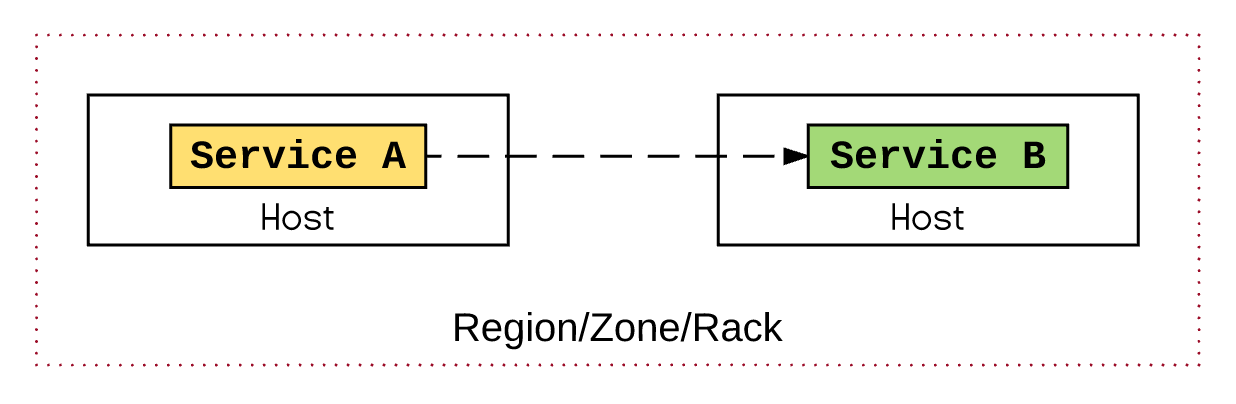
    Kubernetes scheduler and service affinity

    If two services (deployed as Pods in the Kubernetes world) are going to interact a lot, the first approach to reduce the network latency would be to ask politely the scheduler to place the Pods as close as possible using the node affinity feature. How close, depends on our high availability requirements (covered by anti-affinity), but it can be co-located in the same region, availability zone, rack or even on the same host.

    Run services in the same Pod
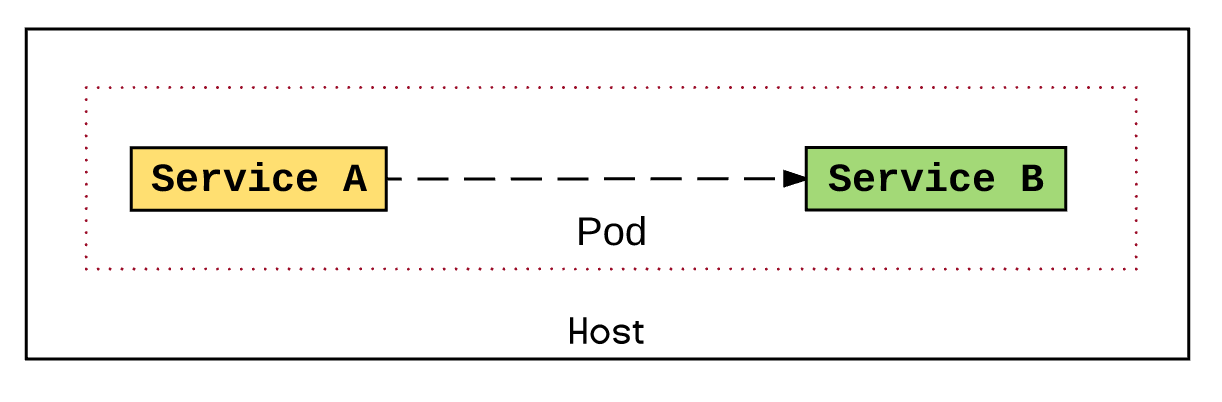
    Run services in the same Pod

    The deployment unit in Kubernetes (Pod) allows a service to be independently updated deployed and scaled. But if performance is a higher priority, we could put two services in the same Pod as long as that is a deliberate decision. Both services would still be independently developed, tested, released as containers, but they would share the same runtime lifecycle in the same deployment unit. That would allow the services to talk to each other over localhost rather than using the service layer, or use the file system, or use some other high performant IPC mechanism on the shared host, or shared memory.

    Run services in the same process
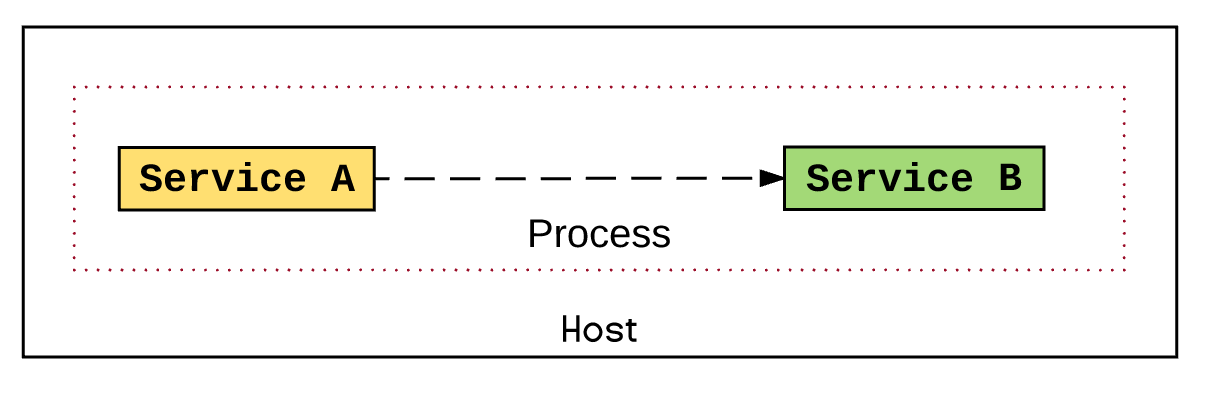
    Run services in the same process

    If co-locating two services on the same host are not good enough, we could have a hybrid between microservices and monolith by sharing the same process for multiple services. That means we are back to a monolith, but we could still use some of the principles of Microservices, allow development time independence, and make a compromise in favor of performance on rare occasions.

    We could develop and release two services independently by two different teams, but place them in the same container and share the runtime.

    For example, in the Java world that would be placing two .jar files in the same Tomcat, WildFly, or Karaf server. At runtime, the services can find each other and interact using a public static field that is accessible from any application in the same JVM. This same approach is used in Apache Camel direct component, which allows synchronous in-memory interaction of Camel routes from different .jar files by sharing the same JVM.

    Other areas to explore

    If none of the above approaches seems like a good idea, maybe you are exploring in the wrong direction. It might be better to explore whether using some alternative approaches such using a cache, data compression, HTTP/2, or something else might help for the overall application performance.

    Bilgin Ibryam

    About the author:

    Bilgin Ibryam is a member of Apache Software Foundation, integration architect at Red Hat, a software craftsman, and blogger. He is an open source fanatic, passionate about distributed systems, messaging and application integration. He is the author of Camel Design Patterns & Kubernetes Patterns books. Follow @bibryam for future blog posts on related topics.


    Download this Kubernetes cheat sheet for automating deployment, scaling and operations. 

    Last updated: March 22, 2023

    Recent Posts

    • Protect data offloaded to GPU-accelerated environments with OpenShift sandboxed containers

    • Case study: Measuring energy efficiency on the x64 platform

    • How to prevent AI inference stack silent failures

    • Preventing GPU waste: A guide to JIT checkpointing with Kubeflow Trainer on OpenShift AI

    • How to manage TLS certificates used by OpenShift GitOps operator

    Red Hat Developers logo LinkedIn YouTube Twitter Facebook

    Platforms

    • Red Hat AI
    • Red Hat Enterprise Linux
    • Red Hat OpenShift
    • Red Hat Ansible Automation Platform
    • See all products

    Build

    • Developer Sandbox
    • Developer tools
    • Interactive tutorials
    • API catalog

    Quicklinks

    • Learning resources
    • E-books
    • Cheat sheets
    • Blog
    • Events
    • Newsletter

    Communicate

    • About us
    • Contact sales
    • Find a partner
    • Report a website issue
    • Site status dashboard
    • Report a security problem

    RED HAT DEVELOPER

    Build here. Go anywhere.

    We serve the builders. The problem solvers who create careers with code.

    Join us if you’re a developer, software engineer, web designer, front-end designer, UX designer, computer scientist, architect, tester, product manager, project manager or team lead.

    Sign me up

    Red Hat legal and privacy links

    • About Red Hat
    • Jobs
    • Events
    • Locations
    • Contact Red Hat
    • Red Hat Blog
    • Inclusion at Red Hat
    • Cool Stuff Store
    • Red Hat Summit
    © 2026 Red Hat

    Red Hat legal and privacy links

    • Privacy statement
    • Terms of use
    • All policies and guidelines
    • Digital accessibility

    Chat Support

    Please log in with your Red Hat account to access chat support.