Standard benchmarks are great for baseline metrics, but real-world enterprise environments are rarely standard. Custom network plugins, security policies, resource optimization tools, and observability integrations can all influence how a platform performs under load. For customers running their compute-intensive workloads on cloud, the real question is whether the platform can meet the performance expectations and support their mission-critical applications in their own environment.
That was a question that the Red Hat Consulting team was tasked to answer. The customer wanted to understand how their customized clusters would perform at scale under the weight of custom configurations, like Cilium CNI, Gatekeeper, ScaleOps, and OpenTelemetry injection, just to name a few.
Turning test results into customer confidence
Red Hat can bring together hands-on consulting expertise, deep product knowledge, and collaboration across Red Hat Consulting, Technical Account Managers (TAMs), and Engineering to help customers move from performance measurements to actionable insights and informed decisions. Red Hat's collaborative support model ensures that you are supported well beyond the initial engagement.
Using kube-burner, an open source performance testing tool, we shared the findings and telemetry with a customer's TAM, who helped coordinate with Red Hat Engineering and other specialists to investigate platform behavior, evaluate potential improvements, and determine appropriate next steps. This approach helps customers connect with the expertise of the broader Red Hat ecosystem, so that they can gain confidence in their architecture and make informed decisions before their production rollout.
Understanding customer configurations
We started performance testing by running the cluster-density test provided by kube-burner-ocp, a wrapper for kube-burner and extends the core functionalities of kube-burner for OpenShift. The cluster-density test creates OpenShift namespaces where resources like pods, deployments, services, and ConfigMaps are created to stress the cluster. The cluster-density workload performed as expected, matching the assessment provided by the Red Hat Performance and Scale team.
The Node-density test, however, showed unusually high PodInitialized latency. This raised a question: Why was pod initialization latency so high when scheduling itself appeared healthy? With this question in mind, we worked with the TAM and Red Hat Engineering to investigate what was happening inside the clusters.
The high PodInitialized latency prompted us to dig deeper. Our first hypothesis was whether image pulling was slowing pod startup. So we inspected the pod events and container creation process. That hypothesis didn't pan out, so we needed a way to preserve the workload state long enough to inspect what was happening inside the cluster.
We ran the test with --gc=false, which disables the garbage collection and prevents kube-burner from deleting namespace and pods, and we watched the namespace events as pods were created. That exposed the first real clue: Cilium was returning 429 putEndpointIdTooManyRequests errors during pod sandbox creation, a total of 127 during the test (see Figure 1).
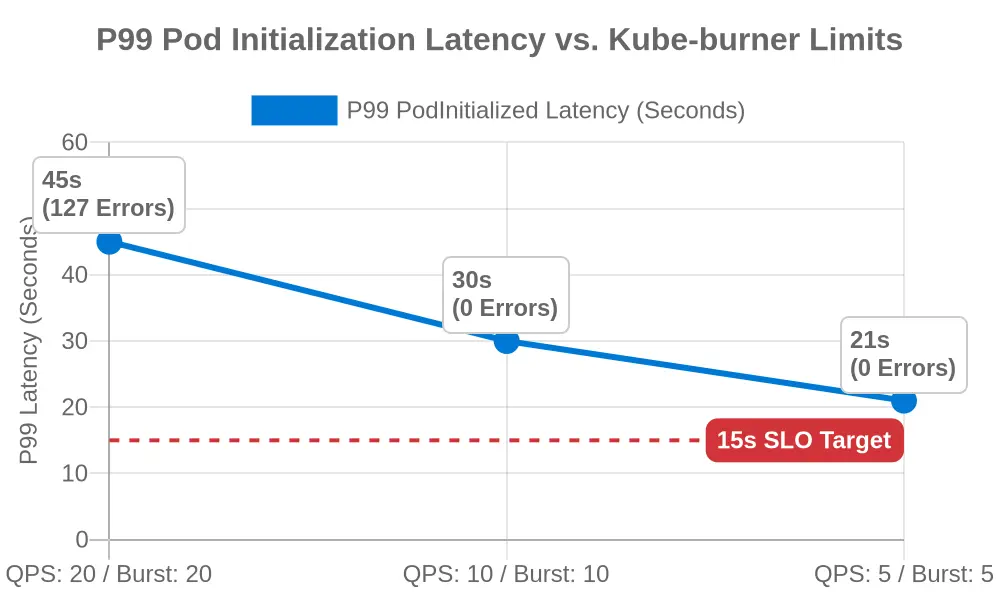
By working with Red Hat Engineering to understand the error messages better, we lowered kube-burner's --qps (queries per second) and --burst settings from the default of 20 to 10 and then eventually down to 5.
QPS limits the rate of object creations per second, and burst is the maximum number of requests allowed before throttling is introduced. Adjusting --qps and --burst settings allowed us to control the rate of queries. We saw that by lowering --qps and --burst to slow pod creation, sandbox delays decreased. This perplexing pod initialization problem was starting to make sense. By running repeatable kube-burner tests, we observed latency was a behavior correlated to a customized network plug-in. The findings helped us identify the next steps so that we could work with the customer to realize the business value of the platform.
Connecting expertise across the Red Hat ecosystem
Red Hat Consulting delivers value beyond a standalone platform performance assessment. Red Hat consultants can collaborate with TAMs and Engineering to bring the right expertise so customers can benefit from deeper insight into the platform. This helps customers find a path forward beyond the initial assessment and engage the right teams for product development and support.
This engagement shows that the performance of the platform depends on the interaction between infrastructure, networking, security and operational tooling. Customers need a partner who can help them navigate the complexities of the platform and make decisions with greater confidence. This is where Red Hat can help. Red Hat services is a team of hands-on consulting, product expertise and ongoing technical support to help customers achieve successful outcomes.
Learn more
Interested in accelerating your enterprise-scale transformation? Contact your Red Hat account team or Red Hat Consulting directly to connect with expert strategists and engineers who can help build tailored solutions to meet your business goals.
For more information about kube-burner, read Test Kubernetes performance and scale with kube-burner.