For years, Red Hat Lightspeed advisor has helped connected Red Hat OpenShift clusters stay healthy by providing proactive recommendations, flagging misconfigurations, and predicting update risk before one update breaks production. But for organizations operating in regulated industries, air-gapped networks, or under strict data residency laws, advisor has been out of reach. Their clusters generate the same operational data, face the same infrastructure risks, and need the same analytical visibility. Until now, they've had none of it.
Now available in Developer Preview, Red Hat Lightspeed advisor self-managed changes that. Delivered as a Red Hat Advanced Cluster Management for Kubernetes add-on, it brings health analytics, recommendations, and upgrade risk predictions directly into your disconnected environment without any data leaving your infrastructure.
Disclaimer
Red Hat Lightspeed advisor self-managed is currently in Developer Preview and is not yet available as part of Red Hat Advanced Cluster Management for Kubernetes in Technology Preview or general availability (GA).
Why have disconnected clusters been left out?
The connected advisor relies on the Insights Operator, a default component in every Red Hat OpenShift cluster. The operator periodically gathers cluster state archives and uploads them to the Hybrid Cloud Console. This archive includes resource definitions, operator health, cluster version metadata, and other information needed to identify risks. The operator also obfuscates sensitive information during collection. Our cloud-hosted pipeline processes these archives, runs them through a rule engine, and makes results available through the console. This model scales well across tens of thousands of clusters.
But for clusters that can't reach the Hybrid Cloud Console due to firewall policies, regulatory mandates, or network isolation, the Insights Operator has historically had nowhere to send its data. Recommendations never arrive, upgrade risks go undetected, and the possibility of an unnoticed issue rises.
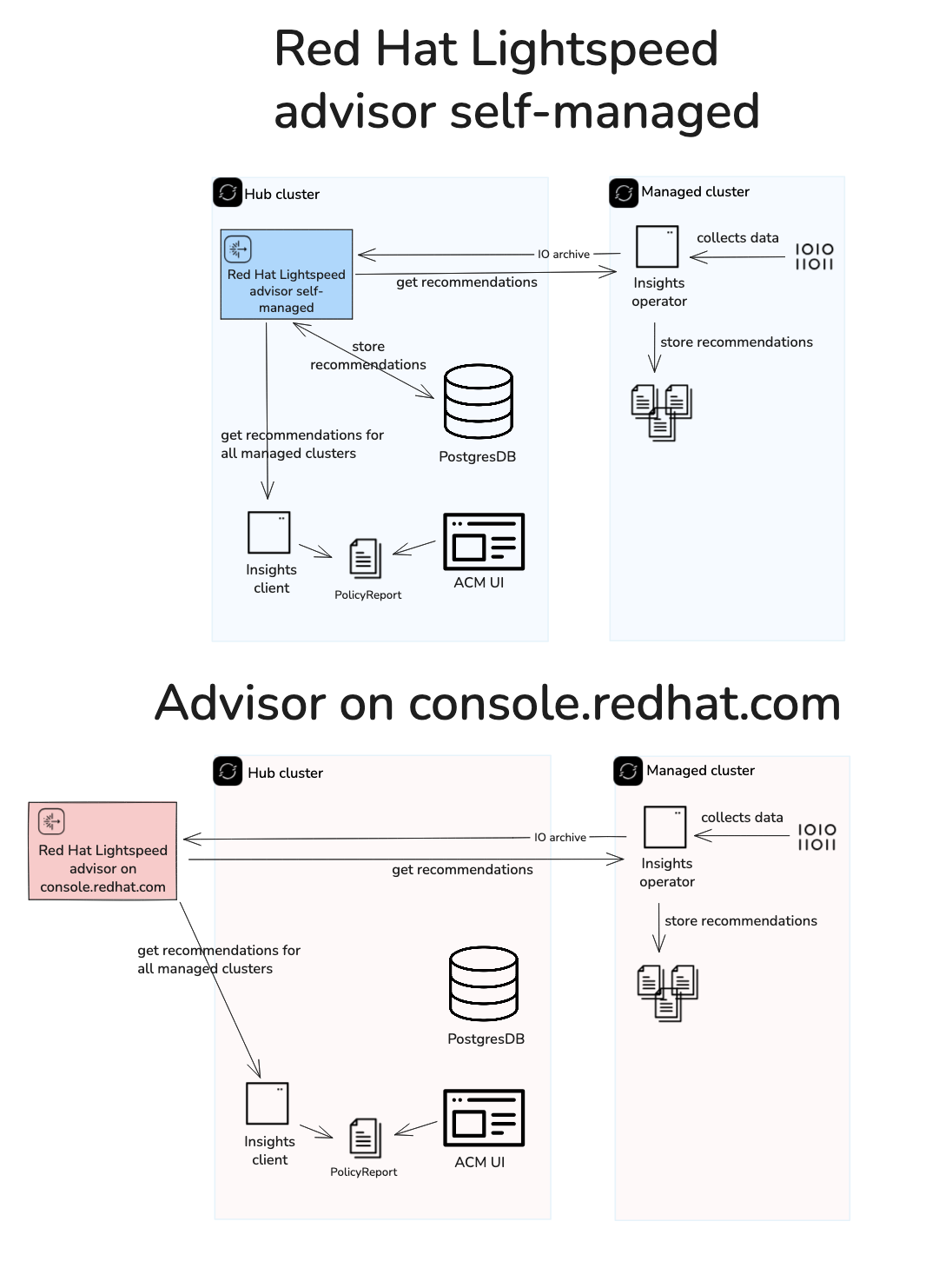
Red Hat Lightspeed advisor self-managed solves this. Instead of uploading data to the original cloud-based pipeline, the Insights Operator on each spoke cluster redirects to a local endpoint running on the Red Hat Advanced Cluster Management Hub. From there, the Hub processes the data in place and displays the results directly in the Red Hat Advanced Cluster Management console, ensuring that the data never leaves the cluster.
The flow: Entirely local
Each managed OpenShift cluster runs the Insights Operator, which collects the cluster's anonymized system configuration—resource configurations, component health, version metadata, and operator conditions. Rather than forwarding this to the connected pipeline, the operator redirects to the Red Hat Lightspeed advisor self-managed endpoint on the Hub cluster.
The Hub receives the archive, runs it through the processing pipeline deployed via the add-on, and stores the results. The Red Hat Advanced Cluster Management console reads those results and displays recommendations derived from the cluster archive.
Upgrade risk predictions draw from a second local source on the Hub called Thanos. This Red Hat Advanced Cluster Management observability tool already holds metrics sent from the spoke clusters, including alerts, operator conditions, and cluster states.
At no point does data cross outside Red Hat Advanced Cluster Management. There are no callbacks to external APIs, no telemetry forwarded upstream, and no dependencies on outbound connectivity. Once deployed, the system is fully self-contained.
Architecture: A single deployment
The connected Red Hat Lightspeed advisor is a set of horizontally scalable microservices. The cloud architecture uses message brokers, storage services, and processing APIs designed to scale dynamically for thousands of concurrent clusters. This architecture works well for a multitenant cloud service where you can never predict how many clusters will onboard each day.
Red Hat Lightspeed advisor self-managed requires a fundamentally different approach. A single deployment serves a single Red Hat Advanced Cluster Management Hub, managing a set of spoke clusters. Rather than deploying and maintaining a set of microservices, the self-managed advisor runs as a single deployment on the Hub cluster.
So why a 1-pod architecture, exactly?
A microservices architecture requires each component to be independently deployed and resourced. Even when idle, multiple pods consume CPU and memory. A single pod consolidates that overhead, keeping the footprint light on infrastructure that might already be resource-constrained.
A single pod also reduces complexity. In a microservices setup, components must constantly talk over the network. Every hop adds latency and introduces a potential point of failure. In a single pod, function calls replace network calls. Processing an archive requires no queue and no serialization overhead. Data goes in, results come out.
Unified experience in Red Hat Advanced Cluster Management
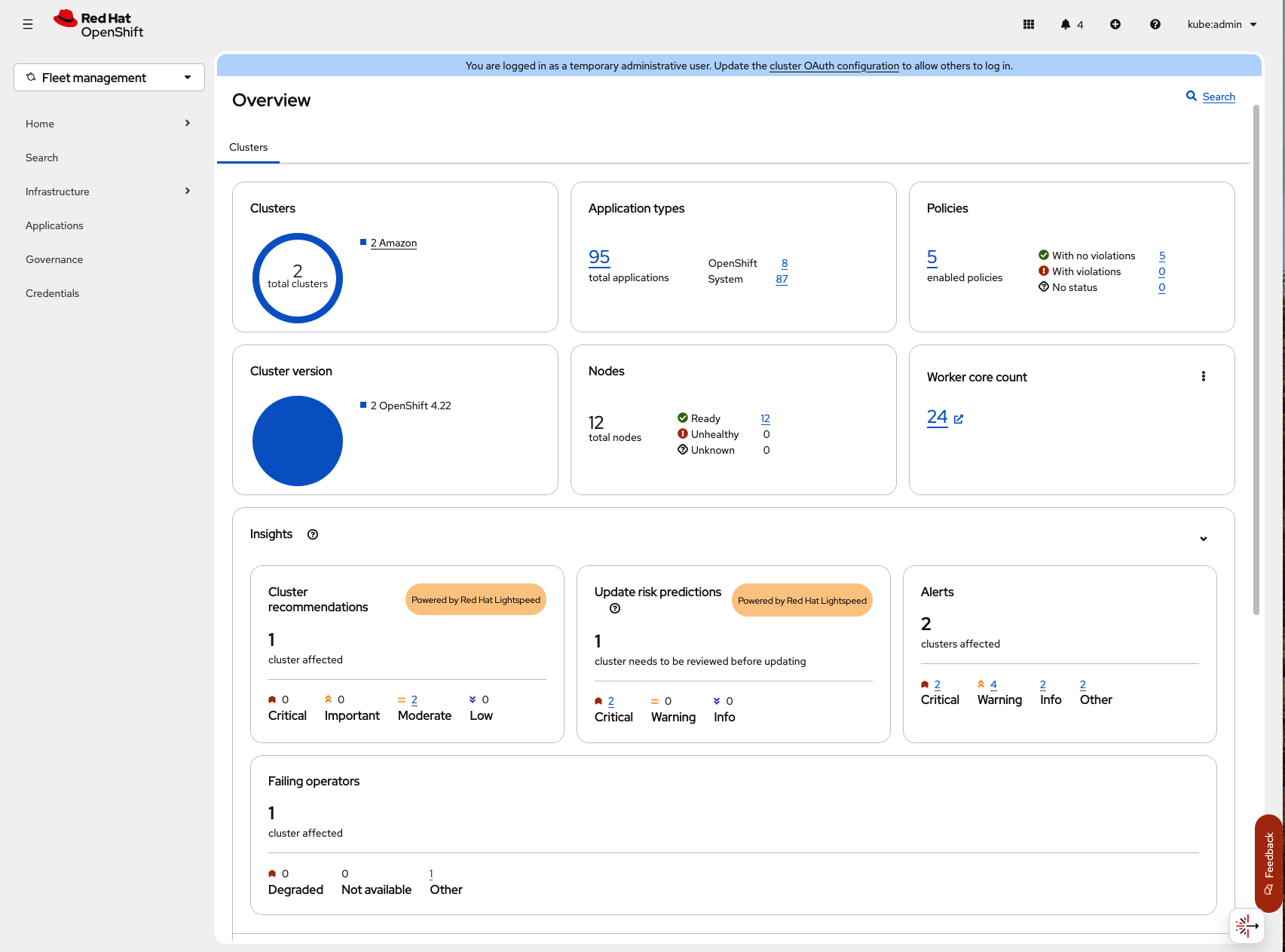
Red Hat Lightspeed advisor self-managed integrates directly into the Red Hat Advanced Cluster Management console. Once deployed and clusters are uploading their archives, recommendations and upgrade risk predictions appear—no separate user interface (UI) needed.
If you manage air-gapped clusters, you can finally gain full visibility into your environment. Disconnected admins can now view cluster health, misconfigurations, and upgrade risks from the same dashboard, getting the proactive visibility connected teams rely on every day. The only difference is that all of this is derived from data that never left the cluster, as shown in Figure 2.
Let us know what you think of the Developer Preview
Red Hat Lightspeed advisor self-managed is currently in Developer Preview, and we're actively looking for feedback from teams running disconnected or air-gapped environments.
Try the Developer Preview in your disconnected environment and share your thoughts:
- Test the add-on: Explore the repository and try the add-on.
- Give feedback: Help us refine Red Hat Lightspeed advisor self-managed before we reach Technology Preview and general availability as part of Red Hat Advanced Cluster Management. Share your feedback.

