Redhat Developers  Logo
  • AI

    Get started with AI

    • Red Hat AI
      Accelerate the development and deployment of enterprise AI solutions.
    • AI learning hub
      Explore learning materials and tools, organized by task.
    • AI interactive demos
      Click through scenarios with Red Hat AI, including training LLMs and more.
    • AI/ML learning paths
      Expand your OpenShift AI knowledge using these learning resources.
    • AI quickstarts
      Focused AI use cases designed for fast deployment on Red Hat AI platforms.
    • No-cost AI training
      Foundational Red Hat AI training.

    Featured resources

    • OpenShift AI learning
    • Open source AI for developers
    • AI product application development
    • Open source-powered AI/ML for hybrid cloud
    • AI and Node.js cheat sheet

    Red Hat AI Factory with NVIDIA

    • Red Hat AI Factory with NVIDIA is a co-engineered, enterprise-grade AI solution for building, deploying, and managing AI at scale across hybrid cloud environments.
    • Explore the solution
  • Learn

    Self-guided

    • Documentation
      Find answers, get step-by-step guidance, and learn how to use Red Hat products.
    • Learning paths
      Explore curated walkthroughs for common development tasks.
    • Guided learning
      Receive custom learning paths powered by our AI assistant.
    • See all learning

    Hands-on

    • Developer Sandbox
      Spin up Red Hat's products and technologies without setup or configuration.
    • Interactive labs
      Learn by doing in these hands-on, browser-based experiences.
    • Interactive demos
      Click through product features in these guided tours.

    Browse by topic

    • AI/ML
    • Automation
    • Java
    • Kubernetes
    • Linux
    • See all topics

    Training & certifications

    • Courses and exams
    • Certifications
    • Skills assessments
    • Red Hat Academy
    • Learning subscription
    • Explore training
  • Build

    Get started

    • Red Hat build of Podman Desktop
      A downloadable, local development hub to experiment with our products and builds.
    • Developer Sandbox
      Spin up Red Hat's products and technologies without setup or configuration.

    Download products

    • Access product downloads to start building and testing right away.
    • Red Hat Enterprise Linux
    • Red Hat AI
    • Red Hat OpenShift
    • Red Hat Ansible Automation Platform
    • See all products

    Featured

    • Red Hat build of OpenJDK
    • Red Hat JBoss Enterprise Application Platform
    • Red Hat OpenShift Dev Spaces
    • Red Hat Developer Toolset

    References

    • E-books
    • Documentation
    • Cheat sheets
    • Architecture center
  • Community

    Get involved

    • Events
    • Live AI events
    • Red Hat Summit
    • Red Hat Accelerators
    • Community discussions

    Follow along

    • Articles & blogs
    • Developer newsletter
    • Videos
    • Github

    Get help

    • Customer service
    • Customer support
    • Regional contacts
    • Find a partner

    Join the Red Hat Developer program

    • Download Red Hat products and project builds, access support documentation, learning content, and more.
    • Explore the benefits

OpenShift joins the Argo CD community (KubeCon Europe 2020)

August 17, 2020
Siamak Sadeghianfar
Related topics:
CI/CDDevOpsKubernetesOperators

    As Kubernetes and Red Hat OpenShift platform adoption grow and organizations move a larger portion of their infrastructure to these platforms, organizations are increasingly faced with the challenge of managing hybrid multicluster environments across the public cloud and on-premises infrastructure. While this approach brings flexibility and scalability to managing applications, the ability to ensure configuration consistency across these clusters, and the ability to roll out applications to multiple clusters in a consistent manner becomes a necessity. Enter the Argo CD GitOps Kubernetes Operator.

    GitOps, Kubernetes, and configuration consistency

    GitOps is an increasingly popular set of practices for managing the complexities of running hybrid multicluster Kubernetes infrastructure. GitOps centers on treating Git repositories as the single source of truth and applying Git workflows that have been consistently used for application development to infrastructure and application operators.

    Declarative configuration and GitOps principles are the core of the OpenShift Container Platform values that led us to make OpenShift one of the most declarative Kubernetes platforms in the world. Virtually all aspects of OpenShift can be configured declaratively, taking advantage of Kubernetes custom resources that allow GitOps practitioners to store OpenShift configuration resources in a Git repo. This makes sure that all OpenShift cluster configurations are in sync with the source of truth in Git using the practitioners' tools of choice.

    Argo CD and OpenShift

    Argo CD is a popular Cloud Native Computing Foundation (CNCF) open source GitOps Kubernetes Operator for declarative configuration on Kubernetes clusters. Argo CD has a lively community of users with a growing user base among OpenShift customers. It is in fact one of the most popular community Kubernetes Operators on the OpenShift platform.

    Red Hat has a long history of engaging with community projects that address enterprise needs. Continuing on that journey, we are now collaborating with Intuit and joining the Argo community as a member of the bootstrap steering committee. Doing this lets us actively contribute to the Argo community and help OpenShift customers take advantage of Argo CD for managing their applications in multicluster OpenShift and Kubernetes infrastructure using GitOps principles.

    Argo CD, shown in Figure 1, works based on the GitOps pattern of using Git repositories as the source of truth for defining the desired application state. Kubernetes manifests can be specified in several ways, such as Helm, kustomize, and plain JSON or YAML, among others. Argo CD automates deploying applications to multiple customers by syncing Kubernetes manifests to the target clusters and making sure the clusters are in the desired state. Furthermore, it monitors the state of the deployed applications on Kubernetes clusters and constantly compares them to the manifests stored in Git, in order to detect any drift from the desired state; for example, in case of manual changes. When drift is detected, admins can be notified, or Argo CD can be configured to automatically correct the state of the application on the cluster based on the Git repositories.
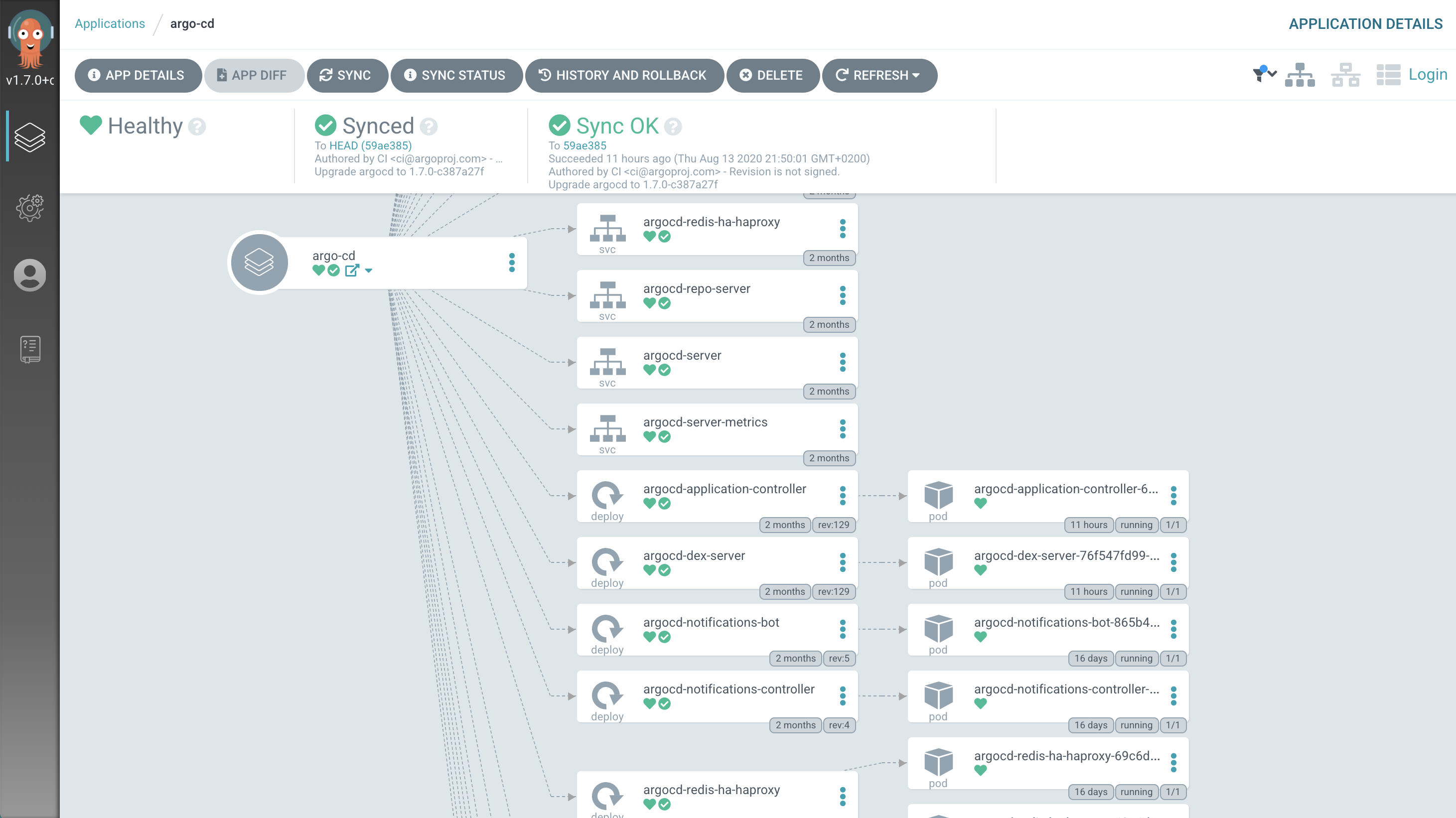
    ArgoCD application state chart showing that the application is fully synced.
    Figure 1: Viewing application state in Argo CD.
    Figure 1: Viewing application state in Argo CD.">

    Adi Sakala, senior director for OpenShift and developer engineering at Red Hat, states:

    "OpenShift continues to help organizations through the Cloud Native journey modernizing their data centers and development teams. Continuous deployment and delivery of infra & applications plays a critical role as organizations rethink and retool delivery processes to scale the adoption of containerized development.

    "The Argo project has widely been recognized and adopted in the Kubernetes ecosystem providing continuous delivery tooling. Red Hat as a leader of open source and hybrid cloud platform is happy to join hands with Intuit and the rest of the Argo community to further help drive the project. We believe when communities thrive with open governance and vibrant users it sets up for sustained growth of the project. Having Argo as a choice for OpenShift users will empower and enable enterprises to declaratively build and run cloud native applications on OpenShift using GitOps. We are thrilled to give OpenShift users this option."

    What’s next

    Argo CD is available today as an Argo community-owned Kubernetes Operator on the OperatorHub accessible through the OpenShift console admin perspective. In the coming months as we ramp up our engagement and contributions upstream in the Argo community, we will simultaneously drive a tighter integration within the OpenShift portfolio of developer tools that span over the three distinct phases that a change goes through until it reaches production (see Figure 2):

    • Local development on the developer’s workstation with odo and CodeReady Containers, or in a web-based workspace with CodeReady Workspaces.
    • Continuous integration (CI) with Tekton Pipelines to build and test applications on every Git change.
    • Continuous delivery (CD) with Argo CD to deliver applications to multicluster staging and production clusters.
    Figure 2: The three phases a change goes through in a CI/CD pipeline.">

    We are excited about the road ahead with the addition of Argo CD to the OpenShift developer tools portfolio. Stay tuned for more exciting news over the coming months on what this means for application development workflows on OpenShift.

    Last updated: August 18, 2020

    Recent Posts

    • Red Hat Hardened Images: Top 5 benefits for software developers

    • How EvalHub manages two-layer Kubernetes control planes

    • Tekton joins the CNCF as an incubating project

    • Federated identity across the hybrid cloud using zero trust workload identity manager

    • Confidential virtual machine storage attack scenarios

    Red Hat Developers logo LinkedIn YouTube Twitter Facebook

    Platforms

    • Red Hat AI
    • Red Hat Enterprise Linux
    • Red Hat OpenShift
    • Red Hat Ansible Automation Platform
    • See all products

    Build

    • Developer Sandbox
    • Developer tools
    • Interactive tutorials
    • API catalog

    Quicklinks

    • Learning resources
    • E-books
    • Cheat sheets
    • Blog
    • Events
    • Newsletter

    Communicate

    • About us
    • Contact sales
    • Find a partner
    • Report a website issue
    • Site status dashboard
    • Report a security problem

    RED HAT DEVELOPER

    Build here. Go anywhere.

    We serve the builders. The problem solvers who create careers with code.

    Join us if you’re a developer, software engineer, web designer, front-end designer, UX designer, computer scientist, architect, tester, product manager, project manager or team lead.

    Sign me up

    Red Hat legal and privacy links

    • About Red Hat
    • Jobs
    • Events
    • Locations
    • Contact Red Hat
    • Red Hat Blog
    • Inclusion at Red Hat
    • Cool Stuff Store
    • Red Hat Summit
    © 2026 Red Hat

    Red Hat legal and privacy links

    • Privacy statement
    • Terms of use
    • All policies and guidelines
    • Digital accessibility

    Chat Support

    Please log in with your Red Hat account to access chat support.