Redhat Developers  Logo
  • AI

    Get started with AI

    • Red Hat AI
      Accelerate the development and deployment of enterprise AI solutions.
    • AI learning hub
      Explore learning materials and tools, organized by task.
    • AI interactive demos
      Click through scenarios with Red Hat AI, including training LLMs and more.
    • AI/ML learning paths
      Expand your OpenShift AI knowledge using these learning resources.
    • AI quickstarts
      Focused AI use cases designed for fast deployment on Red Hat AI platforms.
    • No-cost AI training
      Foundational Red Hat AI training.

    Featured resources

    • OpenShift AI learning
    • Open source AI for developers
    • AI product application development
    • Open source-powered AI/ML for hybrid cloud
    • AI and Node.js cheat sheet

    Red Hat AI Factory with NVIDIA

    • Red Hat AI Factory with NVIDIA is a co-engineered, enterprise-grade AI solution for building, deploying, and managing AI at scale across hybrid cloud environments.
    • Explore the solution
  • Learn

    Self-guided

    • Documentation
      Find answers, get step-by-step guidance, and learn how to use Red Hat products.
    • Learning paths
      Explore curated walkthroughs for common development tasks.
    • Guided learning
      Receive custom learning paths powered by our AI assistant.
    • See all learning

    Hands-on

    • Developer Sandbox
      Spin up Red Hat's products and technologies without setup or configuration.
    • Interactive labs
      Learn by doing in these hands-on, browser-based experiences.
    • Interactive demos
      Click through product features in these guided tours.

    Browse by topic

    • AI/ML
    • Automation
    • Java
    • Kubernetes
    • Linux
    • See all topics

    Training & certifications

    • Courses and exams
    • Certifications
    • Skills assessments
    • Red Hat Academy
    • Learning subscription
    • Explore training
  • Build

    Get started

    • Red Hat build of Podman Desktop
      A downloadable, local development hub to experiment with our products and builds.
    • Developer Sandbox
      Spin up Red Hat's products and technologies without setup or configuration.

    Download products

    • Access product downloads to start building and testing right away.
    • Red Hat Enterprise Linux
    • Red Hat AI
    • Red Hat OpenShift
    • Red Hat Ansible Automation Platform
    • See all products

    Featured

    • Red Hat build of OpenJDK
    • Red Hat JBoss Enterprise Application Platform
    • Red Hat OpenShift Dev Spaces
    • Red Hat Developer Toolset

    References

    • E-books
    • Documentation
    • Cheat sheets
    • Architecture center
  • Community

    Get involved

    • Events
    • Live AI events
    • Red Hat Summit
    • Red Hat Accelerators
    • Community discussions

    Follow along

    • Articles & blogs
    • Developer newsletter
    • Videos
    • Github

    Get help

    • Customer service
    • Customer support
    • Regional contacts
    • Find a partner

    Join the Red Hat Developer program

    • Download Red Hat products and project builds, access support documentation, learning content, and more.
    • Explore the benefits

Easy-to-use tools are key to CI/CD success says 2019 State of DevOps Report

September 18, 2019
editorial-team
Related topics:
CI/CDDevOps

    The most effective strategies for scaling DevOps and fostering productivity include easy-to-use tools and solutions that create community, according to the 2019 Accelerate State of DevOps Report.

    This year’s report, written by Dr. Nicole Forsgren, Dr. Dustin Smith, Jez Humble, and Jessie Frazelle, represents six years of research and data from more than 31,000 professionals and aims to better understand how the technical and cultural practices associated with DevOps affect team and organizational performance. It also explores ways to help improve performance and productivity and even reduce burnout.

    Demographics

    We’ll look at a few highlights of the report, but first it’s worth noting the demographic makeup of survey respondents, most of whom work within the tech industry (38%), followed by financial services (12%), retail/consumer (9%), and other.

    “Gender breakouts from this year’s survey responses remain consistent with 83% male in 2019 (vs 83% last year), 10% female (vs 12% last year), and <1% non-binary (vs <1% last year),” the report states. However, this year’s respondents said that only 16% of their teams include women, which is down from 25% reported last year.

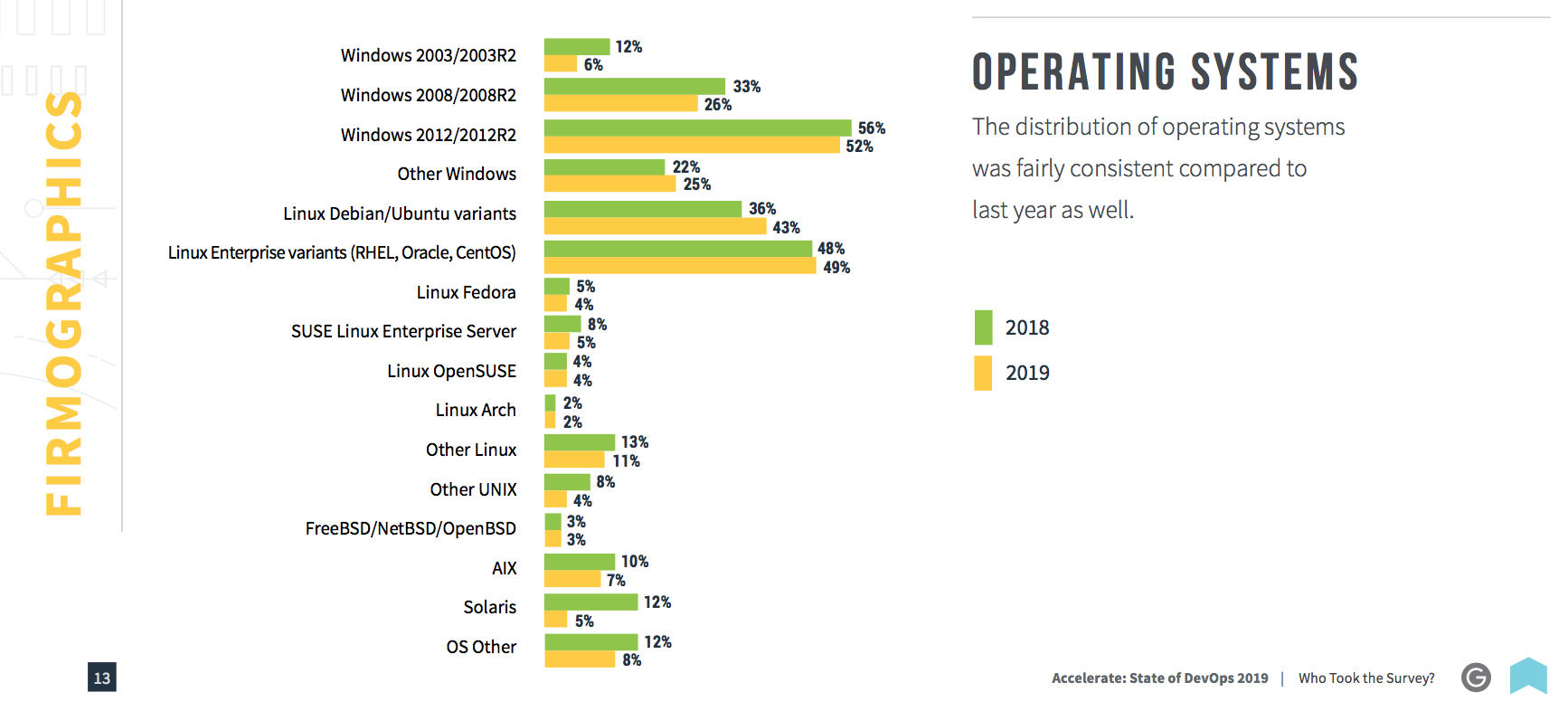
    The number of respondents who work as part of specific DevOps/SRE teams has stayed at approximately 27% for the past three years; 30% are part of Development or Engineering. Additionally, the breakdown of operating systems used has been fairly consistent:
    DevOps OS
    Source: 2019 Accelerate State of DevOps
    Source: 2019 Accelerate State of DevOps">

    Improving performance

    The report notes that many organizations are looking for a specific set of best practices for adopting DevOps, but every organization differs in terms of technology, culture, processes, and goals. Thus, taking a more general, or holistic, approach—through which you first understand and describe your existing processes and desired outcomes and then empower teams to accomplish those goals—can be most effective.

    “Remember that our goal is improving our ability to deliver software, which we accomplish through technical practices in delivery and deployment we call continuous delivery (CD). CD reduces the risk and cost of performing releases. Continuous delivery for the sake of continuous delivery is not enough if you want your organization to succeed, however. It must be done with an eye to organizational goals such as profitability, productivity, and customer satisfaction.”  — 2019 Accelerate State of DevOps Report

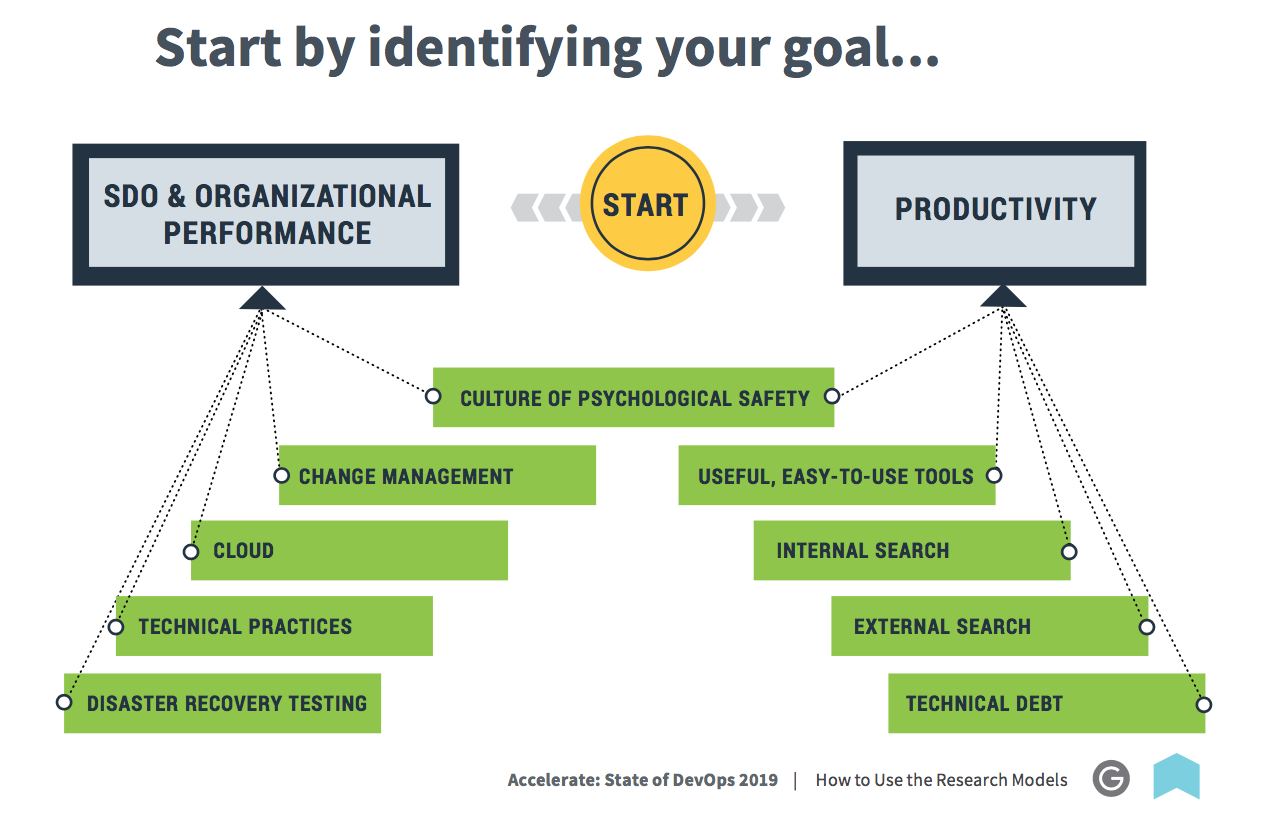
    This year’s report aims to help organizations drive improvement in both performance and productivity using two research models, shown below, and it offers guidance depending on what you want to improve.
    DevOps models
    Source: 2019 Accelerate State of DevOps
    Source: 2019 Accelerate State of DevOps">

    Fostering productivity

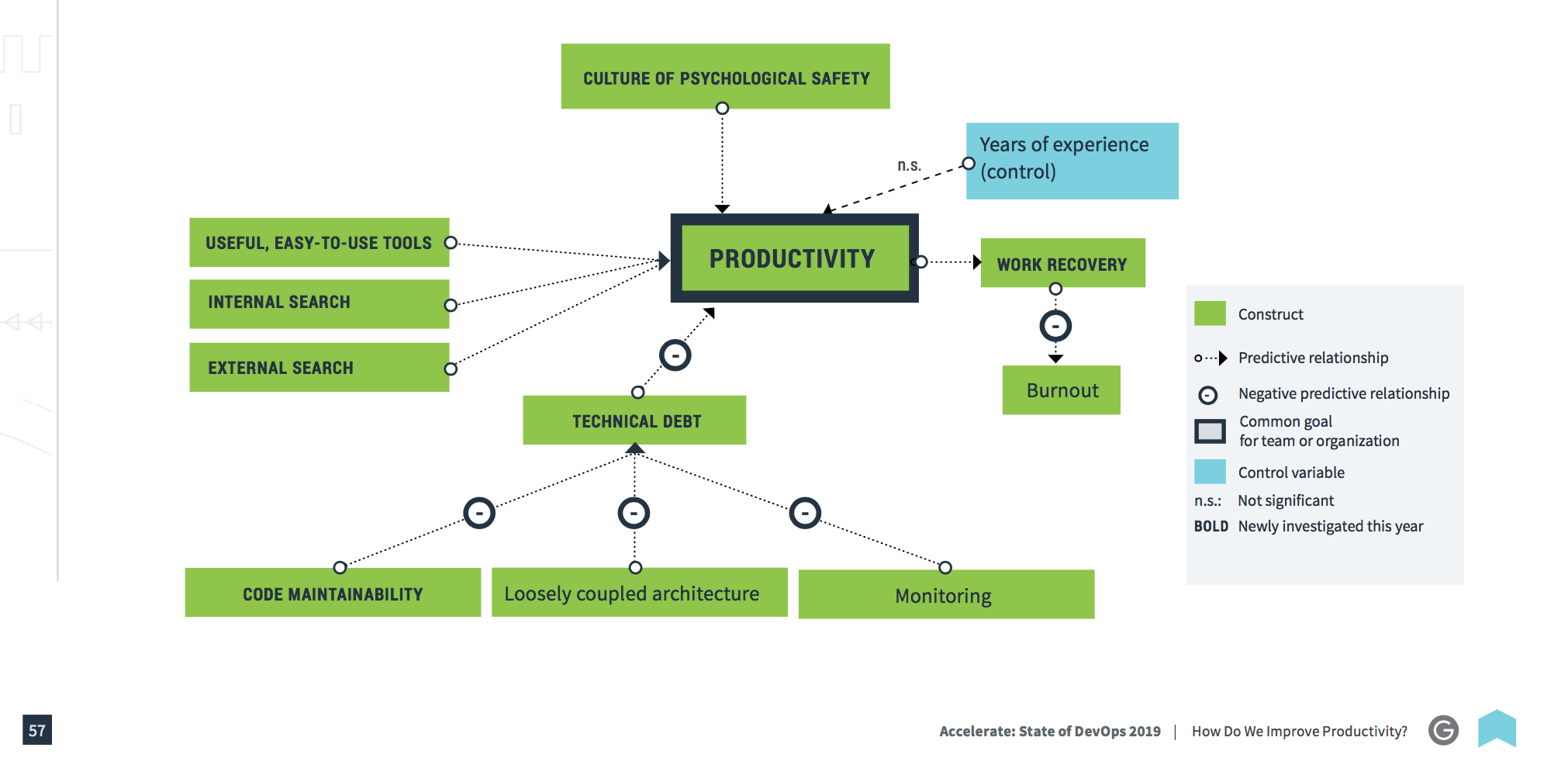
    As defined in the report, “productivity is the ability to get complex, time-consuming tasks completed with minimal distractions and interruptions.” Productive people complete their work efficiently, giving them more time to do other things.
    DevOps productiivty
    Source: 2019 Accelerate State of DevOps">

    One way organizations can help foster productivity is through the use of appropriate tooling. This year’s findings showed that the highest performing engineers are one and a half times more likely to have easy-to-use tools.

    The following image shows a breakdown of performance relating to use of open source, proprietary, and commercial off-the-shelf (COTS) software.

    DevOps tools
    Source: 2019 Accelerate State of DevOps">

    This section of the report focused mainly on tools used in deploying software through the CI/CD and test automation process and found that the following factors foster productivity:

    • How easy it is to use the toolchain (including straightforward and easy interactions and operation).
    • How useful the toolchain is in accomplishing job-related goals.

    The report found that elite performers more frequently automate and integrate tools into their toolchains on almost all dimensions.

    More resources

    You can learn more about DevOps here on the Red Hat Developer blog.

    Join Red Hat Developer 

    Last updated: July 1, 2020

    Recent Posts

    • Tekton joins the CNCF as an incubating project

    • Federated identity across the hybrid cloud using zero trust workload identity manager

    • Confidential virtual machine storage attack scenarios

    • Introducing virtualization platform autopilot

    • Integrate zero trust workload identity manager with Red Hat OpenShift GitOps

    Red Hat Developers logo LinkedIn YouTube Twitter Facebook

    Platforms

    • Red Hat AI
    • Red Hat Enterprise Linux
    • Red Hat OpenShift
    • Red Hat Ansible Automation Platform
    • See all products

    Build

    • Developer Sandbox
    • Developer tools
    • Interactive tutorials
    • API catalog

    Quicklinks

    • Learning resources
    • E-books
    • Cheat sheets
    • Blog
    • Events
    • Newsletter

    Communicate

    • About us
    • Contact sales
    • Find a partner
    • Report a website issue
    • Site status dashboard
    • Report a security problem

    RED HAT DEVELOPER

    Build here. Go anywhere.

    We serve the builders. The problem solvers who create careers with code.

    Join us if you’re a developer, software engineer, web designer, front-end designer, UX designer, computer scientist, architect, tester, product manager, project manager or team lead.

    Sign me up

    Red Hat legal and privacy links

    • About Red Hat
    • Jobs
    • Events
    • Locations
    • Contact Red Hat
    • Red Hat Blog
    • Inclusion at Red Hat
    • Cool Stuff Store
    • Red Hat Summit
    © 2026 Red Hat

    Red Hat legal and privacy links

    • Privacy statement
    • Terms of use
    • All policies and guidelines
    • Digital accessibility

    Chat Support

    Please log in with your Red Hat account to access chat support.
