Redhat Developers  Logo
  • AI

    Get started with AI

    • Red Hat AI
      Accelerate the development and deployment of enterprise AI solutions.
    • AI learning hub
      Explore learning materials and tools, organized by task.
    • AI interactive demos
      Click through scenarios with Red Hat AI, including training LLMs and more.
    • AI/ML learning paths
      Expand your OpenShift AI knowledge using these learning resources.
    • AI quickstarts
      Focused AI use cases designed for fast deployment on Red Hat AI platforms.
    • No-cost AI training
      Foundational Red Hat AI training.

    Featured resources

    • OpenShift AI learning
    • Open source AI for developers
    • AI product application development
    • Open source-powered AI/ML for hybrid cloud
    • AI and Node.js cheat sheet

    Red Hat AI Factory with NVIDIA

    • Red Hat AI Factory with NVIDIA is a co-engineered, enterprise-grade AI solution for building, deploying, and managing AI at scale across hybrid cloud environments.
    • Explore the solution
  • Learn

    Self-guided

    • Documentation
      Find answers, get step-by-step guidance, and learn how to use Red Hat products.
    • Learning paths
      Explore curated walkthroughs for common development tasks.
    • See all learning

    Hands-on

    • Developer Sandbox
      Spin up Red Hat's products and technologies without setup or configuration.
    • Interactive labs
      Learn by doing in these hands-on, browser-based experiences.
    • Interactive demos
      Click through product features in these guided tours.

    Browse by topic

    • AI/ML
    • Automation
    • Java
    • Kubernetes
    • Linux
    • See all topics

    Training & certifications

    • Courses and exams
    • Certifications
    • Skills assessments
    • Red Hat Academy
    • Learning subscription
    • Explore training
  • Build

    Get started

    • Red Hat build of Podman Desktop
      A downloadable, local development hub to experiment with our products and builds.
    • Developer Sandbox
      Spin up Red Hat's products and technologies without setup or configuration.

    Download products

    • Access product downloads to start building and testing right away.
    • Red Hat Enterprise Linux
    • Red Hat AI
    • Red Hat OpenShift
    • Red Hat Ansible Automation Platform
    • See all products

    Featured

    • Red Hat build of OpenJDK
    • Red Hat JBoss Enterprise Application Platform
    • Red Hat OpenShift Dev Spaces
    • Red Hat Developer Toolset

    References

    • E-books
    • Documentation
    • Cheat sheets
    • Architecture center
  • Community

    Get involved

    • Events
    • Live AI events
    • Red Hat Summit
    • Red Hat Accelerators
    • Community discussions

    Follow along

    • Articles & blogs
    • Developer newsletter
    • Videos
    • Github

    Get help

    • Customer service
    • Customer support
    • Regional contacts
    • Find a partner

    Join the Red Hat Developer program

    • Download Red Hat products and project builds, access support documentation, learning content, and more.
    • Explore the benefits

Eclipse Che 7 is Coming and It’s Really Hot (4/4)

December 21, 2018
Stevan Le Meur
Related topics:
Developer toolsIDEsKubernetes
Related products:
Developer Toolset

    Eclipse Che 7 is an enterprise-grade IDE that is designed to solve many of the challenges faced by enterprise development teams. In my previous articles, I covered the main focus areas for Eclipse Che 7, the new plugin model, and kube-native developer workspaces. This article explains security and management of Eclipse Che 7 in enterprise deployment scenarios as well as release timing.

    Enterprise Grade Cloud IDE

    Eclipse Che has gained a great deal of interest in large enterprises that are moving to containers and want to standardize the developer workspace and remove intellectual property (source code) from hard-to-secure laptops. There are a number of features needed in order to make Che a simple-to-manage tool for these large and often private environments. Organizations want to secure workspaces, deploy them on new infrastructure, and make it easier for teams to collaborate while maintaining developer autonomy.

    For those reasons, we are working on a number of different facets to make Eclipse Che easier to run and simpler to administer and manage.

    Eclipse Che 7 — timing?

    There is A LOT that is coming with Eclipse Che 7. We spent a lot of time redefining the project’s foundations for the future, making it more enjoyable to use, easier to adopt by large enterprise, and able to support its community growth.

    We are all very excited about this new version. In the following weeks, you’ll be reading more about the new capabilities and how they have been built. Eclipse Con Europe was a great event where we were able to unveil a lot of the work we’ve been doing. Now it is time to share it with a broader audience.

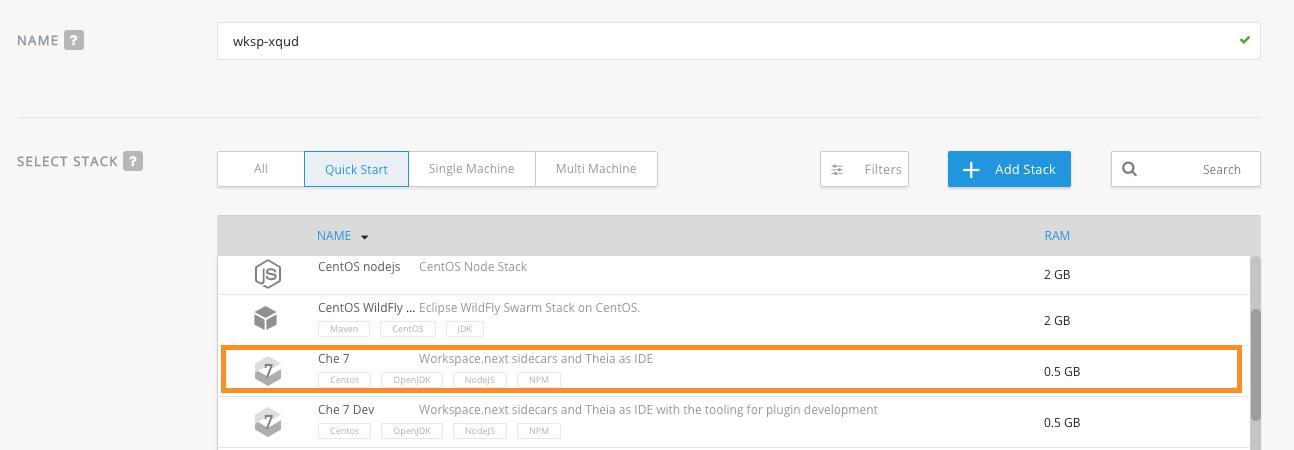
    It’s available today: when you create a new workspace from the latest Eclipse Che release, you can select Che 7 stacks. You can test it now, and you can post feedback or report bugs — those are always helpful and valuable !

    Eclipse Che 7 early beta will be available in February with GA-level Che 7 planned for March.


    Try Eclipse Che 7 Now!

    Want to try to the new version of Eclipse Che 7?  Here's how:

    Click on the following factory URL:

    https://che.openshift.io/f?id=factoryvbwekkducozn3jsn

    Or Create your account on che.openshift.io, create a new workspace and select “Che 7” stack.
    Try Eclipse Che 7 on OpenShift

    You can also test on your local machine, by installing the latest version of Eclipse Che, See Quick Start with Eclipse Che.

    Want to learn more?

    My articles about Eclipse Che 7:

    • Part 1—Eclipse Che 7 overview, and introducing the new IDE
    • Part 2—Introducing the plugin model
    • Part 3—Kube-native developer workspaces
    • Part 4—Functionality for Enterprise Development Teams and schedule (this article)

    That’s it for the fourth article introducing Eclipse Che 7. I hope you enjoyed this series.

    See also

    For information about Che running on Red Hat OpenShift, see CodeReady WorkSpaces for OpenShift (currently in beta) and Doug Tidwell's article and videos, CodeReady Workspaces for OpenShift (Beta)–It works on their machines too. Doug covers stacks and workspaces and factories to help  you get started with Che.

    Last updated: November 8, 2023

    Recent Posts

    • Federated identity across the hybrid cloud using zero trust workload identity manager

    • Confidential virtual machine storage attack scenarios

    • Introducing virtualization platform autopilot

    • Integrate zero trust workload identity manager with Red Hat OpenShift GitOps

    • Best Practice Configuration and Tuning for Linux and Windows VMs

    Red Hat Developers logo LinkedIn YouTube Twitter Facebook

    Platforms

    • Red Hat AI
    • Red Hat Enterprise Linux
    • Red Hat OpenShift
    • Red Hat Ansible Automation Platform
    • See all products

    Build

    • Developer Sandbox
    • Developer tools
    • Interactive tutorials
    • API catalog

    Quicklinks

    • Learning resources
    • E-books
    • Cheat sheets
    • Blog
    • Events
    • Newsletter

    Communicate

    • About us
    • Contact sales
    • Find a partner
    • Report a website issue
    • Site status dashboard
    • Report a security problem

    RED HAT DEVELOPER

    Build here. Go anywhere.

    We serve the builders. The problem solvers who create careers with code.

    Join us if you’re a developer, software engineer, web designer, front-end designer, UX designer, computer scientist, architect, tester, product manager, project manager or team lead.

    Sign me up

    Red Hat legal and privacy links

    • About Red Hat
    • Jobs
    • Events
    • Locations
    • Contact Red Hat
    • Red Hat Blog
    • Inclusion at Red Hat
    • Cool Stuff Store
    • Red Hat Summit
    © 2026 Red Hat

    Red Hat legal and privacy links

    • Privacy statement
    • Terms of use
    • All policies and guidelines
    • Digital accessibility

    Chat Support

    Please log in with your Red Hat account to access chat support.