Redhat Developers  Logo
  • AI

    Get started with AI

    • Red Hat AI
      Accelerate the development and deployment of enterprise AI solutions.
    • AI learning hub
      Explore learning materials and tools, organized by task.
    • AI interactive demos
      Click through scenarios with Red Hat AI, including training LLMs and more.
    • AI/ML learning paths
      Expand your OpenShift AI knowledge using these learning resources.
    • AI quickstarts
      Focused AI use cases designed for fast deployment on Red Hat AI platforms.
    • No-cost AI training
      Foundational Red Hat AI training.

    Featured resources

    • OpenShift AI learning
    • Open source AI for developers
    • AI product application development
    • Open source-powered AI/ML for hybrid cloud
    • AI and Node.js cheat sheet

    Red Hat AI Factory with NVIDIA

    • Red Hat AI Factory with NVIDIA is a co-engineered, enterprise-grade AI solution for building, deploying, and managing AI at scale across hybrid cloud environments.
    • Explore the solution
  • Learn

    Self-guided

    • Documentation
      Find answers, get step-by-step guidance, and learn how to use Red Hat products.
    • Learning paths
      Explore curated walkthroughs for common development tasks.
    • Guided learning
      Receive custom learning paths powered by our AI assistant.
    • See all learning

    Hands-on

    • Developer Sandbox
      Spin up Red Hat's products and technologies without setup or configuration.
    • Interactive labs
      Learn by doing in these hands-on, browser-based experiences.
    • Interactive demos
      Click through product features in these guided tours.

    Browse by topic

    • AI/ML
    • Automation
    • Java
    • Kubernetes
    • Linux
    • See all topics

    Training & certifications

    • Courses and exams
    • Certifications
    • Skills assessments
    • Red Hat Academy
    • Learning subscription
    • Explore training
  • Build

    Get started

    • Red Hat build of Podman Desktop
      A downloadable, local development hub to experiment with our products and builds.
    • Developer Sandbox
      Spin up Red Hat's products and technologies without setup or configuration.

    Download products

    • Access product downloads to start building and testing right away.
    • Red Hat Enterprise Linux
    • Red Hat AI
    • Red Hat OpenShift
    • Red Hat Ansible Automation Platform
    • See all products

    Featured

    • Red Hat build of OpenJDK
    • Red Hat JBoss Enterprise Application Platform
    • Red Hat OpenShift Dev Spaces
    • Red Hat Developer Toolset

    References

    • E-books
    • Documentation
    • Cheat sheets
    • Architecture center
  • Community

    Get involved

    • Events
    • Live AI events
    • Red Hat Summit
    • Red Hat Accelerators
    • Community discussions

    Follow along

    • Articles & blogs
    • Developer newsletter
    • Videos
    • Github

    Get help

    • Customer service
    • Customer support
    • Regional contacts
    • Find a partner

    Join the Red Hat Developer program

    • Download Red Hat products and project builds, access support documentation, learning content, and more.
    • Explore the benefits

Which Camel DSL to choose and why?

<p>&nbsp;</p> <quillbot-extension-portal></quillbot-extension-portal>

December 21, 2017
Bilgin Ibryam
Related topics:
Developer tools
Related products:
Red Hat Fuse

    Note: An updated version of this article was published on September 20, 2023: Which Camel DSL should you use?

    Apache Camel is a powerful integration library that provides mainly three things: lot’s of integration connectors + implementation of multiple integration patterns + a higher-level Domain Specific Language (DSL) abstraction to glue all together nicely. While the connectors and pattern choices are use case and feature driven and easy to make, choosing which Camel DSL to use might be a little hard to reason about. I hope this article will help to guide you in your first Camel journey.

    I work for Red Hat Consulting as an Integration Architect and one of my primary goals is to help customers get the design and the architecture of their future systems as right as possible, and consequently get the best value out of Apache Camel. One of the common questions I get at the start of every new Camel-based project is: “Which Camel DSL should we use? What are the pros and cons of each?”

    I have two pieces of good news for you. First, by choosing to use Apache Camel you have already made the right choice. Camel will turn out to be a very useful toolkit in your arsenal of libraries for lot’s of future use cases and projects to come. And second, the DSL is just a technicality that will not impact the success of your project. You can always change your mind later and even mix and match.

    If you are a part of large company, with multiple independent two-pizza size teams that use Java language here and there, the chances are that some teams are already using Camel. Even in small companies, teams use Camel without being aware of each other. Camel is useful for all kind of tasks and has a small enough library for you to add to your pom.xml and use it without a permission from the technical design board. If that is the case, just talk to your colleagues and learn first hand about their experience with their DSL of choice.

    If you need a more comprehensive comparison and a reason to choose one of the DSLs, the chart below is a brain dump from multiple engineers developing Apache Camel along with consultants using Camel at multiple customer projects across the globe. Pick the arguments that are valid in your context and make your choice.
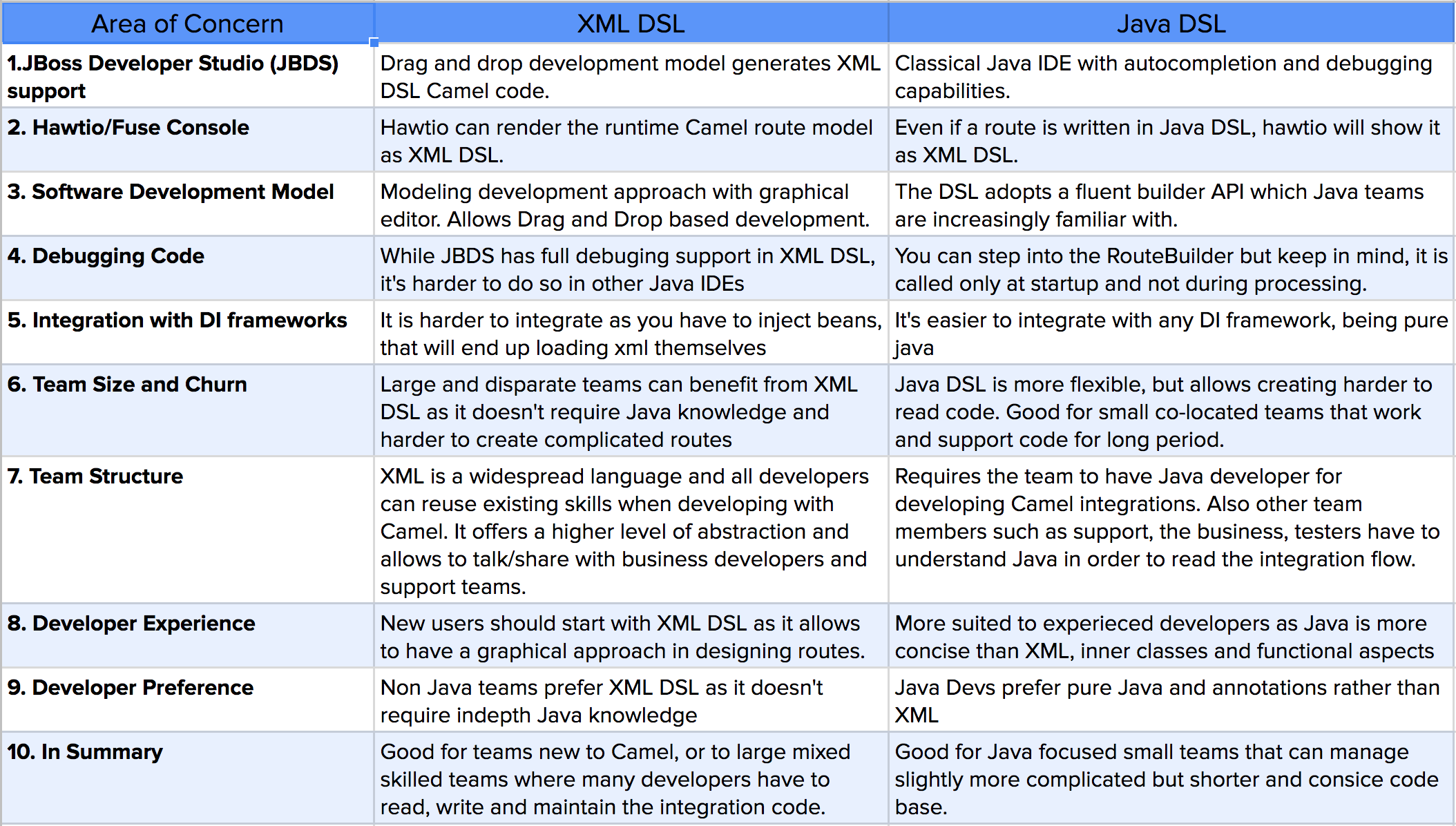
    Comparing Apache Camel's XML and Java DSLs

    If this table doesn’t give you the straight answer you were looking for, probably the answer is: it doesn’t matter. Camel has multiple DSLs, but there are good reasons for both Java and XML-based DSLs to be equally popular. The more important takeaway from here is for developers to get used to thinking in terms of Pipes and Filters, learning the Enterprise Integration Patterns and their notations. Using one of the Camel DSLs to express these patterns is a technicality without a technical consequence. Usually it is a team preference and culture-based choice, such as “We are a hard-core Java shop and we hate XML” or “Can we do all through drag and drop?”.

    All that said, the only advice I can suggest is to strive for consistency. Avoid using different DSLs in the same service, even for different services in the same project. If you can convince everybody in the company to use the same DSL, even better.

    Bilgin Ibryam

    About the author:

    Bilgin Ibryam is a member of Apache Software Foundation, Integration Architect at Red Hat, a software craftsman and blogger. He is an open source fanatic, passionate about distributed systems, messaging and application integration. He is the author of Camel Design Patterns & Kubernetes Patterns books. Follow @bibryam for future blog posts on related topics.


    Red Hat JBoss Fuse is an open source, lightweight, modular integration platform. Leveraging Apache Camel, JBoss Fuse comes with over 160 built-in components. Get started with JBoss Fuse development using Red Hat Development Suite.

    Last updated: September 20, 2023

    Related Posts

    • Which Camel DSL should you use?

    • Design event-driven integrations with Kamelets and Camel K

    • Six reasons to love Camel K

    • Writing Your First Camel Spring Boot Project With the Rest DSL

    • Choose the best Camel for your integration ride, Part 1

    Recent Posts

    • Red Hat Hardened Images: Top 5 benefits for software developers

    • How EvalHub manages two-layer Kubernetes control planes

    • Tekton joins the CNCF as an incubating project

    • Federated identity across the hybrid cloud using zero trust workload identity manager

    • Confidential virtual machine storage attack scenarios

    Red Hat Developers logo LinkedIn YouTube Twitter Facebook

    Platforms

    • Red Hat AI
    • Red Hat Enterprise Linux
    • Red Hat OpenShift
    • Red Hat Ansible Automation Platform
    • See all products

    Build

    • Developer Sandbox
    • Developer tools
    • Interactive tutorials
    • API catalog

    Quicklinks

    • Learning resources
    • E-books
    • Cheat sheets
    • Blog
    • Events
    • Newsletter

    Communicate

    • About us
    • Contact sales
    • Find a partner
    • Report a website issue
    • Site status dashboard
    • Report a security problem

    RED HAT DEVELOPER

    Build here. Go anywhere.

    We serve the builders. The problem solvers who create careers with code.

    Join us if you’re a developer, software engineer, web designer, front-end designer, UX designer, computer scientist, architect, tester, product manager, project manager or team lead.

    Sign me up

    Red Hat legal and privacy links

    • About Red Hat
    • Jobs
    • Events
    • Locations
    • Contact Red Hat
    • Red Hat Blog
    • Inclusion at Red Hat
    • Cool Stuff Store
    • Red Hat Summit
    © 2026 Red Hat

    Red Hat legal and privacy links

    • Privacy statement
    • Terms of use
    • All policies and guidelines
    • Digital accessibility

    Chat Support

    Please log in with your Red Hat account to access chat support.