Redhat Developers  Logo
  • AI

    Get started with AI

    • Red Hat AI
      Accelerate the development and deployment of enterprise AI solutions.
    • AI learning hub
      Explore learning materials and tools, organized by task.
    • AI interactive demos
      Click through scenarios with Red Hat AI, including training LLMs and more.
    • AI/ML learning paths
      Expand your OpenShift AI knowledge using these learning resources.
    • AI quickstarts
      Focused AI use cases designed for fast deployment on Red Hat AI platforms.
    • No-cost AI training
      Foundational Red Hat AI training.

    Featured resources

    • OpenShift AI learning
    • Open source AI for developers
    • AI product application development
    • Open source-powered AI/ML for hybrid cloud
    • AI and Node.js cheat sheet

    Red Hat AI Factory with NVIDIA

    • Red Hat AI Factory with NVIDIA is a co-engineered, enterprise-grade AI solution for building, deploying, and managing AI at scale across hybrid cloud environments.
    • Explore the solution
  • Learn

    Self-guided

    • Documentation
      Find answers, get step-by-step guidance, and learn how to use Red Hat products.
    • Learning paths
      Explore curated walkthroughs for common development tasks.
    • Guided learning
      Receive custom learning paths powered by our AI assistant.
    • See all learning

    Hands-on

    • Developer Sandbox
      Spin up Red Hat's products and technologies without setup or configuration.
    • Interactive labs
      Learn by doing in these hands-on, browser-based experiences.
    • Interactive demos
      Click through product features in these guided tours.

    Browse by topic

    • AI/ML
    • Automation
    • Java
    • Kubernetes
    • Linux
    • See all topics

    Training & certifications

    • Courses and exams
    • Certifications
    • Skills assessments
    • Red Hat Academy
    • Learning subscription
    • Explore training
  • Build

    Get started

    • Red Hat build of Podman Desktop
      A downloadable, local development hub to experiment with our products and builds.
    • Developer Sandbox
      Spin up Red Hat's products and technologies without setup or configuration.

    Download products

    • Access product downloads to start building and testing right away.
    • Red Hat Enterprise Linux
    • Red Hat AI
    • Red Hat OpenShift
    • Red Hat Ansible Automation Platform
    • See all products

    Featured

    • Red Hat build of OpenJDK
    • Red Hat JBoss Enterprise Application Platform
    • Red Hat OpenShift Dev Spaces
    • Red Hat Developer Toolset

    References

    • E-books
    • Documentation
    • Cheat sheets
    • Architecture center
  • Community

    Get involved

    • Events
    • Live AI events
    • Red Hat Summit
    • Red Hat Accelerators
    • Community discussions

    Follow along

    • Articles & blogs
    • Developer newsletter
    • Videos
    • Github

    Get help

    • Customer service
    • Customer support
    • Regional contacts
    • Find a partner

    Join the Red Hat Developer program

    • Download Red Hat products and project builds, access support documentation, learning content, and more.
    • Explore the benefits

Build bootable image mode for Red Hat Enterprise Linux with image builder

Build and deploy a bootable Red Hat Enterprise Linux image with image builder

August 17, 2026
Shane McDowell
Related topics:
Containers
Related products:
Image mode for Red Hat Enterprise Linux

    Image mode for Red Hat Enterprise Linux (RHEL) streamlines your operating system deployment, management, and updates, by leveraging the power of bootable containers (bootc). To get started with this technology, and to get hands-on experience with this new deployment method, you can build a bootable image with Red Hat image builder.

    Red Hat image builder is a tool that allows you to assemble customized RHEL images optimized for your specific target platforms. It supports you in standardizing and streamlining your deployments by applying customizations at build time. You can build a bootable RHEL image with RHEL image builder locally on a RHEL 9 or RHEL 10 host, or with the hosted Red Hat image builder service on the Hybrid Cloud Console.

    The hosted Red Hat image builder service on Hybrid Cloud Console provides advantages for users just getting started with image mode for RHEL, including:

    • Point-and-click wizard for defining and building your first bootable image
    • Storing of image blueprints
    • Building and downloading images without maintaining a build host yourself
    • Accessing RHEL bootc base images that are optimized for for virtualization and public clouds
    • No additional authenticating and downloading images from a container registry

    Create an image blueprint and build a bootable image

    An image blueprint is the configuration file that the image builder service uses to create the image artifact. The image blueprint includes basic metadata, definitions of package content, system customizations, and first boot scripts.

    To get started, visit the Image builder page on Hybrid Cloud Console and click the Create image blueprint button to launch the image blueprint creation wizard. Provide a name and description for your blueprint, then select Image mode to see the available customizations (as in Figure 1).
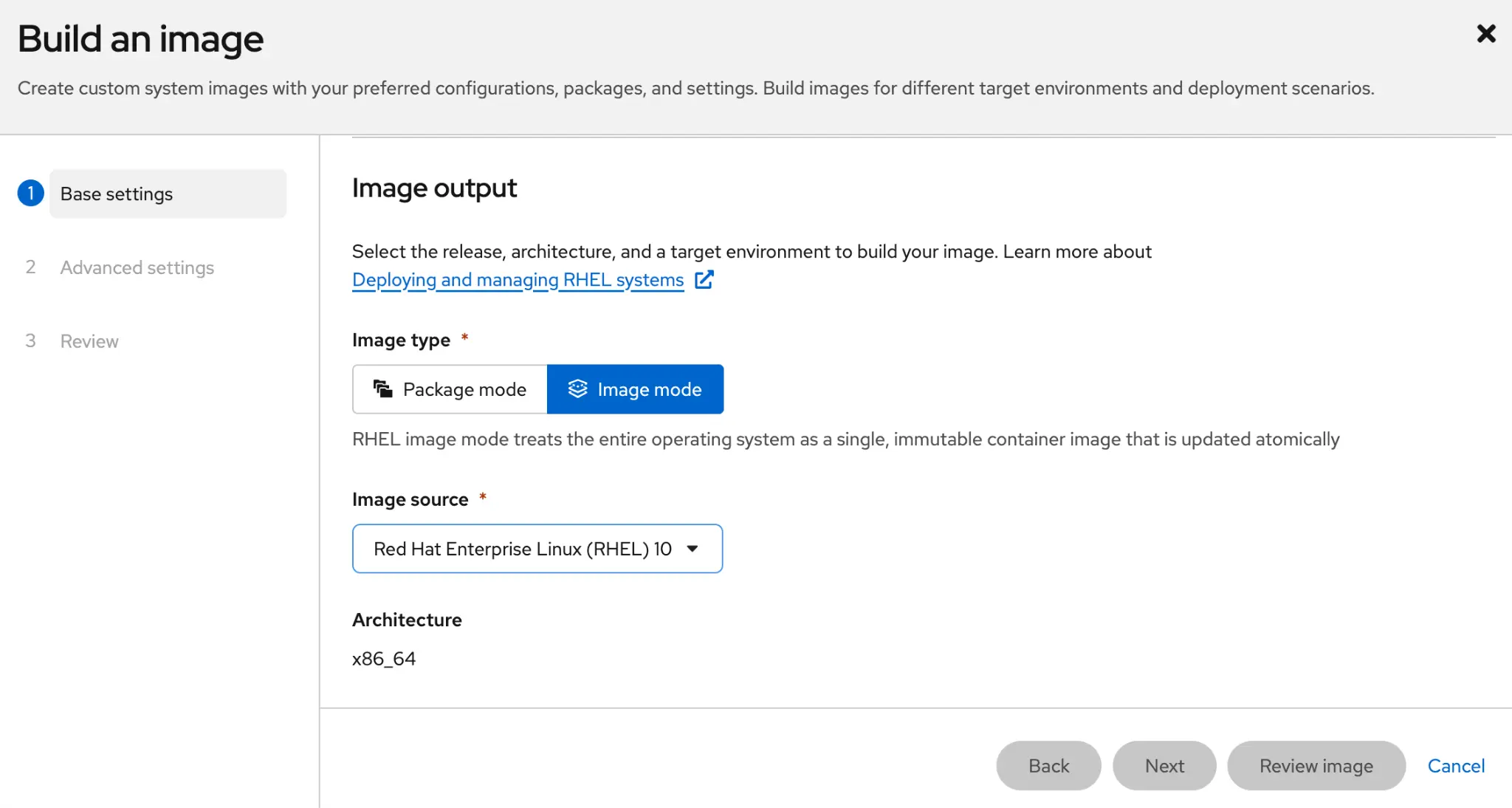
    Select Image mode in the image blueprint creation wizard.
    Figure 1: Select Image mode in the image blueprint creation wizard.

    You can build an image optimized for the public cloud, or to run on a virtualization platform like libvirt or Red Hat OpenShift Virtualization. Select your target environment (Figure 2) and then continue to additional customizations.
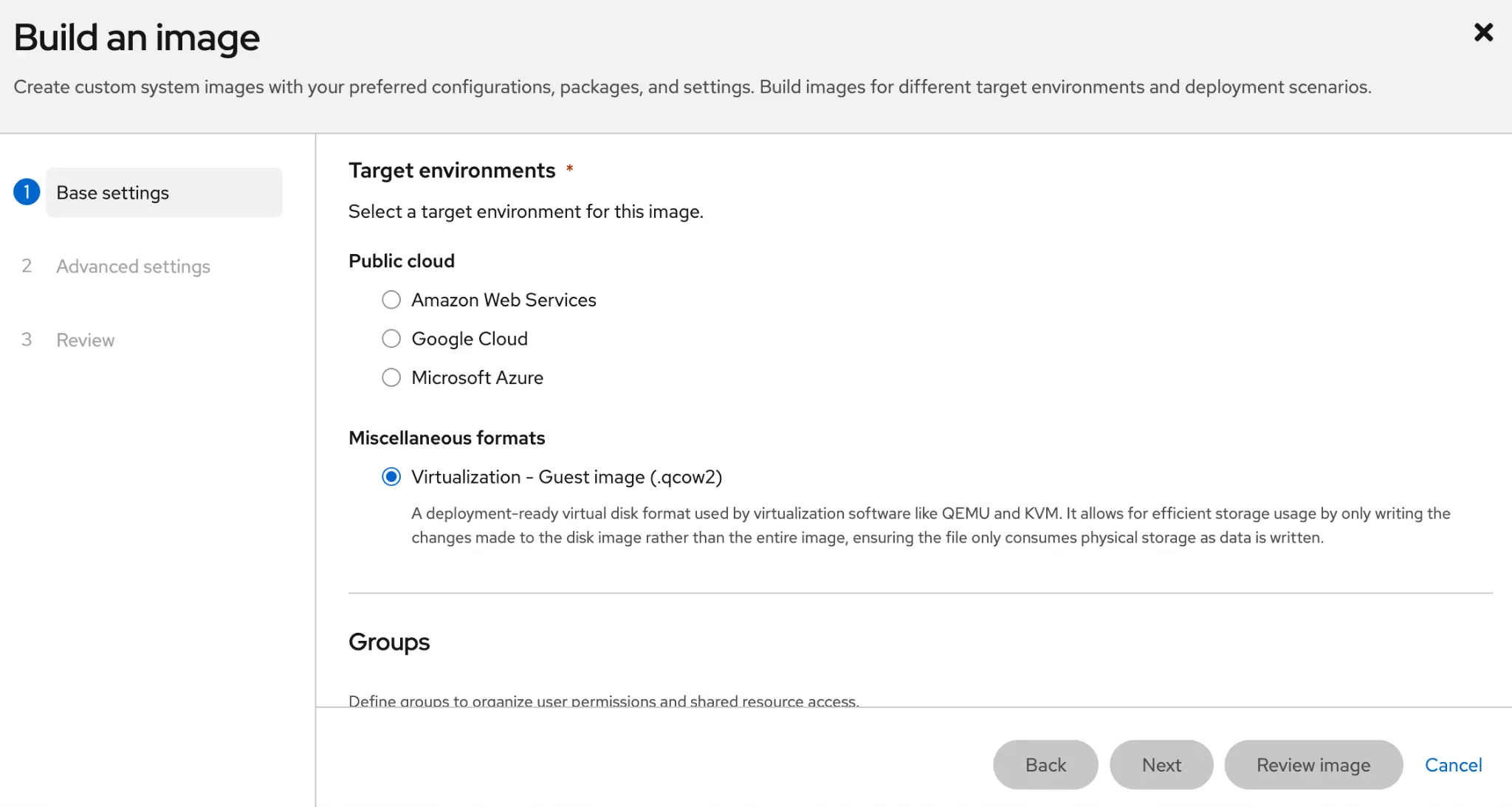
    Select your target environment in the image blueprint creation wizard.
    Figure 2: Select your target environment in the image blueprint creation wizard.

    With package mode for RHEL, you can customize your image blueprints with packages, security settings, and many system configurations. With image mode for RHEL, most of the configuration is in the container image, so the customizations in the image blueprint wizard are limited to users, groups, and filesystem partitioning. At a minimum, you need to create a user so that you can log into any systems you deploy from this image.

    Proceed to the review step to confirm your choices and click Create blueprint and build image(s) to build your bootable RHEL image (Figure 3).
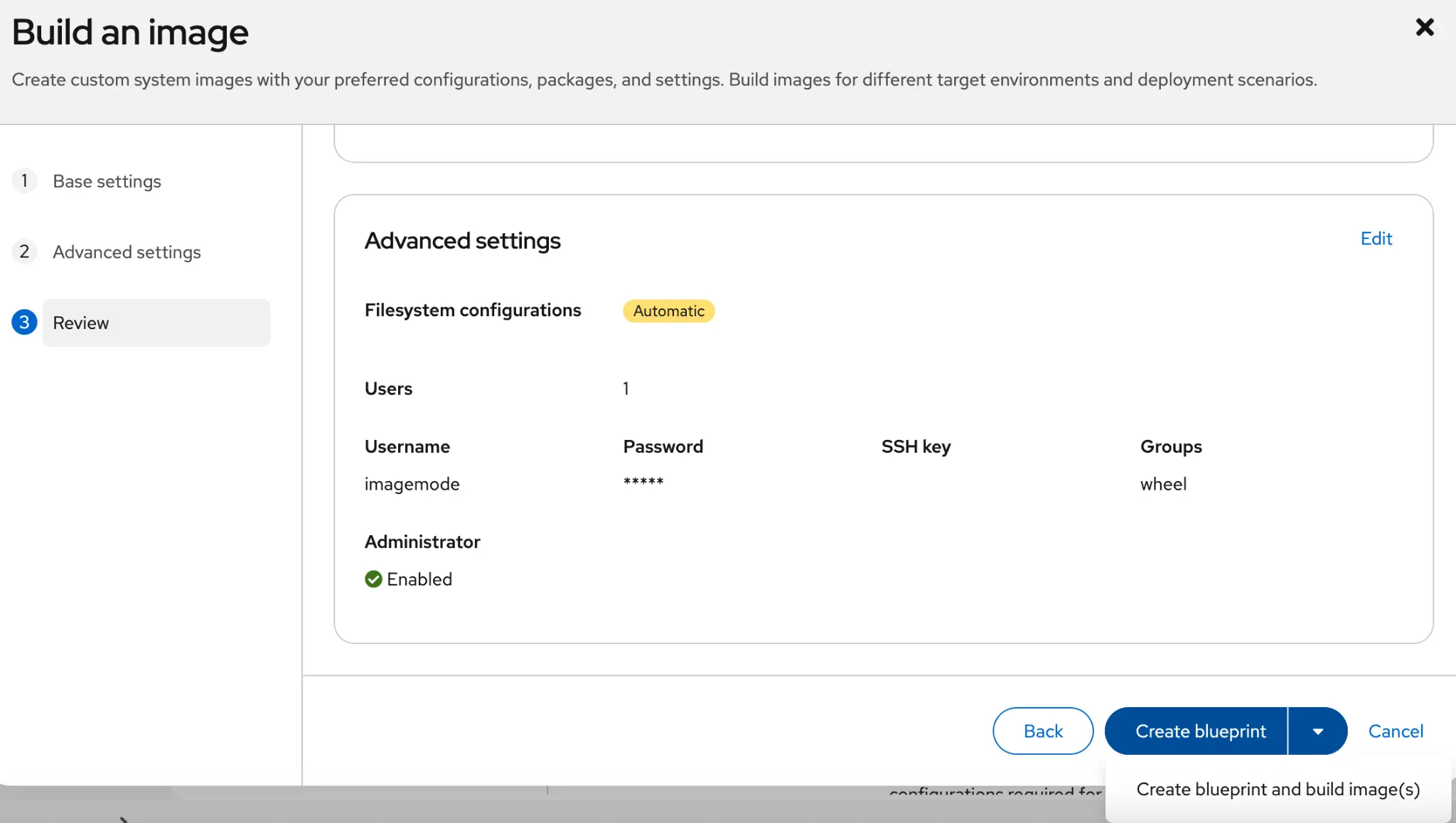
    Click Create blueprint and build image(s).
    Figure 3: Click Create blueprint and build image(s).

    Deploy and manage your bootable image

    After your bootable RHEL image builds, you can download it and deploy a system on your target environment. The result is a basic RHEL system without a workload, but all of the structures in place for you to learn how image-based management works. Read more about connecting and managing an image mode for RHEL system with Red Hat Lightspeed (formerly Red Hat Insights).

    To get the full value of image mode for RHEL and the immutability and consistency that comes with image-based management, build a custom bootc container image, push that image to a container registry and switch your basic RHEL system to pull from this new image. All of the customizations that you configured with image builder, like users, groups, and filesystem layouts, will remain. Learn more about image mode for RHEL.

    Get started today

    Go to the Red Hat image builder in the Hybrid Cloud Console to build your customized bootable image for RHEL, and then deploy your image locally or to the public cloud to get started with image mode for RHEL.

    For more information on Red Hat image builder, check out the image builder overview and list of latest blog posts at redhat.com/image-builder.

    For a step-by-step guide, try our image mode learning path.

    Related Posts

    • Provisioning image mode for Red Hat Enterprise Linux using Red Hat Satellite

    • Security is Getting Harder: Here's Why Image Mode for RHEL Helps

    • Bootable containers: Reduce friction with Red Hat Enterprise Linux image mode

    • Control image mode updates with download-only via bootc

    Recent Posts

    • Build bootable image mode for Red Hat Enterprise Linux with image builder

    • Kubernetes chaos engineering at scale: Krkn Operator Developer Preview in Red Hat Advanced Cluster Management

    • Developer experience improvements you can apply to your own projects

    • Introducing the Red Hat OpenShift Virtualization incident must-gather

    • How llm-d routes model inference traffic on Amazon EKS

    What’s up next?

    Learning Path A blurry keyboard with a Red Hat logo on the upper left side and the word LAMP across the front of the keyboard

    Build a hardened LAMP stack and deploy it in image mode for Red Hat Enterprise Linux

    Build a LAMP stack application on Red Hat Enterprise Linux 10 using hardened...
    Red Hat Developers logo LinkedIn YouTube Twitter Facebook

    Platforms

    • Red Hat AI
    • Red Hat Enterprise Linux
    • Red Hat OpenShift
    • Red Hat Ansible Automation Platform
    • See all products

    Build

    • Developer Sandbox
    • Developer tools
    • Interactive tutorials
    • API catalog

    Quicklinks

    • Learning resources
    • E-books
    • Cheat sheets
    • Blog
    • Events
    • Newsletter

    Communicate

    • About us
    • Contact sales
    • Find a partner
    • Report a website issue
    • Site status dashboard
    • Report a security problem

    RED HAT DEVELOPER

    Build here. Go anywhere.

    We serve the builders. The problem solvers who create careers with code.

    Join us if you’re a developer, software engineer, web designer, front-end designer, UX designer, computer scientist, architect, tester, product manager, project manager or team lead.

    Sign me up

    Red Hat legal and privacy links

    • About Red Hat
    • Jobs
    • Events
    • Locations
    • Contact Red Hat
    • Red Hat Blog
    • Inclusion at Red Hat
    • Cool Stuff Store
    • Red Hat Summit
    © 2026 Red Hat

    Red Hat legal and privacy links

    • Privacy statement
    • Terms of use
    • All policies and guidelines
    • Digital accessibility
    Ask AI