Enterprise Java Design Patterns in the Cloud Native Era
Overview
Enterprise Java systems often carry technical debt that slows delivery and complicates the adoption of Kubernetes or generative AI. Replacing these monoliths with high-risk "big bang" rewrites frequently threatens business continuity.
In Enterprise Java Design Patterns in the Cloud Native Era, Markus Eisele provides a toolkit for incremental modernization. This report introduces a framework to organize architecture by responsibility rather than technology stack.
Download this guide to build scalable systems that support modern workloads. You will:
- Select a modernization strategy—maintain, migrate, refactor, or innovate—based on specific business goals.
- Structure services into architectural planes to isolate platform concerns from application logic.
- Apply the Strangler Fig or Leave and Layer patterns to shift traffic to new services without downtime.
- Protect data and manage costs using AI gateways and retrieval-augmented generation (RAG).
- Enforce consistency across distributed databases with Saga and Outbox patterns.
Excerpt
Enterprise Java has evolved from J2EE to Jakarta EE, but Kubernetes, cloud infrastructure, and generative AI demand new approaches. Traditional design patterns no longer fit modern distributed systems.
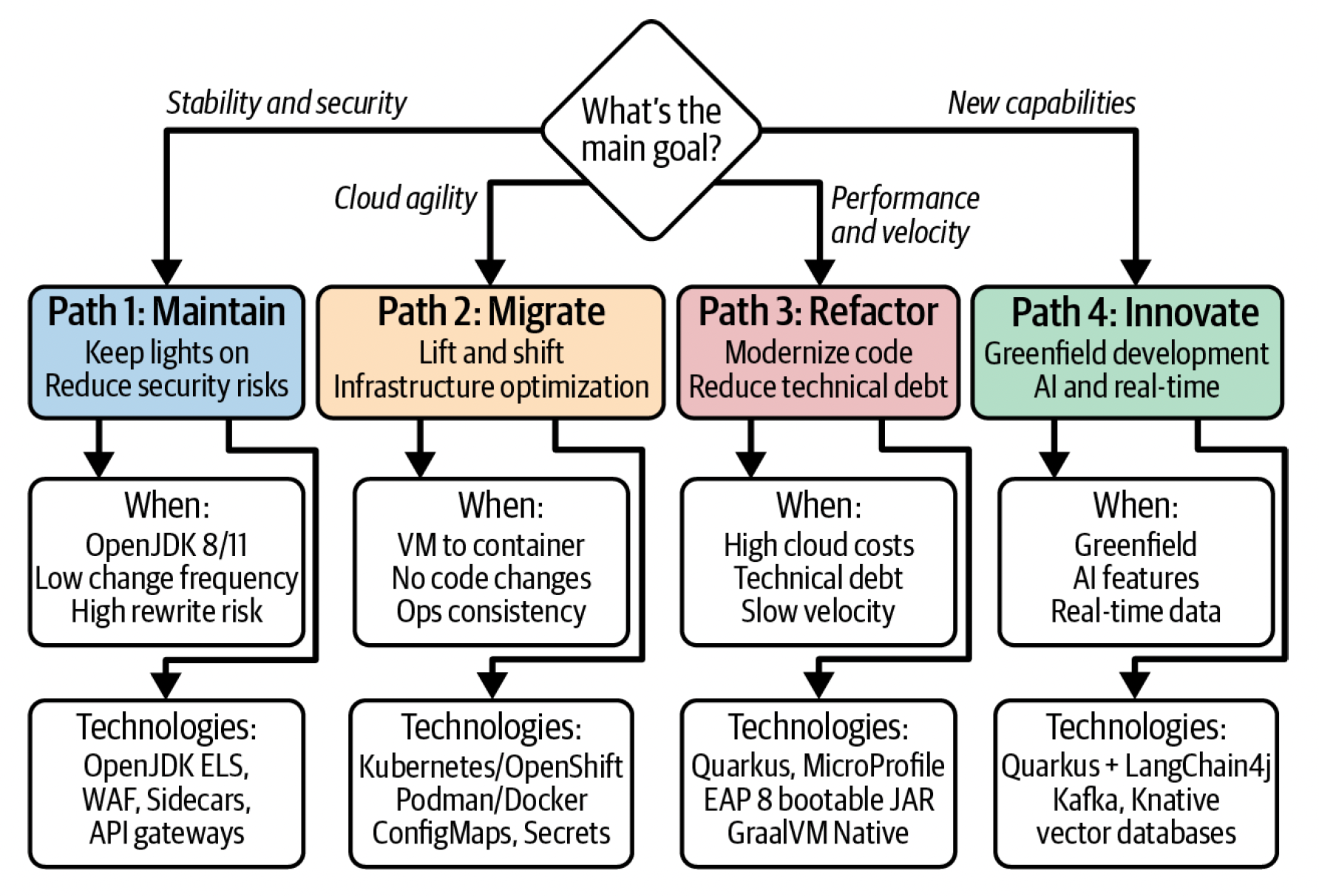
The challenge: enterprise systems now span stable OpenJDK 8 monoliths, containerized modular applications, and AI-powered microservices on GraalVM (a high-performance JVM that compiles Java to native binaries), all running simultaneously. This chapter introduces the “Four-Path Framework” for navigating this complexity and making structured modernization decisions, as shown in Figure 1-1.
Start with your main goal (stability and security, cloud agility, performance and velocity, or new capabilities) and follow the path to the appropriate modernization strategy. Each path leads to specific outcomes and technology choices that match your business objectives.
Related E-books