Redhat Developers  Logo
  • AI

    Get started with AI

    • Red Hat AI
      Accelerate the development and deployment of enterprise AI solutions.
    • AI learning hub
      Explore learning materials and tools, organized by task.
    • AI interactive demos
      Click through scenarios with Red Hat AI, including training LLMs and more.
    • AI/ML learning paths
      Expand your OpenShift AI knowledge using these learning resources.
    • AI quickstarts
      Focused AI use cases designed for fast deployment on Red Hat AI platforms.
    • No-cost AI training
      Foundational Red Hat AI training.

    Featured resources

    • OpenShift AI learning
    • Open source AI for developers
    • AI product application development
    • Open source-powered AI/ML for hybrid cloud
    • AI and Node.js cheat sheet

    Red Hat AI Factory with NVIDIA

    • Red Hat AI Factory with NVIDIA is a co-engineered, enterprise-grade AI solution for building, deploying, and managing AI at scale across hybrid cloud environments.
    • Explore the solution
  • Learn

    Self-guided

    • Documentation
      Find answers, get step-by-step guidance, and learn how to use Red Hat products.
    • Learning paths
      Explore curated walkthroughs for common development tasks.
    • Guided learning
      Receive custom learning paths powered by our AI assistant.
    • See all learning

    Hands-on

    • Developer Sandbox
      Spin up Red Hat's products and technologies without setup or configuration.
    • Interactive labs
      Learn by doing in these hands-on, browser-based experiences.
    • Interactive demos
      Click through product features in these guided tours.

    Browse by topic

    • AI/ML
    • Automation
    • Java
    • Kubernetes
    • Linux
    • See all topics

    Training & certifications

    • Courses and exams
    • Certifications
    • Skills assessments
    • Red Hat Academy
    • Learning subscription
    • Explore training
  • Build

    Get started

    • Red Hat build of Podman Desktop
      A downloadable, local development hub to experiment with our products and builds.
    • Developer Sandbox
      Spin up Red Hat's products and technologies without setup or configuration.

    Download products

    • Access product downloads to start building and testing right away.
    • Red Hat Enterprise Linux
    • Red Hat AI
    • Red Hat OpenShift
    • Red Hat Ansible Automation Platform
    • See all products

    Featured

    • Red Hat build of OpenJDK
    • Red Hat JBoss Enterprise Application Platform
    • Red Hat OpenShift Dev Spaces
    • Red Hat Developer Toolset

    References

    • E-books
    • Documentation
    • Cheat sheets
    • Architecture center
  • Community

    Get involved

    • Events
    • Live AI events
    • Red Hat Summit
    • Red Hat Accelerators
    • Community discussions

    Follow along

    • Articles & blogs
    • Developer newsletter
    • Videos
    • Github

    Get help

    • Customer service
    • Customer support
    • Regional contacts
    • Find a partner

    Join the Red Hat Developer program

    • Download Red Hat products and project builds, access support documentation, learning content, and more.
    • Explore the benefits

Migrating a namespace-scoped Operator to a cluster-scoped Operator

June 26, 2020
Abhishek Koserwal
Related topics:
DevOpsKubernetesOperators

    Within the context of Kubernetes, a namespace allows dividing resources, policies, authorization, and a boundary for cluster objects. In this article, we cover two different types of Operators: namespace-scoped and cluster-scoped. We then walk through an example of how to migrate from one to the other, which illustrates the difference between the two.

    Namespace-scoped and cluster-scoped

    A namespace-scoped Operator is defined within the boundary of a namespace with the flexibility to handle upgrades without impacting others. It watches objects within that namespace and maintains Role and RoleBinding for role-based access control (RBAC) policies for accessing the resource.

    Meanwhile, a cluster-scoped Operator promotes reusability and manages defined resources across the cluster. It watches all namespaces in a cluster and maintains ClusterRole and ClusterRoleBinding for RBAC policies for authorizing cluster objects. Two examples of cluster-scoped operators are istio-operator and cert-manager. The istio-operator can be deployed as a cluster-scoped to manage the service mesh for an entire cluster, while the cert-manager is used to issue certificates for an entire cluster.

    These two types of Operators support both types of installation based on your requirements. In the case of a cluster-scoped Operator, upgrading the Operator version can impact resources managed by the Operator in the entire cluster, as compared to upgrading the namespace-scoped Operator, which will be easier to upgrade as it only affects the resource within its scope.

    Migration guide: Namespace-scoped to cluster-scoped

    Let's generate two Operators: namespace-scope-op and cluster-scope-op using operator-sdk:

    $ operator-sdk new namespace-scope-op
    $ operator-sdk new cluster-scope-op

    By default, both Operators are namespace-scoped. Let’s add the kind type Foo to both of these Operators:

    $ operator-sdk add api --api-version=foo.example.com/v1alpha1 --kind=Foo

    I’ll now make changes to the cluster-scope Operator to show how it is different from the namespace-scope Operator.

    Step 1: Watch all of the namespaces

    The first change we need to make in the cluster-scope-op Operator is keeping the namespace option set to empty. To watch all of the namespaces, run:

    $ cluster-scope-op/cmd/manager/main.go

    Figure 1 shows the difference between the results for cluster-scope on the left and namespace-scope on the right.

    Comparison: Watching all of the namespaces
    Figure 1: Comparison: Watching all of the namespaces.

    Step 2: Update the added API schema's scope

    Next, we need to update our API type: *_types.go. If you were setting the namespace scope, you would use:

    // +kubebuilder:resource:path=foos,scope=Namespaced

    To set the cluster scope, use:

    // +kubebuilder:resource:path=foos,scope=Cluster

    Figure 2 shows the difference between the results for cluster-scope on the left and namespace-scope on the right.
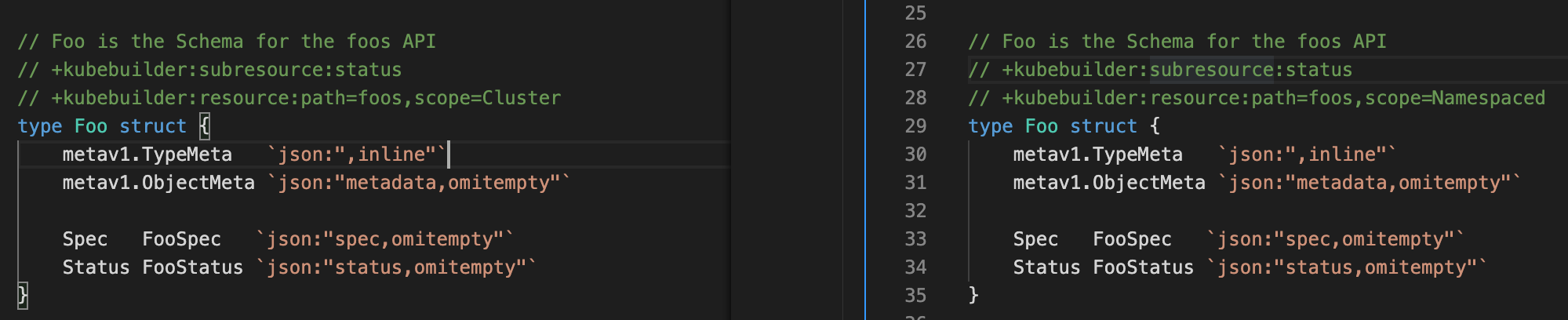
    Screenshot of the output for both scopes
    Figure 2: Updating the added API schema's scope.

    Step 3: Generate the CRDs for the cluster-scope Operator

    Now it's time to generate the custom resource definitions (CRDs) for the cluster-scope Operator:

    cluster-scope-op-:$ operator-sdk generate crds
    INFO[0000] Running CRD generator.
    INFO[0000] CRD generation complete.

    Figure 3 shows that the generated CRD was updated for the cluster-scope Operator (on the left) in *crd*.yaml.

    screenshot showing the changed CRD on the left
    Figure 3: Generating the CRDs for cluster-scope.

    Step 4: Update the kind type

    At this point, we update the kind type for Role/RoleBinding to ClusterRole/ClusterRoleBinding.  First, update the kind type from Roleto ClusterRole in role.yaml:

    kind: ClusterRole

    Then, update the kind typeRoleBinding to ClusterRoleBinding and the kind roleRef to ClusterRole in role_binding.yaml:

    kind: ClusterRoleBinding
    apiVersion: rbac.authorization.k8s.io/v1
    metadata:
      name: cluster-scope-op
    subjects:
    - kind: ServiceAccount
      name: cluster-scope-op
      namespace: ${NAMESPACE}
    roleRef:
      kind: ClusterRole
      name: cluster-scope-op
      apiGroup: rbac.authorization.k8s.io

    Caution: The exact resource/verb needed should be specified in the cluster role. Avoid using a wildcard (*) permission for security concerns when defining cluster roles.

    The cluster-scoped Operator will be deployed under a namespace, but the Operator is used to manage the resources in a cluster-wide scope. As compared to namespace scoped Operator, which is deployed under a namespace, but only manage resources under that namespace.

    Step 5: Update the WATCH_NAMESPACE

    Finally, we can add a controller by updating WATCH_NAMESPACE to an empty string in operator.yaml:

    $ operator-sdk add controller --api-version=cache.example.com/v1alpha1 --kind=Foo

    Figure 4 shows how this section looks now for the cluster-scope Operator (on the left) compared to the namespace-scope on the right.

    Cluster namescape scoped operator 4
    Figure 4: Updating the WATCH_NAMESPACE.

    Keep in mind that you need watchers that are entitled to watch the object within the cluster, which are generated by default for the primary object.

    Operator Lifecycle Manager

    If you want to use the Operator Lifecycle Manager (OLM) for deploying the Operator, you can generate the CSV using the command:

    $ operator-sdk generate csv --csv-version 0.0.1

    You can support installModes as you see in this CSV. By default, this CSV supports all installModes:

    installModes:- supported: true
    type: OwnNamespace- supported: true
    type: SingleNamespace- supported: false
    type: MultiNamespace- supported: true
    type: AllNamespaces

    You can also define an Operator group. An OperatorGroup is an OLM resource that provides multitenant configuration to OLM-installed Operators:

    apiVersion: operators.coreos.com/v1
    kind: OperatorGroup
    metadata:
      name: my-group
      namespace: my-namespace
    spec:
      targetNamespaces:
      - my-namespace
      - my-other-namespace
      - my-other-other-namespace

    Conclusion

    This is all you need to know in order to make your namespace Operator into a cluster-scoped Operator. Both Operator examples can be found in this repo.

    Last updated: June 25, 2020

    Recent Posts

    • Preventing GPU waste: A guide to JIT checkpointing with Kubeflow Trainer on OpenShift AI

    • How to manage TLS certificates used by OpenShift GitOps operator

    • Configure a split disk on OpenShift Container Platform

    • Red Hat Enterprise Linux 10.2 and 9.8: Top features for developers

    • What GPU kernels mean for your distributed inference

    Red Hat Developers logo LinkedIn YouTube Twitter Facebook

    Platforms

    • Red Hat AI
    • Red Hat Enterprise Linux
    • Red Hat OpenShift
    • Red Hat Ansible Automation Platform
    • See all products

    Build

    • Developer Sandbox
    • Developer tools
    • Interactive tutorials
    • API catalog

    Quicklinks

    • Learning resources
    • E-books
    • Cheat sheets
    • Blog
    • Events
    • Newsletter

    Communicate

    • About us
    • Contact sales
    • Find a partner
    • Report a website issue
    • Site status dashboard
    • Report a security problem

    RED HAT DEVELOPER

    Build here. Go anywhere.

    We serve the builders. The problem solvers who create careers with code.

    Join us if you’re a developer, software engineer, web designer, front-end designer, UX designer, computer scientist, architect, tester, product manager, project manager or team lead.

    Sign me up

    Red Hat legal and privacy links

    • About Red Hat
    • Jobs
    • Events
    • Locations
    • Contact Red Hat
    • Red Hat Blog
    • Inclusion at Red Hat
    • Cool Stuff Store
    • Red Hat Summit
    © 2026 Red Hat

    Red Hat legal and privacy links

    • Privacy statement
    • Terms of use
    • All policies and guidelines
    • Digital accessibility

    Chat Support

    Please log in with your Red Hat account to access chat support.