Redhat Developers  Logo
  • AI

    Get started with AI

    • Red Hat AI
      Accelerate the development and deployment of enterprise AI solutions.
    • AI learning hub
      Explore learning materials and tools, organized by task.
    • AI interactive demos
      Click through scenarios with Red Hat AI, including training LLMs and more.
    • AI/ML learning paths
      Expand your OpenShift AI knowledge using these learning resources.
    • AI quickstarts
      Focused AI use cases designed for fast deployment on Red Hat AI platforms.
    • No-cost AI training
      Foundational Red Hat AI training.

    Featured resources

    • OpenShift AI learning
    • Open source AI for developers
    • AI product application development
    • Open source-powered AI/ML for hybrid cloud
    • AI and Node.js cheat sheet

    Red Hat AI Factory with NVIDIA

    • Red Hat AI Factory with NVIDIA is a co-engineered, enterprise-grade AI solution for building, deploying, and managing AI at scale across hybrid cloud environments.
    • Explore the solution
  • Learn

    Self-guided

    • Documentation
      Find answers, get step-by-step guidance, and learn how to use Red Hat products.
    • Learning paths
      Explore curated walkthroughs for common development tasks.
    • See all learning

    Hands-on

    • Developer Sandbox
      Spin up Red Hat's products and technologies without setup or configuration.
    • Interactive labs
      Learn by doing in these hands-on, browser-based experiences.
    • Interactive demos
      Click through product features in these guided tours.

    Browse by topic

    • AI/ML
    • Automation
    • Java
    • Kubernetes
    • Linux
    • See all topics

    Training & certifications

    • Courses and exams
    • Certifications
    • Skills assessments
    • Red Hat Academy
    • Learning subscription
    • Explore training
  • Build

    Get started

    • Red Hat build of Podman Desktop
      A downloadable, local development hub to experiment with our products and builds.
    • Developer Sandbox
      Spin up Red Hat's products and technologies without setup or configuration.

    Download products

    • Access product downloads to start building and testing right away.
    • Red Hat Enterprise Linux
    • Red Hat AI
    • Red Hat OpenShift
    • Red Hat Ansible Automation Platform
    • See all products

    Featured

    • Red Hat build of OpenJDK
    • Red Hat JBoss Enterprise Application Platform
    • Red Hat OpenShift Dev Spaces
    • Red Hat Developer Toolset

    References

    • E-books
    • Documentation
    • Cheat sheets
    • Architecture center
  • Community

    Get involved

    • Events
    • Live AI events
    • Red Hat Summit
    • Red Hat Accelerators
    • Community discussions

    Follow along

    • Articles & blogs
    • Developer newsletter
    • Videos
    • Github

    Get help

    • Customer service
    • Customer support
    • Regional contacts
    • Find a partner

    Join the Red Hat Developer program

    • Download Red Hat products and project builds, access support documentation, learning content, and more.
    • Explore the benefits

Event-driven business automation powered by cloud-native Java

September 23, 2019
Maciej Swiderski
Related topics:
JavaQuarkus

    Kogito is a new Java toolkit, based on Drools and jBPM, that’s made to bring rules and processes to the Quarkus world. The DevNation Live tech talk at the end of this article explains how Kogito can be used to build cloud-ready, event-driven business applications, and it includes a demo of implementing the business logic of a complex domain.

    Kogito itself is defined as a cloud-native business automation toolkit that helps you to build intelligent applications. It's way more than just a business process or a single business rule—it’s a bunch of business rules, and it's based on battle-tested capabilities.

    Focus on the business domain

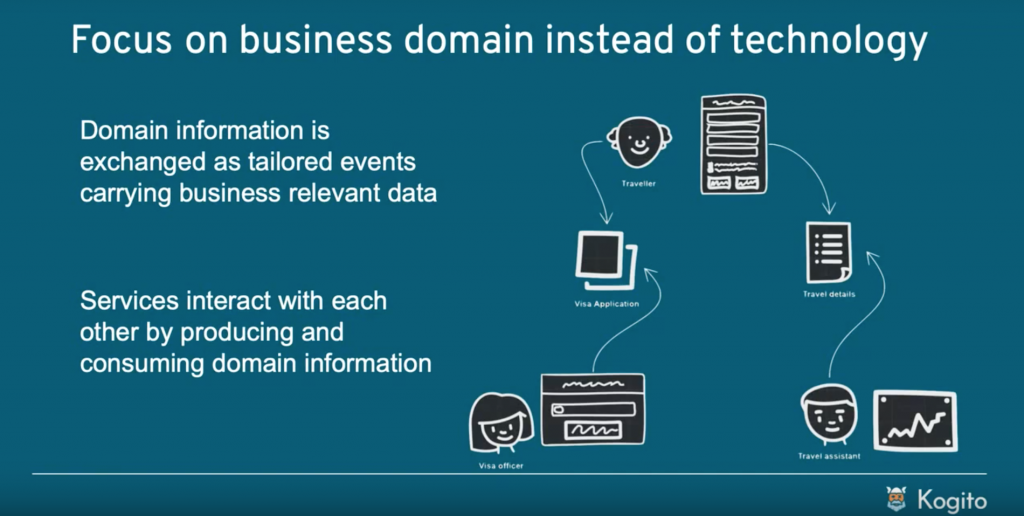
    One of the most important things in the Kogito ecosystem, or in the way you build with Kogito, is the focus on the business domain rather than the technology itself.
    Kogito business

    In the example use case, we have a startup travel agency, called Kogito Travel Agency, that wants to increase its online presence. In the example, we have a traveler, a visa officer, and a travel assistant, all of whom want to be informed as soon as they need to react to some action that is waiting for them. In terms of the overall architecture, we have two main services: the Kogito travel agency service and the Kogito visas. Those are microservices.

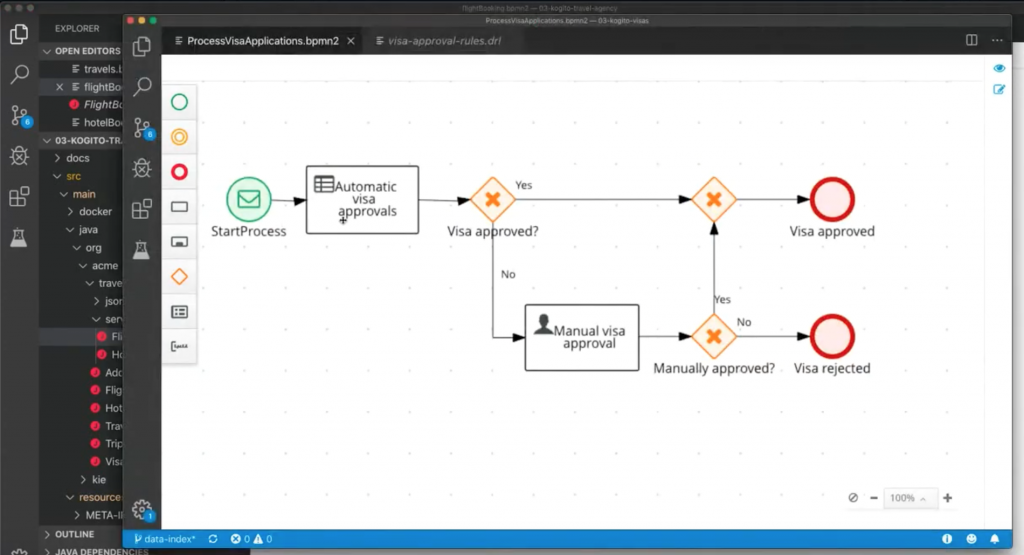
    The backbone of the application is actually a business process that is exposed as a service. The process itself has several nodes that you need to traverse, which define the way the application is actually built up. Then, we can use “process composition” to divide the actual business process into multiple steps or smaller pieces.

    Message events

    The other service, which is responsible for visa applications, is only initiated with the message event, and that message event is connected to a Kafka topic. As a message arises for the Kafka topic, it will create a new instance of that process.
    Kogito event process

    The idea is to start enhancing the process even more, so those events can produce other events that are of business relevance.

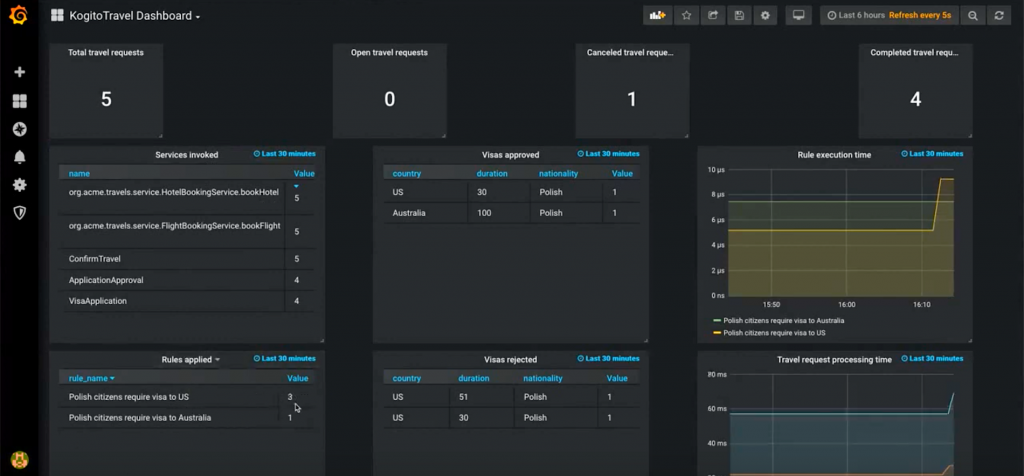
    For the last step, the travel requests are completed. But, since everything is domain driven and business relevant, we can now take advantage of Grafana and the metrics that we expose. As you can see, it's not just that we have the basic information about travel requests—how many are open, canceled, or completed, etc. We also have indirect information about what services have been invoked or what rules have been applied.
    Kogito metrics

    So, now we can start deriving not only the business-related information but the domain-specific information as well.

    Watch the complete DevNation Live tech talk below. DevNation Live tech talks are hosted by the Red Hat technologists who create our products. These sessions include real solutions and code and sample projects to help you get started. In this talk, presented by Red Hat’s Maciej Swiderski, Principal Software Engineer, and Burr Sutter, Chief Developer Evangelist, you’ll learn about event-driven business automation using Kogito, Quarkus, and more.

    Get more details in the demo: https://github.com/mswiderski/kogito-travel-agency-tutorial

    Learn more

    Join us at an upcoming developer event, and see our collection of past DevNation Live tech talks.

    Last updated: July 1, 2020

    Recent Posts

    • Federated identity across the hybrid cloud using zero trust workload identity manager

    • Confidential virtual machine storage attack scenarios

    • Introducing virtualization platform autopilot

    • Integrate zero trust workload identity manager with Red Hat OpenShift GitOps

    • Best Practice Configuration and Tuning for Linux and Windows VMs

    Red Hat Developers logo LinkedIn YouTube Twitter Facebook

    Platforms

    • Red Hat AI
    • Red Hat Enterprise Linux
    • Red Hat OpenShift
    • Red Hat Ansible Automation Platform
    • See all products

    Build

    • Developer Sandbox
    • Developer tools
    • Interactive tutorials
    • API catalog

    Quicklinks

    • Learning resources
    • E-books
    • Cheat sheets
    • Blog
    • Events
    • Newsletter

    Communicate

    • About us
    • Contact sales
    • Find a partner
    • Report a website issue
    • Site status dashboard
    • Report a security problem

    RED HAT DEVELOPER

    Build here. Go anywhere.

    We serve the builders. The problem solvers who create careers with code.

    Join us if you’re a developer, software engineer, web designer, front-end designer, UX designer, computer scientist, architect, tester, product manager, project manager or team lead.

    Sign me up

    Red Hat legal and privacy links

    • About Red Hat
    • Jobs
    • Events
    • Locations
    • Contact Red Hat
    • Red Hat Blog
    • Inclusion at Red Hat
    • Cool Stuff Store
    • Red Hat Summit
    © 2026 Red Hat

    Red Hat legal and privacy links

    • Privacy statement
    • Terms of use
    • All policies and guidelines
    • Digital accessibility

    Chat Support

    Please log in with your Red Hat account to access chat support.