Redhat Developers  Logo
  • AI

    Get started with AI

    • Red Hat AI
      Accelerate the development and deployment of enterprise AI solutions.
    • AI learning hub
      Explore learning materials and tools, organized by task.
    • AI interactive demos
      Click through scenarios with Red Hat AI, including training LLMs and more.
    • AI/ML learning paths
      Expand your OpenShift AI knowledge using these learning resources.
    • AI quickstarts
      Focused AI use cases designed for fast deployment on Red Hat AI platforms.
    • No-cost AI training
      Foundational Red Hat AI training.

    Featured resources

    • OpenShift AI learning
    • Open source AI for developers
    • AI product application development
    • Open source-powered AI/ML for hybrid cloud
    • AI and Node.js cheat sheet

    Red Hat AI Factory with NVIDIA

    • Red Hat AI Factory with NVIDIA is a co-engineered, enterprise-grade AI solution for building, deploying, and managing AI at scale across hybrid cloud environments.
    • Explore the solution
  • Learn

    Self-guided

    • Documentation
      Find answers, get step-by-step guidance, and learn how to use Red Hat products.
    • Learning paths
      Explore curated walkthroughs for common development tasks.
    • See all learning

    Hands-on

    • Developer Sandbox
      Spin up Red Hat's products and technologies without setup or configuration.
    • Interactive labs
      Learn by doing in these hands-on, browser-based experiences.
    • Interactive demos
      Click through product features in these guided tours.

    Browse by topic

    • AI/ML
    • Automation
    • Java
    • Kubernetes
    • Linux
    • See all topics

    Training & certifications

    • Courses and exams
    • Certifications
    • Skills assessments
    • Red Hat Academy
    • Learning subscription
    • Explore training
  • Build

    Get started

    • Red Hat build of Podman Desktop
      A downloadable, local development hub to experiment with our products and builds.
    • Developer Sandbox
      Spin up Red Hat's products and technologies without setup or configuration.

    Download products

    • Access product downloads to start building and testing right away.
    • Red Hat Enterprise Linux
    • Red Hat AI
    • Red Hat OpenShift
    • Red Hat Ansible Automation Platform
    • See all products

    Featured

    • Red Hat build of OpenJDK
    • Red Hat JBoss Enterprise Application Platform
    • Red Hat OpenShift Dev Spaces
    • Red Hat Developer Toolset

    References

    • E-books
    • Documentation
    • Cheat sheets
    • Architecture center
  • Community

    Get involved

    • Events
    • Live AI events
    • Red Hat Summit
    • Red Hat Accelerators
    • Community discussions

    Follow along

    • Articles & blogs
    • Developer newsletter
    • Videos
    • Github

    Get help

    • Customer service
    • Customer support
    • Regional contacts
    • Find a partner

    Join the Red Hat Developer program

    • Download Red Hat products and project builds, access support documentation, learning content, and more.
    • Explore the benefits

How to build a containerized IoT solution with OpenShift

February 10, 2017
Ishu Verma
Related topics:
ContainersJavaLinuxKubernetesMicroservices
Related products:
Streams for Apache KafkaRed Hat FuseRed Hat OpenShift Container PlatformRed Hat Enterprise Linux

    For businesses looking to build scalable Internet of Things (IoT) solutions using containers, here is a sample project built on the Red Hat OpenShift Container Platform. This project implements an intelligent IoT gateway on the OpenShift Container platform. The IoT Gateway is critical for enterprise IoT as it brings intelligence, and enables key services, at the edge. In this project, the gateway application is deployed as a set of microservices inside containers on OpenShift.

    A software sensor sends a stream of temperature and vibration data to the IoT gateway. If the sensor data reaches the critical threshold, business rules are triggered to take appropriate action.  The proximity of the IoT gateway to the data generation source allows near real-time decision making, a key requirement for safety-critical use cases. The gateway can also help reduce the network bandwidth and cloud resources by aggregating, summarizing and transforming the sensor data before it is sent to the cloud or datacenter. As the number of end devices or volume of sensor data increases over time, OpenShift can auto-scale the resources to keep the business functions running without human intervention.
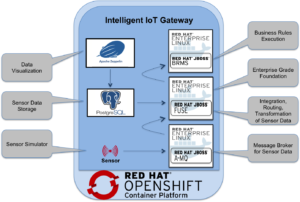
    Intelligent Internet of Things gateway

    The core components of the project are:

    • Red Hat JBoss Fuse Integration Services (FIS): Integration, routing, and transformation of messages and protocols through Apache Camel
    • Red Hat JBoss A-MQ: Apache ActiveMQ-based message broker for receiving messages from the Sensor over MQTT protocol
    • Red Hat JBoss BRMS Decision Server: Real-time execution of business rules
    • Apache Zeppelin: Tool for data visualization
    • PostgreSQL: Persistent database for storing sensor data as containers are natively non-persistent
    • Software Sensor: A simple Spring Boot application that simulates temperature, vibration, and GPS sensor data

    This project comes with a script that downloads, builds and deploys various containers needed for our application. For our build process, we’re using a Source-to-Image (S2I) tool for building these container images.  Each component of the demo will be running in a container and is using microservices. This IoT solution built with enterprise grade tools offers great scalability, manageability, and security.

    Video: You can watch a short video (< 5 min) walk- through of how to setup this example project.

    Code: You can download the example project here: https://github.com/sabre1041/iot-ocp

    Last updated: January 22, 2024

    Recent Posts

    • Introducing virtualization platform autopilot

    • Integrate zero trust workload identity manager with Red Hat OpenShift GitOps

    • Best Practice Configuration and Tuning for Linux and Windows VMs

    • Red Hat UBI 8 builders have been promoted to the Paketo Buildpacks organization

    • Using eBPF in Red Hat products

    Red Hat Developers logo LinkedIn YouTube Twitter Facebook

    Platforms

    • Red Hat AI
    • Red Hat Enterprise Linux
    • Red Hat OpenShift
    • Red Hat Ansible Automation Platform
    • See all products

    Build

    • Developer Sandbox
    • Developer tools
    • Interactive tutorials
    • API catalog

    Quicklinks

    • Learning resources
    • E-books
    • Cheat sheets
    • Blog
    • Events
    • Newsletter

    Communicate

    • About us
    • Contact sales
    • Find a partner
    • Report a website issue
    • Site status dashboard
    • Report a security problem

    RED HAT DEVELOPER

    Build here. Go anywhere.

    We serve the builders. The problem solvers who create careers with code.

    Join us if you’re a developer, software engineer, web designer, front-end designer, UX designer, computer scientist, architect, tester, product manager, project manager or team lead.

    Sign me up

    Red Hat legal and privacy links

    • About Red Hat
    • Jobs
    • Events
    • Locations
    • Contact Red Hat
    • Red Hat Blog
    • Inclusion at Red Hat
    • Cool Stuff Store
    • Red Hat Summit
    © 2026 Red Hat

    Red Hat legal and privacy links

    • Privacy statement
    • Terms of use
    • All policies and guidelines
    • Digital accessibility