For most PyTorch users, "distributed" still means c10d. That's the runtime surface they use today, and it will remain the surface for a while. The real question is how the old back-end layer underneath it should evolve as training and inference systems demand more than host-driven process groups and standard collectives. TorchComms is the clearest answer PyTorch has presented so far.
Why the comm API is evolving
The c10d library gave PyTorch a ProcessGroup-centered distributed runtime. That interface is still what most users touch, and it's not going away overnight. But the old back-end layer underneath it was designed around host-driven collectives and a smaller communication design space than modern LLM training and inference now need. TorchComms is the clearest signal for where the communication model in torch.distributed is going next.
That's the right scope for the claim. TorchComms doesn't need you to rewrite your code and throw away torch.distributed. Instead, it moves the communication model inside torch.distributed toward explicit communicators, richer semantics, and more flexible backends.
The official launch material makes that roadmap explicit: The goal is to bring these capabilities into PyTorch Distributed over time, not to force users onto a separate stack.
That distinction matters. The part that is changing is the communication layer under torch.distributed, not the entire distributed surface area. ProcessGroup, DeviceMesh, FSDP, TorchTitan, and higher-level training code can keep their existing structure while the communication implementation underneath them becomes more explicit, more extensible, and easier to evolve.
Communicator-centric API
The core API shift is simple: TorchComms starts from explicit per-device communicators.
import torch
import torchcomms
device = torch.device("cuda")
backend = "ncclx"
comm = torchcomms.new_comm(backend, device, name="global")
x = torch.ones(1024, device=device)
comm.all_reduce(x, torchcomms.ReduceOp.SUM, async_op=False)
That looks small, but it is a real model change. Collectives, point-to-point operations, hooks, finalize, and window operations all hang off the communicator object. TorchComms also exposes pluggable backends, eager communicator setup, DeviceMesh integration, and communication surfaces that go beyond classic ProcessGroup collectives.
The practical payoff is lifecycle control. With a communicator object, setup, split, finalize, and backend-specific extensions live in one place. That makes it easier to add semantics such as windows, RMA, transport-specific hints, or future fault-tolerance operations without overloading a single generic ProcessGroup interface.
It also reaches into areas that the old c10d back-end abstraction never really centered. The same surface extends to windows and RMA with comm.new_window(...) and to DeviceMesh with torchcomms.device_mesh.init_device_mesh(...). That's a useful signal: TorchComms is not only exposing another collective path, it is expanding the communication model itself.
Those prototypes are not production-ready, but they reinforce the same point: TorchComms is not just a replacement for an old back-end interface, it's becoming the place where new communication ideas can be tried without first rewriting the C++ comms stack.
Migration path into PyTorch and Torchtitan
TorchComms is not only a standalone API. PyTorch already contains a wrapper path in torch/distributed/distributed_c10d.py that instantiates a TorchComms communicator, wraps it in _BackendWrapper, and attaches it to the existing ProcessGroup machinery when dist.config.use_torchcomms is enabled. That keeps the migration small:
import torch.distributed as dist
import torch.distributed.config as dist_config
dist_config.use_torchcomms = True
dist.init_process_group(backend="nccl")
dist.all_reduce(tensor)
The important detail in this local checkout is that the safe wrapper example is backend="nccl". The equivalent backend="ncclx" wrapper path still fails locally with AssertionError: Unknown backend type ncclx, so it must not be presented as already working everywhere.
Even with that caveat, the direction is clear. TorchComms is not being built as an isolated alternate runtime. It is being wired into the same torch.distributed and DeviceMesh ecosystem that large PyTorch training stacks already use today.
The same pattern shows up in Torchtitan. Torchtitan already exposes --comm.mode torchcomms, and its distributed initialization path sets dist.config.use_torchcomms = True before normal process-group and DeviceMesh setup.
Architecturally, that is the point: The model and parallelism code stay in the usual TorchTitan and DeviceMesh world. The communication layer underneath is what changes. In this bundle, the command is illustrative rather than a locally green end-to-end run, because the current environment still hits a tyro/typeguard mismatch before TorchComms initialization.
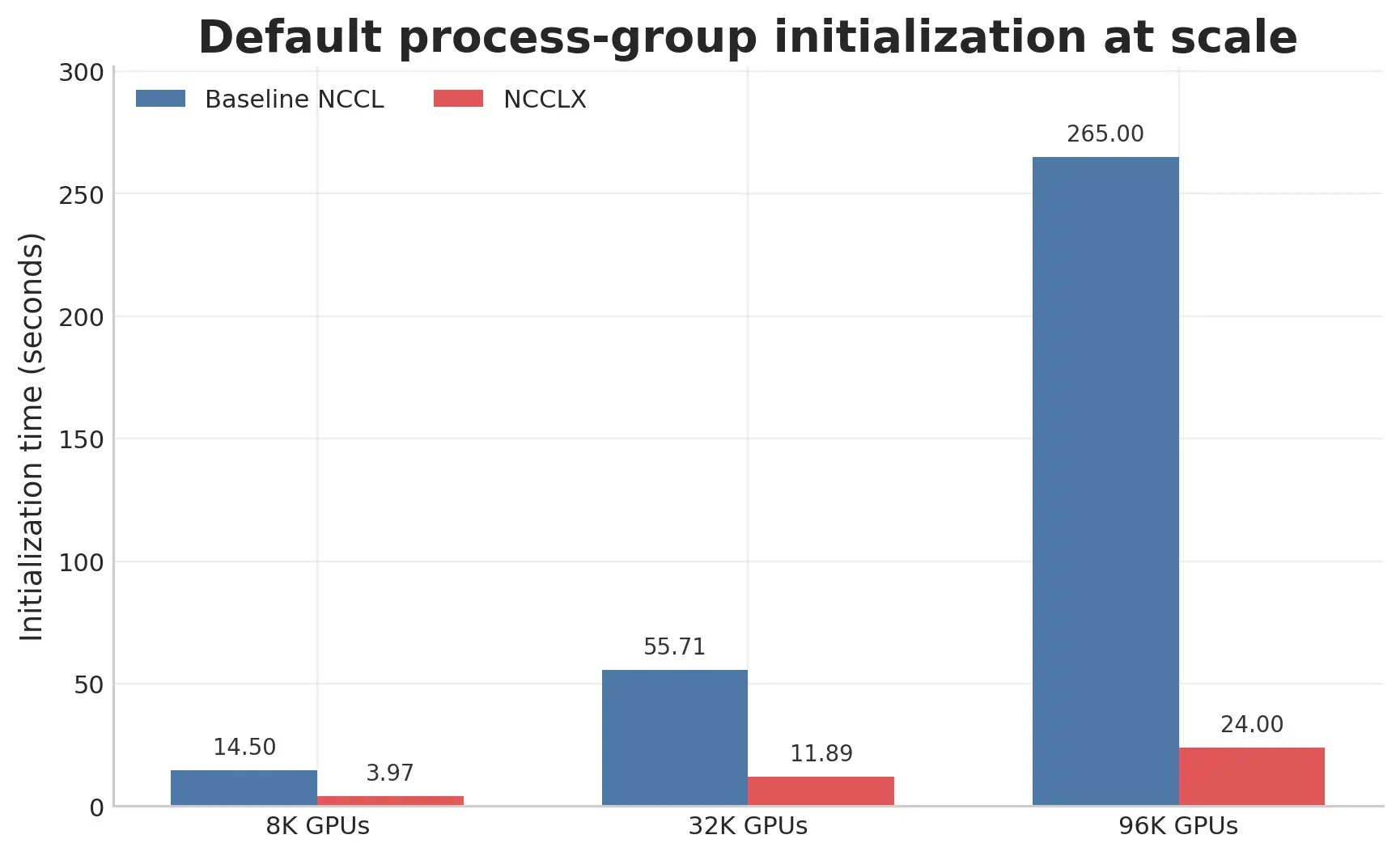
Figure 1 shows the clearest startup result. Default process-group initialization drops from 14.5 seconds to 3.97 seconds at 8,000 GPUs, from 55.71 seconds to 11.89 seconds at 32,000 GPUs, and from 265 seconds to 24 seconds at 96,000 GPUs.
That's the strongest argument for moving the communication layer in torch.distributed toward something built for large communicator counts, faster control-plane work, and topology-aware setup.
Those numbers matter because startup is not a cosmetic metric at this scale. Large jobs create many communicators, restart after faults, and repeatedly pay control-plane costs that are negligible on a small cluster but dominant at tens of thousands of GPUs. Faster initialization directly changes how practical a communication stack is for real training systems.
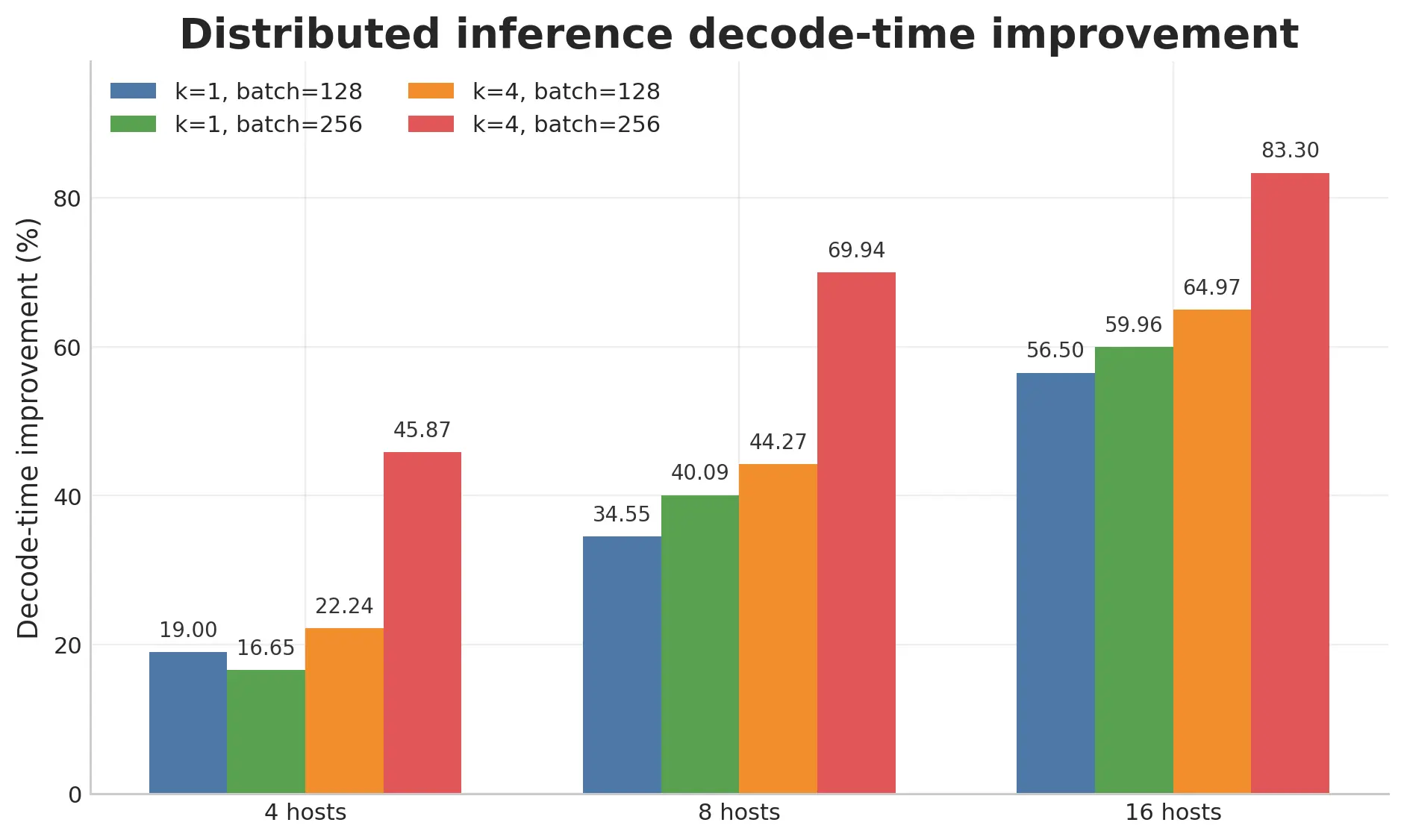
Figure 2 shows the inference side. Decode-time improvement rises with communication pressure: for k=1, batch=128, it grows from 19% at 4 hosts to 56.5% at 16 hosts. For k=4, batch=256, it grows from 45.87% at 4 hosts to 83.3% at 16 hosts. The baseline here is the token-shuffling path built from two AllGather operations and one AllToAll with the same compute kernels, so this is a back-end layer result rather than a generic c10d against TorchComms chart.
This is also why the TorchComms story is not only about training collectives. The back-end layer must handle both bulk-synchronous training and more dynamic, metadata-sensitive inference patterns. GPU-resident metadata, transport flexibility, and lower small-message overhead are central to that problem.
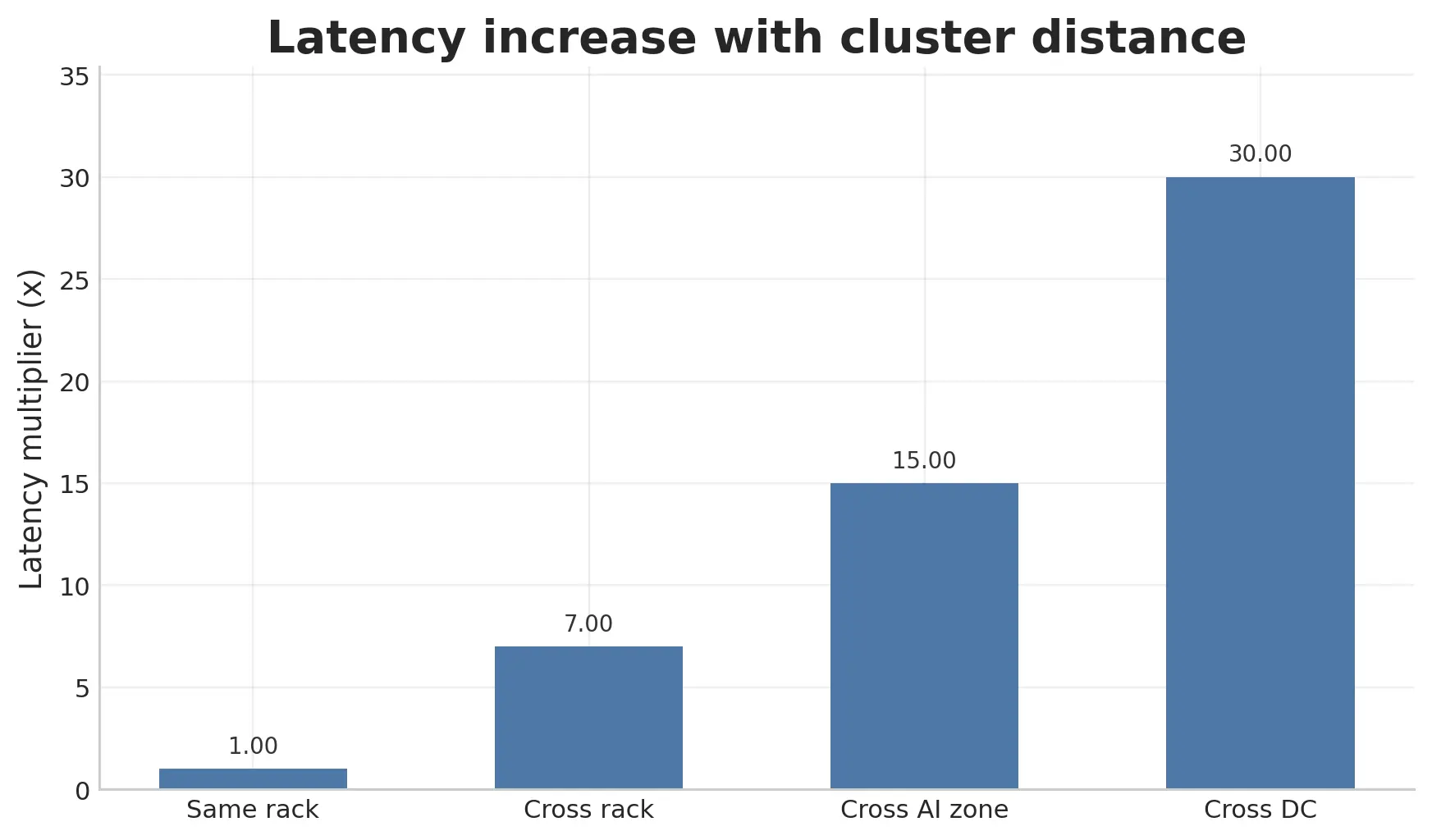
Figure 3 shows the network backdrop. Cross-rack, cross-zone, and cross-data-center traffic sees roughly 7x, 15x, and 30x the latency of same-rack communication. At that point, initialization, topology handling, registration, and small-message overhead are system constraints, not cleanup details.
Current status
The open source stack already has the key pieces in place: Direct communicators, a torch.distributed wrapper path, DeviceMesh integration, and a TorchTitan communication mode.
The safe wrapper example to show today is still the nccl route. The ncclx wrapper path is not something to present as universally wired through init_process_group yet.
That's a good way to read the current state of the project overall. The core architecture is already visible in the open tree. What is still uneven is the completeness of specific integration paths, not the direction of the design
Conclusion
The c10d library will remain the user-facing interface for a while, but the back-end layer underneath it is moving. TorchComms gives PyTorch explicit communicators, a wrapper path back into existing torch.distributed code, DeviceMesh integration, and communication surfaces such as windows and RMA that do not fit naturally inside the old back-end abstraction. The startup and inference results show why that matters at scale. Architecturally, the migration path is already visible in the open tree. That makes TorchComms the clearest view today of how new communication ideas are coming over into the c10d stack inside torch.distributed, not just another back-end toggle.

