AI
  • Get started with AI

    • Red Hat AI

      Accelerate the development and deployment of enterprise AI solutions.

    • AI learning hub

      Explore learning materials and tools, organized by task.

    • AI interactive demos

      Click through scenarios with Red Hat AI, including training LLMs and more.

    • AI/ML learning paths

      Expand your Red Hat OpenShift AI knowledge using these learning resources.

    • AI quickstarts

      Focused AI use cases designed for fast deployment on Red Hat AI platforms.

    • No-cost AI training

      Foundational Red Hat AI training.

  • Featured resources

    • Red Hat OpenShift AI
    • Open source AI for developers
    • AI product application development
    • Open source-powered AI/ML for hybrid cloud
    • AI and Node.js cheat sheet

Red Hat AI Factory with NVIDIA

Red Hat AI Factory with NVIDIA is a co-engineered, enterprise-grade AI solution for building, deploying, and managing AI at scale across hybrid cloud environments.

Learn
  • Self-guided

    • Documentation

      Find answers, get step-by-step guidance, and learn how to use Red Hat products.

    • Learning paths

      Explore curated walkthroughs for common development tasks.

    • Guided learning

      Receive custom learning paths powered by our AI assistant.

    • See all learning
  • Hands-on

    • Developer Sandbox

      Spin up Red Hat's products and technologies without setup or configuration.

    • Interactive labs

      Learn by doing in these hands-on, browser-based experiences.

    • Interactive demos

      Click through product features in these guided tours.

  • Browse by topic

    • AI/ML
    • Automation
    • Java
    • Kubernetes
    • Linux
    • See all topics
  • Training & certifications

    • Courses and exams
    • Certifications
    • Skills assessments
    • Red Hat Academy
    • Learning subscription
    • Explore training
Build
  • Get started

    • Red Hat build of Podman Desktop

      A downloadable, local development hub to experiment with our products and builds.

    • Developer Sandbox

      Spin up Red Hat's products and technologies without setup or configuration.

  • Download products

    • Red Hat Enterprise Linux
    • Red Hat AI
    • Red Hat OpenShift
    • Red Hat Ansible Automation Platform
    • See all products
  • Featured

    • Red Hat build of OpenJDK
    • Red Hat JBoss Enterprise Application Platform
    • Red Hat OpenShift Dev Spaces
    • Red Hat Developer Toolset
  • References

    • E-books
    • Documentation
    • Cheat sheets
    • Architecture center
Community
  • Get involved

    • Events
    • Live AI events
    • Red Hat Summit
    • Red Hat Accelerators
    • Community discussions
  • Follow along

    • Articles & blogs
    • Developer newsletter
    • Videos
    • Github
  • Get help

    • Customer service
    • Customer support
    • Regional contacts
    • Find a partner

Join the Red Hat Developer program

Download Red Hat products and project builds, access support documentation, learning content, and more.

ConsoleDocsSupport Search
New For you

Recommended

We'll recommend resources you may like as you browse. Try these suggestions for now.

  • Product downloads
  • Cheat sheets
  • Red Hat Developer learning portal
  • Developer blog
  • E-books
  • Developer Sandbox
Log in

Get more with a Red Hat Developer account

  • Product downloads
  • Console access
  • Event registration
  • Training & trials
Explore more account benefitsLog in or register

A subscription may be required for some services.

Contact us

Introducing Quarkus: a next-generation Kubernetes native Java framework

March 7, 2019
Jason Greene
Related topics:
JavaKubernetesQuarkusServerless
Related products:
Red Hat build of Quarkus

    Java was introduced to the open-source community more than 20 years ago and it still remains popular among developers. In fact, Java has never ranked lower than #2 on the TIOBE Index. Java was born in the mid-1990s and has nearly 20 years of optimizations for running highly dynamic monolithic applications that assumed sole ownership of (virtualized) host CPU and memory. However, we now live in a world dominated by the cloud, mobile, IoT, and open source, where containers, Kubernetes, microservices, reactive, Function-as-a-Service (FaaS), 12-factor, and cloud-native application development can deliver higher levels of productivity and efficiency. As an industry, we need to rethink how Java can be best utilized to address these new deployment environments and application architectures.

    We’d like to introduce you to Quarkus and Supersonic Subatomic Java!

    Quarkus is a Kubernetes Native Java framework tailored for GraalVM and HotSpot, crafted from best-of-breed Java libraries and standards. The goal of Quarkus is to make Java a leading platform in Kubernetes and serverless environments while offering developers a unified reactive and imperative programming model to optimally address a wider range of distributed application architectures.

    Container First

    Quarkus delivers significant runtime efficiencies (based on Red Hat testing), such as:
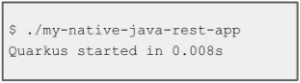
    • Fast Startup (tens of milliseconds) allows automatic scaling up and down of microservices on containers and Kubernetes as well as FaaS on-the-spot execution
    • Low memory utilization helps optimize container density in microservices architecture deployments requiring multiple containers
    • Smaller application and container image footprint

    Unifies Imperative and Reactive

    Most Java developers are familiar with the imperative programming model and would like to utilize that experience when adopting a new platform. At the same time, developers are rapidly adopting a cloud native, event-driven, asynchronous, and reactive model to address business requirements to build highly concurrent and responsive applications. Quarkus is designed to seamlessly brings the two models together in the same platform, resulting in strong leverage within an organization.

    Developer Joy

    A cohesive platform for optimized developer joy:
    • Unified configuration with all configuration in a single property file.
    • Zero config, live reload in the blink of an eye
    • Streamlined code for the 80% common usages, flexible for the 20%
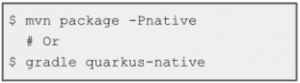
    • No hassle native executable generation

    Best of Breed Libraries and Standards

    Quarkus brings a cohesive, fun-to-use full-stack framework by leveraging best of breed libraries you love and use wired on a standard backbone - these include Eclipse MicroProfile, JPA/Hibernate, JAX-RS/RESTEasy, Eclipse Vert.x, Netty, and more.

    Quarkus also includes an extension framework that third-party framework authors can leverage to extend it. The Quarkus extension framework reduces the complexity for making third-party frameworks run on Quarkus and compile to a GraalVM native binary.

    Summary

    Quarkus provides an effective solution for running Java in this new world of serverless, microservices, containers, Kubernetes, FaaS, and the cloud because it has been designed with these in mind. Its container-first approach for cloud-native Java applications unifies imperative and reactive programming paradigms for microservices development and offers an extensible set of standards-based enterprise Java libraries and frameworks combined with extreme developer productivity that promises to revolutionize the way we develop in Java.

    We’d love you to join the Quarkus open-source community. If you’re interested in helping us continue to improve Quarkus, developing third-party extensions, using Quarkus to develop applications, or if you’re just curious about it, please join us at:

    • Quarkus website: http://quarkus.io
    • Quarkus GitHub project: https://github.com/quarkusio/quarkus
    • Quarkus Twitter: https://twitter.com/QuarkusIO
    • Quarkus chat: https://quarkusio.zulipchat.com/


    Get quarked! and let’s start building some hadrons

    Last updated: January 12, 2024

    Recent Posts

    • A day in the life of an NVIDIA H100 on Red Hat OpenShift 5

    • Migrate BuildConfigs to builds for Red Hat OpenShift with one plug-in install

    • Run Red Hat Enterprise Linux CoreOS on NVIDIA BlueField DPUs

    • Agent harness engineering: Separating model capabilities from enforcement

    • What's new for developers in Red Hat Enterprise Linux 10.3 and 9.9

    Red Hat Developers logo

    Platforms

    • Red Hat AI
    • Red Hat Enterprise Linux
    • Red Hat OpenShift
    • Red Hat Ansible Automation Platform
    • See all products

    Build

    • Developer Sandbox
    • Developer tools
    • Interactive tutorials
    • API catalog

    Quicklinks

    • Learning resources
    • E-books
    • Cheat sheets
    • Blog
    • Events
    • Newsletter

    Communicate

    • About us
    • Contact sales
    • Find a partner
    • Report a website issue
    • Site status dashboard
    • Report a security problem

    Red Hat Developer

    Build here. Go anywhere.

    We serve the builders. The problem solvers who create careers with code.

    Join us if you’re a developer, software engineer, web designer, front-end designer, UX designer, computer scientist, architect, tester, product manager, project manager or team lead.

    Sign me up

    Red Hat legal and privacy links

    • About Red Hat
    • Jobs
    • Events
    • Locations
    • Contact Red Hat
    • Red Hat Blog
    • Inclusion at Red Hat
    • Cool Stuff Store
    • Red Hat Summit
    © 2026 Red Hat

    Red Hat legal and privacy links

    • Privacy statement
    • Terms of use
    • All policies and guidelines
    • Digital accessibility
    Ask AI