AI
  • Get started with AI

    • Red Hat AI

      Accelerate the development and deployment of enterprise AI solutions.

    • AI learning hub

      Explore learning materials and tools, organized by task.

    • AI interactive demos

      Click through scenarios with Red Hat AI, including training LLMs and more.

    • AI/ML learning paths

      Expand your Red Hat OpenShift AI knowledge using these learning resources.

    • AI quickstarts

      Focused AI use cases designed for fast deployment on Red Hat AI platforms.

    • No-cost AI training

      Foundational Red Hat AI training.

  • Featured resources

    • Red Hat OpenShift AI
    • Open source AI for developers
    • AI product application development
    • Open source-powered AI/ML for hybrid cloud
    • AI and Node.js cheat sheet

Red Hat AI Factory with NVIDIA

Red Hat AI Factory with NVIDIA is a co-engineered, enterprise-grade AI solution for building, deploying, and managing AI at scale across hybrid cloud environments.

Learn
  • Self-guided

    • Documentation

      Find answers, get step-by-step guidance, and learn how to use Red Hat products.

    • Learning paths

      Explore curated walkthroughs for common development tasks.

    • Guided learning

      Receive custom learning paths powered by our AI assistant.

    • See all learning
  • Hands-on

    • Developer Sandbox

      Spin up Red Hat's products and technologies without setup or configuration.

    • Interactive labs

      Learn by doing in these hands-on, browser-based experiences.

    • Interactive demos

      Click through product features in these guided tours.

  • Browse by topic

    • AI/ML
    • Automation
    • Java
    • Kubernetes
    • Linux
    • See all topics
  • Training & certifications

    • Courses and exams
    • Certifications
    • Skills assessments
    • Red Hat Academy
    • Learning subscription
    • Explore training
Build
  • Get started

    • Red Hat build of Podman Desktop

      A downloadable, local development hub to experiment with our products and builds.

    • Developer Sandbox

      Spin up Red Hat's products and technologies without setup or configuration.

  • Download products

    • Red Hat Enterprise Linux
    • Red Hat AI
    • Red Hat OpenShift
    • Red Hat Ansible Automation Platform
    • See all products
  • Featured

    • Red Hat build of OpenJDK
    • Red Hat JBoss Enterprise Application Platform
    • Red Hat OpenShift Dev Spaces
    • Red Hat Developer Toolset
  • References

    • E-books
    • Documentation
    • Cheat sheets
    • Architecture center
Community
  • Get involved

    • Events
    • Live AI events
    • Red Hat Summit
    • Red Hat Accelerators
    • Community discussions
  • Follow along

    • Articles & blogs
    • Developer newsletter
    • Videos
    • Github
  • Get help

    • Customer service
    • Customer support
    • Regional contacts
    • Find a partner

Join the Red Hat Developer program

Download Red Hat products and project builds, access support documentation, learning content, and more.

ConsoleDocsSupport Search
New For you

Recommended

We'll recommend resources you may like as you browse. Try these suggestions for now.

  • Product downloads
  • Cheat sheets
  • Red Hat Developer learning portal
  • Developer blog
  • E-books
  • Developer Sandbox
Log in

Get more with a Red Hat Developer account

  • Product downloads
  • Console access
  • Event registration
  • Training & trials
Explore more account benefitsLog in or register

A subscription may be required for some services.

Contact us

How Red Hat developers can create handy shortcuts with Firefox keyword bookmarks

<p>&nbsp;</p> <quillbot-extension-portal></quillbot-extension-portal>

March 6, 2019
Florian Weimer
Related topics:
Developer tools
Related products:
Developer Toolset

    Firefox offers a simple way to enhance the browsing experience. With a little bit of configuration, you can turn the URL bar into a simple command-line tool to search bug databases, Internet RFCs, and CVEs. This comes in handy when you have an ID for a bug, but you do not have a link to click through. For example, if you have a Red Hat Bugzilla ID, just type rhbz <bugid> into Firefox's search bar and Firefox will take you directly to that bug in Bugzilla.

    In this article, after I show how to set up keyword-based bookmarks, I share a list of my shortcuts that I think will be handy for developers working with Red Hat products, projects, and communities.

    To use this feature, you must create a bookmark using the full New Bookmark dialog box. You can open this dialog box from the bookmark window. Press Ctrl+Shift+O to access that, or choose Show All Bookmarks from the Bookmarks menu. In that window, you need to choose New Bookmark … in the Organize menu, and the following dialog box will show.
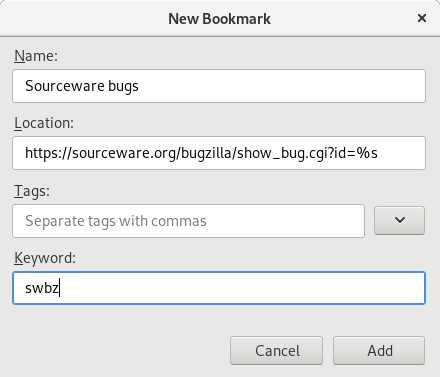
    New Bookmark dialog box

    A keyword bookmark has a URL that contains a %s sequence (just as in printf) and a keyword name. When the keyword is entered into the URL bar, the URL is not used directly. Instead, the arguments following the keyword are spliced in the URL instead of the %s placeholder. For example, an example keyword bookmark with the URL https://example.com/%s will turn the URL bar command example sample.html into https://example.com/sample.html.

    I find the following keyword bookmarks particularly useful. They allow me to access information quickly when someone mentions an identifier on IRC, without pasting a full hyperlink (or a hyperlink going to a different resource that does not provide the information I want to view).

    KeywordURL
    swbzhttps://sourceware.org/bugzilla/show_bug.cgi?id=%s
    rhbzhttps://bugzilla.redhat.com/bugzilla/show_bug.cgi?id=%s
    gcchttps://gcc.gnu.org/%s
    debhttps://bugs.debian.org/%s
    rfchttp://tools.ietf.org/html/rfc%s
    kojihttps://koji.fedoraproject.org/koji/search?match=glob&type=package&terms=%s
    bzsourcewarehttps://bugzilla.redhat.com/buglist.cgi?f1=ext_bz_bug_map.ext_bz_bug_id&f2=external_bugzilla.url&o1=equals&o2=equals&query_format=advanced&v2=https%3A%2F%2Fsourceware.org%2Fbugzilla&v1=%s

    The first entry works for bugs in Sourceware Bugzilla, which covers binutils, glibc, elfutils, and a few others. For example, swbz 18665 shows a glibc bug, and since we create CVE aliases for security bugs, you can get the same bug using swbz CVE-2015-7547.

    rhbz works in a similar fashion, but with the Red Hat Bugzilla instance, which covers Fedora and most Red Hat products. For example, rhbz CVE-2015-7547 leads to the flaw bug maintained by Red Hat Product Security.

    gcc is a little bit different. To view a bug, you need to use gcc PR89225. But you can also use gcc r268597 to view specific revisions in Subversion. (This relies on the fact that the gcc.gnu.org web server has redirects for PR* and r* URLs at the root.)

    The deb shortcut allows you to view individual bugs, such as deb 903514, or all bugs for a binary or source package by using deb libc6 or deb src:glibc.

    IETF RFCs can be viewed using rfc 1035.

    If you want to locate a package in Koji (Fedora's build system), you can use something like koji binutils.

    bzsourceware allows you to perform a reverse lookup on Sourceware bugs in Red Hat Bugzilla (where these bugs have been linked manually). bzsourceware 18665 again provides information about the glibc vulnerability used as an example above. Such keyword bookmarks can be particularly powerful, but since they are derived from what are essentially web application implementation details, they can bitrot over time and need occasional tweaks to keep them working.

    The following shortcuts for accessing information in the Customer Portal are specific to Red Hat:

    KeywordURL
    cvehttps://access.redhat.com/security/cve/%s
    casehttps://access.redhat.com/support/cases/#/case/%s

    cve CVE-2015-7547 shows the same vulnerability in the Customer Portal. (These resources contain customer-facing vulnerability information.) If you have a valid subscription and a case number, you can enter it after case, and you will be directed to the case overview for that case. (Note that this is the customer-facing view; Red Hat associates working in Support have access to the backend, using different URLs and, unfortunately, different IDs as well.

    Of course, there are many Red-Hat-internal resources (using internal, non-public URLs) that can be accessed in the same manner.

    I hope this little Firefox feature can be as useful to you as it is to me.

    Last updated: May 31, 2024

    Recent Posts

    • A day in the life of an NVIDIA H100 on Red Hat OpenShift 5

    • Migrate BuildConfigs to builds for Red Hat OpenShift with one plug-in install

    • Run Red Hat Enterprise Linux CoreOS on NVIDIA BlueField DPUs

    • Agent harness engineering: Separating model capabilities from enforcement

    • What's new for developers in Red Hat Enterprise Linux 10.3 and 9.9

    Red Hat Developers logo

    Platforms

    • Red Hat AI
    • Red Hat Enterprise Linux
    • Red Hat OpenShift
    • Red Hat Ansible Automation Platform
    • See all products

    Build

    • Developer Sandbox
    • Developer tools
    • Interactive tutorials
    • API catalog

    Quicklinks

    • Learning resources
    • E-books
    • Cheat sheets
    • Blog
    • Events
    • Newsletter

    Communicate

    • About us
    • Contact sales
    • Find a partner
    • Report a website issue
    • Site status dashboard
    • Report a security problem

    Red Hat Developer

    Build here. Go anywhere.

    We serve the builders. The problem solvers who create careers with code.

    Join us if you’re a developer, software engineer, web designer, front-end designer, UX designer, computer scientist, architect, tester, product manager, project manager or team lead.

    Sign me up

    Red Hat legal and privacy links

    • About Red Hat
    • Jobs
    • Events
    • Locations
    • Contact Red Hat
    • Red Hat Blog
    • Inclusion at Red Hat
    • Cool Stuff Store
    • Red Hat Summit
    © 2026 Red Hat

    Red Hat legal and privacy links

    • Privacy statement
    • Terms of use
    • All policies and guidelines
    • Digital accessibility
    Ask AI