Welcome to the Q3'26 edition of Red Hat’s quarterly newsletter, all about Apache Camel! This series aims to share all the noteworthy Camel goodness from the last quarter, so you don’t miss a thing. Be sure to read the previous edition to catch up on all the exciting updates and insights in Q1 and Q2 of 2026.
Doubling down on AI
The Apache Camel team has been hard at work over the last few months, delivering an impressive array of new AI capabilities designed to bridge enterprise integration with modern AI ecosystems. Starting in Camel 4.22, we introduced the unified camel-ai-tool component alongside a built-in camel-mcp-server. Together, they allow developers to define integration logic once as a standard Camel route and expose it seamlessly as a Model Context Protocol (MCP) tool (covered in more detail in an upcoming article). To solve the security challenges of calling these MCP tools, Camel can place authorization below the LLM with the camel-spiffe component (now in preview). This component can evaluate SPIFFE workload identities and Open Policy Agent (OPA) WebAssembly policies in-process directly at the tool call boundary, ensuring that even if an AI model is manipulated, it cannot execute actions beyond the permissions granted to the underlying caller.
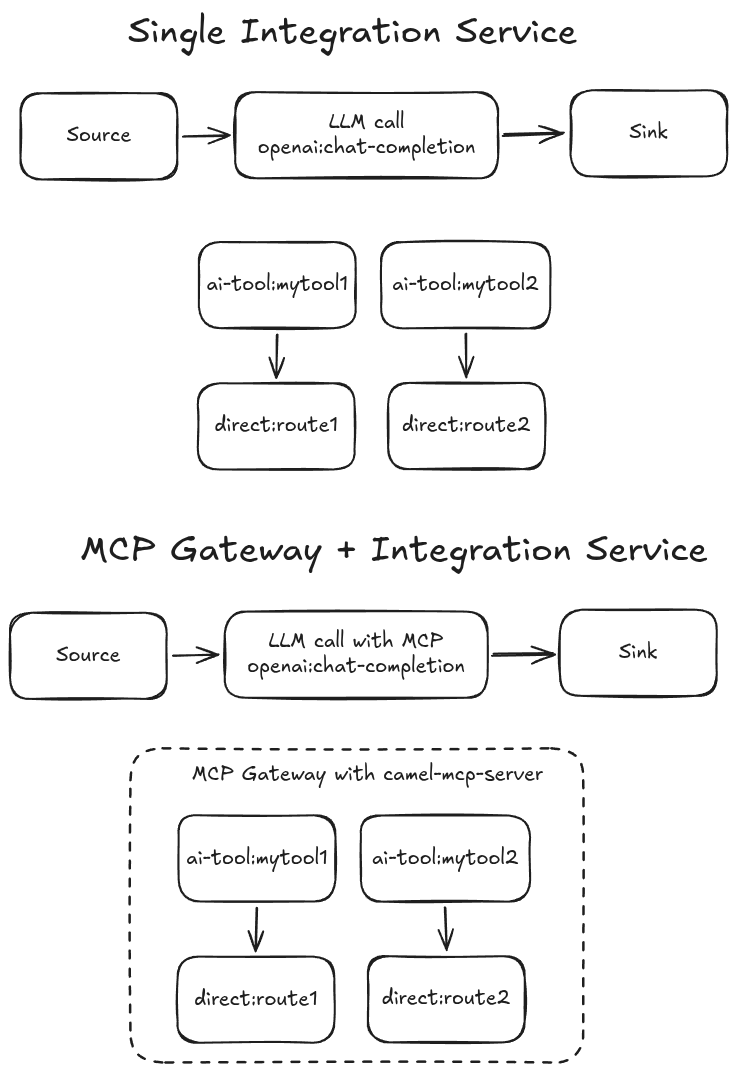
With Camel 4.23, we expand further into semantic decision-making, production observability, and agent-driven framework improvements. Currently available in preview, the new camel-semantic language integrates calibrated System One decision models (such as TypeSafe Jev) into Enterprise Integration Patterns (EIPs) like Split, Switch, and Loop, delivering fast judgments for request classification, severity scoring, and fan-out routing without the latency of text generation. For production operations, camel-ai-observability instruments LLM calls with OpenTelemetry spans and Micrometer metrics, providing real-time visibility into token costs and model latencies. Finally, rigorous local-model benchmarking against real-world scenarios drove over 30 targeted framework fixes in Camel 4.23, significantly improving error diagnostics and validation for both AI coding assistants and human developers.
There is still much more to come on the AI integration front. Stay tuned for additional features that will be announced in the upcoming Red Hat Build of Apache Camel 4.22 release next month!
Articles
Dive into the latest developments within Apache Camel through our curated selection of articles.
1. AI + Integration
Camel Routes as AI Tools: Unified Tooling and MCP Server in Camel 4.22 (by Zineb Bendhiba, Federico Mariani, Jiri Ondrusek)
Introduces the camel-ai-tool component and camel-mcp-server in Camel 4.22, providing a unified abstraction for exposing Camel routes as AI tools. By defining tools once with ai-tool: consumers and tags, routes become accessible across LangChain4j, Spring AI, OpenAI, and external MCP-compatible agents like Claude Desktop or Cursor. The article details bridge architectures for Camel Main, Quarkus, and Spring Boot, emphasizing built-in security features such as error sanitization, execution timeouts, and tag-based access control.
Authorizing what an AI agent may do in Apache Camel (by Andrea Cosentino)
This post addresses AI security risks such as prompt injection by establishing strict, in-process authorization boundaries for Camel routes exposed as AI tools. Combining camel-ai-tool, camel-spiffe, and camel-opa, it shows how tool calls triggered by an AI agent are evaluated in-process against Open Policy Agent (OPA) WebAssembly policies and verified SPIFFE workload identities. This mechanism ensures that even if an AI model is manipulated, it cannot execute actions beyond the permissions granted to the underlying caller.
TypeSafe Jev meets Apache Camel: semantic decisions in Camel routes (by Luigi De Masi)
This article explores camel-semantic, a preview abstraction layer introduced in Camel 4.23 for integrating System One fast-inference decision models into integration routes. Using TypeSafe AI’s Jev model via the camel-typesafe-ai adapter, the post outlines six practical YAML DSL patterns including ticket classification, message filtering, severity scoring, action validation, feedback batching, and outbound review. Exposing structured semantic decisions as native Camel expressions and predicates allows low-latency AI judgments directly inside EIPs while maintaining deterministic route control.
System One Models in Java: Camel's Semantic Language and LangChain4j's Decision API (by Zineb Bendhiba)
This post compares two methods for leveraging calibrated System One decision models (such as TypeSafe Jev and open-weight Tev1) in Java: Camel's camel-semantic language and LangChain4j's experimental Decision API. By replacing verbose LLM structured output schemas with calibrated decision primitives (Noul probabilities, Choice categories, and Score scales), both frameworks achieve sub-100ms inference for ticket triage. The author demonstrates how Camel routes can route messages dynamically using semantic predicates without complex Content-Based Router choice blocks.
B.Y.O.A. — Bring Your Own Agent to Camel TUI and Build Integrations with Camel Kit (by Luigi De Masi)
This post introduces Agent Client Protocol (ACP) support in Camel TUI for Camel 4.23, enabling developers to integrate coding agents (such as IBM Bob, Claude Code, or Codex) directly into their terminal dashboard. By pairing ACP with Camel Kit—an open-source toolkit providing structured AI workflows—and Camel’s embedded MCP server, developers can design, plan, implement, and monitor integrations within a single interface. A complete walkthrough illustrates building an MQTT weather telemetry pipeline with InfluxDB storage and circuit breaker protection.
Talk to Your CRM: Connecting Local AI to Business Systems with Apache Camel and MCP (by Simon Hartl)
This article demonstrates how Apache Camel connects local large language models running in LM Studio to business applications using the Model Context Protocol.
One request, several agents: semantic routing with Apache Camel and Jev (by Luigi De Masi)
This post explores multi-agent coordination by pairing camel-semantic and the TypeSafe AI Jev decision model with Camel EIPs.
Observe Your Camel AI Routes with GenAI OpenTelemetry (by Omar Atie)
GenAI Observability with Spring Boot and the Camel Observability Stack (by Omar Atie)
These articles introduce GenAI observability in Apache Camel 4.23, providing OpenTelemetry spans and Micrometer metrics aligned with OpenTelemetry semantic conventions. The example integrates Prometheus for metric scraping, VictoriaTraces for OTLP trace storage, and Perses for per-model visual dashboards.
We had a frontier AI coach a small local model through Camel. It found 99 things wrong for humans too (by Claus Ibsen)
Round 2: a real-world example set, a step-by-step benchmark, and 31 more Camel fixes (by Claus Ibsen)
These articles detail an experiment where a frontier model (Claude) coached a 22 GB local model through various Camel integration tasks. Over 20 iterative test runs, analyzing model failures led to substantial usability fixes across runtime diagnostics, YAML schema validations, and Simple expression error messages. Many issues uncovered by the local model were cryptic error messages or ambiguous schemas that would equally confuse human developers.
2. Developer Tooling & Visual Design
Kaoto 2.12 release (by Dominik Jelinek, Lars Heinemann, and Matej Melko)
Announcing Kaoto 2.12, the visual integration designer for Apache Camel powered by the Camel 4.22.1 catalog. Key features include an experimental Infrastructure view in VS Code for managing Docker/Podman services like databases and message brokers, major DataMapper enhancements with XPath 3.1/XSLT 3.0 function auto-completion, automatic catalog discovery for custom workspace Kamelets, and visual step-container support for the Agent-to-Agent Sub Task EIP.
Kaoto Infrastructure view: manage Camel dev services from VS Code (by Dominik Jelinek)
This article details an experimental sidebar panel introduced in Kaoto 2.12 for VS Code to manage backing infrastructure services. Powered by camel infra dev services, the view allows developers to start, monitor, and stop databases or message brokers directly inside the editor.
Transform Orders with DataMapper (by Matej Melko)
This workshop guides developers through visually mapping XML order schemas between an Order Management System and a shipping platform using Kaoto DataMapper. Readers build a complete two-route integration that polls pending orders, transforms XML payloads, dispatches shipping orders, and sends acknowledgments.
Stop copy-pasting your data filter: build a reusable Kamelet in Kaoto (by Shivam Gupta)
This tutorial demonstrates implementing the Content Filter EIP as a reusable custom action Kamelet using Kaoto's visual designer.
Introducing Camel TUI — A Terminal Dashboard for Apache Camel (by Claus Ibsen)
Launches Camel TUI, an interactive experimental terminal dashboard introduced in Camel 4.21 for monitoring and troubleshooting local Camel integrations. Built on top of the Camel CLI, the dashboard provides primary tabs for real-time exchange feeds, ASCII route topology diagrams, step-by-step exchange payload inspection, stack trace error analysis, and embedded AI prompt interaction or MCP server pairing.
3. Integration Testing & Quality Assurance
Fast and easy integration testing with the Camel CLI Test Plugin (by Christoph Deppisch)
This post introduces declarative, zero-code integration testing for Camel YAML routes using the camel test CLI plugin powered by Citrus.
Camel Integration Testing Pitfalls (by Christoph Deppisch)
This article analyzes real-world integration testing traps in Apache Camel projects that cause false test confidence or flaky test suites.
Camel Testing Strategies - From Unit to Integration Tests
Explores complementary testing approaches for Apache Camel routes, contrasting in-memory unit testing (AdviceWith and MockEndpoint) with end-to-end Citrus integration testing.
Database Testing with Citrus - SQL Polling Consumers and Data Verification
Guides developers through testing database-driven Camel routes—such as SQL Polling Consumers and Transactional Outbox patterns—using citrus-sql and Testcontainers PostgreSQL.
Multi-Runtime Testing — One Test Pattern, Three Different Runtimes
Demonstrates how core Citrus testing patterns (send(), receive(), repeatOnError(), and waitForCamelRouteStarted()) remain portable across Quarkus, Spring Boot, and standalone YAML DSL (JBang) runtimes.
Kafka Testing Pitfalls in Camel Integration Tests
Identifies common Kafka-specific integration testing traps in Camel projects and provides concrete fixes.
Testing Reliability Patterns - Dead Letter Queues, Idempotent Receivers, and Circuit Breakers
Explains how to write rigorous integration tests for Camel error-handling and reliability patterns.
Testing Apache Camel routing logic (Content-Based Router, Filters, and Splitters)
Focuses on achieving full test coverage for core EIP routing patterns using Citrus.
4. Security & Zero-Trust Architecture
Workload identity in Apache Camel with SPIFFE and SPIRE (by Andrea Cosentino)
This article introduces camel-spiffe, a component in Apache Camel 4.23 for automated zero-trust workload identity management.
Built to Patch Fast: Apache Camel's Security Response in 2026 (by Andrea Cosentino)
Details Apache Camel's security response process, focusing on the simultaneous release of 32 security advisories across Camel 4.21.0, 4.18.3, and 4.14.8 within four days.
5. Core Framework & Release Overviews
Apache Camel 4.22 What's New (by Claus Ibsen)
An overview of Apache Camel 4.22 LTS, a Long Term Support release bringing major enhancements across core runtime, tooling, security, and AI capabilities. Headline features include Camel TUI with an embedded low-code YAML editor, one-line CLI installer scripts, unified AI tool routing (camel-ai-tool) with an embedded MCP server, enhanced Splitter EIP features (chunking, error thresholds, watermark resume), percentile latency statistics, and extensive security hardening across deserialization filters and URI allow-lists.
Apache Camel 4.23 What's New (by Claus Ibsen, Federico Mariani, Christoph Deppisch)
This release announcement highlights Apache Camel 4.23, which resolved over 1,030 JIRA tickets with significant assistance from AI coding assistants. Key features include Semantic EIPs, read-through caching, the fast Switch EIP, zero-trust authorization components, and Kafka Share Groups. Additional upgrades deliver scripting performance boosts for Groovy and JavaScript, strict documentation code snippet validation, and expanded CLI and TUI tooling.
Real-Time Analytics with Apache Camel and ClickHouse (by Omar Atie)
This post introduces the dedicated camel-clickhouse component in Camel 4.22 for high-throughput OLAP data ingestion and querying.
Echonect: Fifteen Years on Apache Camel (by Andriy Andrunevchyn)
This case study recounts fifteen years of operating Echonect, a major European SMS gateway routing millions of messages daily on Apache Camel. It details rebuilding the platform under a strict twelve-month deadline and scaling performance from 50 to over 500 messages per second per node.
Extending Apache Camel Simple with Your Own Functions (by Simon Hartl)
This article presents techniques for extending Camel's Simple expression language within YAML routes without converting entire flows to Java.
Upcoming
Here’s a look at our key planned milestones and where you can connect with us at upcoming conferences:
November
- Red Hat build of Apache Camel 4.22 GA
December
- https://www.opensource-experience.com, Paris, France

