Redhat Developers  Logo
  • AI

    Get started with AI

    • Red Hat AI
      Accelerate the development and deployment of enterprise AI solutions.
    • AI learning hub
      Explore learning materials and tools, organized by task.
    • AI interactive demos
      Click through scenarios with Red Hat AI, including training LLMs and more.
    • AI/ML learning paths
      Expand your OpenShift AI knowledge using these learning resources.
    • AI quickstarts
      Focused AI use cases designed for fast deployment on Red Hat AI platforms.
    • No-cost AI training
      Foundational Red Hat AI training.

    Featured resources

    • OpenShift AI learning
    • Open source AI for developers
    • AI product application development
    • Open source-powered AI/ML for hybrid cloud
    • AI and Node.js cheat sheet

    Red Hat AI Factory with NVIDIA

    • Red Hat AI Factory with NVIDIA is a co-engineered, enterprise-grade AI solution for building, deploying, and managing AI at scale across hybrid cloud environments.
    • Explore the solution
  • Learn

    Self-guided

    • Documentation
      Find answers, get step-by-step guidance, and learn how to use Red Hat products.
    • Learning paths
      Explore curated walkthroughs for common development tasks.
    • Guided learning
      Receive custom learning paths powered by our AI assistant.
    • See all learning

    Hands-on

    • Developer Sandbox
      Spin up Red Hat's products and technologies without setup or configuration.
    • Interactive labs
      Learn by doing in these hands-on, browser-based experiences.
    • Interactive demos
      Click through product features in these guided tours.

    Browse by topic

    • AI/ML
    • Automation
    • Java
    • Kubernetes
    • Linux
    • See all topics

    Training & certifications

    • Courses and exams
    • Certifications
    • Skills assessments
    • Red Hat Academy
    • Learning subscription
    • Explore training
  • Build

    Get started

    • Red Hat build of Podman Desktop
      A downloadable, local development hub to experiment with our products and builds.
    • Developer Sandbox
      Spin up Red Hat's products and technologies without setup or configuration.

    Download products

    • Access product downloads to start building and testing right away.
    • Red Hat Enterprise Linux
    • Red Hat AI
    • Red Hat OpenShift
    • Red Hat Ansible Automation Platform
    • See all products

    Featured

    • Red Hat build of OpenJDK
    • Red Hat JBoss Enterprise Application Platform
    • Red Hat OpenShift Dev Spaces
    • Red Hat Developer Toolset

    References

    • E-books
    • Documentation
    • Cheat sheets
    • Architecture center
  • Community

    Get involved

    • Events
    • Live AI events
    • Red Hat Summit
    • Red Hat Accelerators
    • Community discussions

    Follow along

    • Articles & blogs
    • Developer newsletter
    • Videos
    • Github

    Get help

    • Customer service
    • Customer support
    • Regional contacts
    • Find a partner

    Join the Red Hat Developer program

    • Download Red Hat products and project builds, access support documentation, learning content, and more.
    • Explore the benefits

Replacing Confluent Schema Registry with Red Hat integration service registry

December 17, 2019
Hugo Guerrero

    With the latest release of Red Hat Integration now available, we’ve introduced some exciting new capabilities. Along the enhancements for Apache Kafka-based environments, Red Hat announced the Technical Preview of the Red Hat Integration service registry to help teams to govern their services schemas. Developers can now use the registry to query for the schemas and artifacts required by each service endpoint or register and store new structures for future use.

    Registry for event-driven architecture

    Red Hat Integration’s service registry, based on the Apicurio project registry, provides a way to decouple the schema used to serialize and deserialize Kafka messages with the applications that are sending/receiving them. The service registry is a store for schema (and API design) artifacts providing a REST API and a set of optional rules for enforcing content validity and evolution. The registry handles data formats like Apache Avro, JSON Schema, Google Protocol Buffers (protobuf), as well as OpenAPI and AsyncAPI definitions.

    To make it easy to transition from Confluent, the service registry added compatibility with the Confluent Schema Registry REST API. This means that applications using Confluent client libraries can replace Schema Registry and use Red Hat Integration service registry instead.

    Replacing Confluent Schema Registry

    For the sake of simplicity in this article, I will use an existing Avro client example already available to show you how to switch from Confluent Schema Registry to the Red Hat Integration service registry.

    You will need to use docker-compose for starting a local environment and Git for cloning the repository code.

    1. Clone the example GitHub repository:

    $ git clone https://github.com/confluentinc/examples.git
    $ cd examples
    $ git checkout 5.3.1-post

    2. Change to the avro example folder:

    $ cd clients/avro/

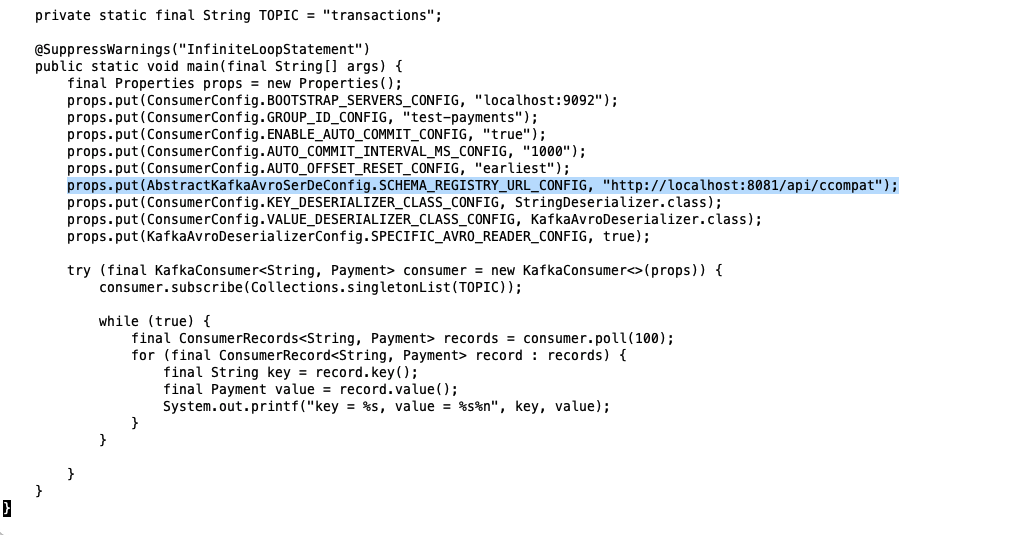
    3. Open the ConsumerExample.java file under src/main/java/io/confluent/examples/clients/basicavro.
    4. Replace the SCHEMA_REGISTRY_URL_CONFIG property with the following:

    ...
    props.put(AbstractKafkaAvroSerDeConfig.SCHEMA_REGISTRY_URL_CONFIG, "http://localhost:8081/api/ccompat");
    ...

    5. Repeat the last step with the ProducerExample.java file.
    6. Download this docker-compose.yaml file example to deploy a simple Kafka cluster with the Apicurio registry.
    7. Start the Kafka cluster and registry.

    $ docker-compose -f docker-compose.yaml up

    8. To run the producer, compile the project:

    $ mvn clean compile package

    9. Run ProducerExample.java:

    $ mvn exec:java -Dexec.mainClass=io.confluent.examples.clients.basicavro.ProducerExample

    10. After a few moments you should see the following output:

    ...
    Successfully produced 10 messages to a topic called transactions
    [INFO] ------------------------------------------------------------------------
    [INFO] BUILD SUCCESS
    [INFO] ------------------------------------------------------------------------
    ...

    11. Now run the consumer:

    $ mvn exec:java -Dexec.mainClass=io.confluent.examples.clients.basicavro.ConsumerExample

    The messages should be displayed on your screen:

    ...
    offset = 0, key = id0, value = {"id": "id0", "amount": 1000.0}
    offset = 1, key = id1, value = {"id": "id1", "amount": 1000.0}
    offset = 2, key = id2, value = {"id": "id2", "amount": 1000.0}
    offset = 3, key = id3, value = {"id": "id3", "amount": 1000.0}
    offset = 4, key = id4, value = {"id": "id4", "amount": 1000.0}
    offset = 5, key = id5, value = {"id": "id5", "amount": 1000.0}
    offset = 6, key = id6, value = {"id": "id6", "amount": 1000.0}
    offset = 7, key = id7, value = {"id": "id7", "amount": 1000.0}
    offset = 8, key = id8, value = {"id": "id8", "amount": 1000.0}
    offset = 9, key = id9, value = {"id": "id9", "amount": 1000.0}
    ...

    12. To check the schema that the producer added to the registry you can issue the following curl command:

    $ curl --silent -X GET http://localhost:8081/api/ccompat/schemas/ids/1 | jq .

    13. The result should show you the Avro schema:

    {
      "schema": "{\"type\":\"record\",\"name\":\"Payment\",\"namespace\":\"io.confluent.examples.clients.basicavro\",\"fields\":[{\"name\":\"id\",\"type\":\"string\"},{\"name\":\"amount\",\"type\":\"double\"}]}"
    }

    Done!

    As you can see, you can just change the URL for the registry to use Red Hat service registry instead without the need to change any code in your applications.

    If you are interested in other features of the Red Hat Integration service registry, you can see a full-fledged example using Quarkus Kafka extension in my amq-examples GitHub repository.

    Summary

    The Red Hat Integration service registry is a central data store for schemas and API artifacts. Developers can query, create, read, update, and delete service artifacts, versions, and rules to govern the structure of their services. The service registry could be also used as a drop-in replacement for Confluent Schema Registry with Apache Kafka clients. With just a change to the URL for the registry, you can use Red Hat service registry without needing to change code in your applications.

    See also:

    • Red Hat advances Debezium CDC connectors for Apache Kafka support to Technical Preview
    • Red Hat simplifies transition to open source Kafka with new service registry and HTTP bridge
    Last updated: April 13, 2021

    Recent Posts

    • Every layer counts: Defense in depth for AI agents with Red Hat AI

    • Fun in the RUN instruction: Why container builds with distroless images can surprise you

    • Trusted software factory: Building trust in the agentic AI era

    • Build a zero trust AI pipeline with OpenShift and RHEL CVMs

    • Red Hat Hardened Images: Top 5 benefits for software developers

    Red Hat Developers logo LinkedIn YouTube Twitter Facebook

    Platforms

    • Red Hat AI
    • Red Hat Enterprise Linux
    • Red Hat OpenShift
    • Red Hat Ansible Automation Platform
    • See all products

    Build

    • Developer Sandbox
    • Developer tools
    • Interactive tutorials
    • API catalog

    Quicklinks

    • Learning resources
    • E-books
    • Cheat sheets
    • Blog
    • Events
    • Newsletter

    Communicate

    • About us
    • Contact sales
    • Find a partner
    • Report a website issue
    • Site status dashboard
    • Report a security problem

    RED HAT DEVELOPER

    Build here. Go anywhere.

    We serve the builders. The problem solvers who create careers with code.

    Join us if you’re a developer, software engineer, web designer, front-end designer, UX designer, computer scientist, architect, tester, product manager, project manager or team lead.

    Sign me up

    Red Hat legal and privacy links

    • About Red Hat
    • Jobs
    • Events
    • Locations
    • Contact Red Hat
    • Red Hat Blog
    • Inclusion at Red Hat
    • Cool Stuff Store
    • Red Hat Summit
    © 2026 Red Hat

    Red Hat legal and privacy links

    • Privacy statement
    • Terms of use
    • All policies and guidelines
    • Digital accessibility

    Chat Support

    Please log in with your Red Hat account to access chat support.
