
Article
Performance and usability enhancements in Red Hat CodeReady Workspaces 2.2
Red Hat CodeReady Workspaces 2.2 brings performance and configuration improvements, a debug mode for workspaces, and CPU limits for IDE plugins.
Red Hat CodeReady Workspaces 2.2 brings performance and configuration improvements, a debug mode for workspaces, and CPU limits for IDE plugins.

Get started with Kourier for a simpler, more lightweight way to expose Knative applications to an external network with no additional CRDs.

Learn about namespace-scoped and cluster-scoped Operators, and see the difference between the two by migrating from one scope to the other.

Operatorhub.io and your Kubernetes cluster | DevNation Tech Talk
Helm or Operator SDK with Kubernetes: Why not both? | DevNation Tech Talk

Check out the Open Data Hub team's plans for upcoming releases: making Kubeflow 1.0 available on Red Hat OpenShift, improving Kubeflow CI, and more.

Find out what to expect from the Camel K 1.0 GA release, a lightweight integration platform that runs natively on Kubernetes.

Learn how to install CodeReady Workspaces in a restricted Red Hat OpenShift 4 environment by pulling images into a private registry.

A quick introduction to Apicurio Registry 1.2.2's new web-based UI and Operator, which make it easier to store and retrieve service artifacts.
GPU enablement for data science on OpenShift | DevNation Tech Talk
Jupyter Notebooks for machine learning on Kubernetes & OpenShift | DevNation Tech Talk

Explore the bug fixes provided in Open Data Hub 0.6.1's Kubeflow Operator, manifests, testing, and continuous integration.

Deploy enterprise-grade runtime components into Kubernetes with Runtime Component Operator, Service Binding Operator, and Open Liberty Operator.

Discover 10 design patterns from the Kubernetes Patterns book that will help you follow basic Kubernetes concepts and design Kubernetes-based applications.

Explore the changes in Open Data Hub version 0.6, including significant changes to the overall architecture as well as component updates and additions.

This cheat sheet covers how to create a Kubernetes Operator in Java using Quarkus.
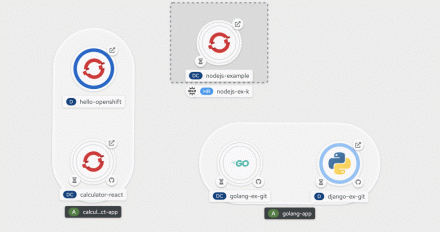
Explore the new application deployment features in OpenShift 4.4 to the Developer Catalog, plus the Helm 3 GA, and an add context option in Topology.
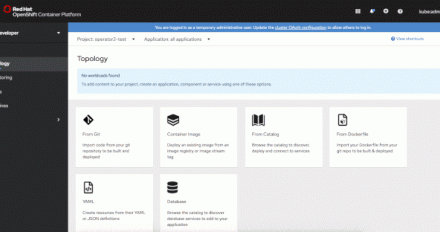
Check out this overview of the developer improvements to OpenShift 4.4 around application deployment, Topology view, monitoring, pipelines, and serverless.

Learn how to create an Operator to deploy a sample application based on Spring Boot and Camel, then deploy it on an OpenShift cluster.

Kubernetes is the foundation of cloud software architectures.

An introduction to the Red Hat Marketplace by example: Installing and using CockroachDB on OpenShift.

Explore the Red Hat Marketplace technical preview and see how Red Hat and IBM are making it easier to build Kubernetes applications on OpenShift.

In this fourth part of this series, learn how to use OpenShift Pipelines, Tekton, and React as a CI/CD alternative to a chained build.
Package applications and services for Kubernetes with the Operator framework.

Download Kubernetes Operators, the definitive guide to extending Kubernetes and automating container orchestration.

Build here. Go anywhere.
We serve the builders. The problem solvers who create careers with code.
Join us if you’re a developer, software engineer, web designer, front-end designer, UX designer, computer scientist, architect, tester, product manager, project manager or team lead.
 Ask AI